
If you own a packet of Hondashi or any instant dashi granules, there is a very good chance it lives next to your miso paste and comes out only when you make miso soup. Maybe you use it once a week. Maybe once a month. The rest of the time it sits in the cupboard, slowly becoming furniture.
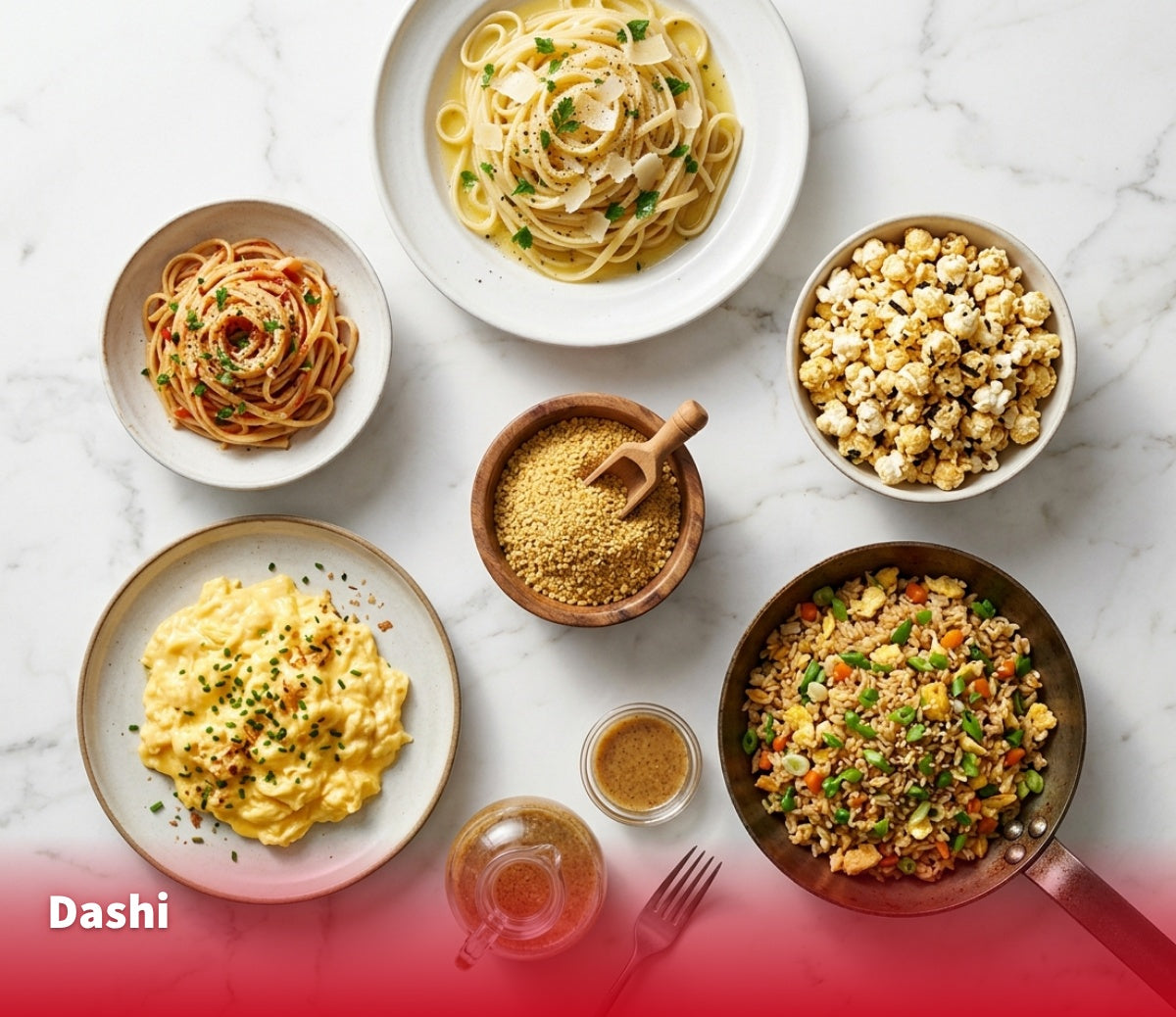
This is an enormous waste of one of the most versatile seasonings ever created. Dashi is not a "Japanese soup base." It is a concentrated delivery system for umami -- the savory fifth taste that makes food taste more like itself. And it works in almost anything: pasta water, popcorn, fried rice, scrambled eggs, salad dressing. Once you understand what dashi actually does, you will start reaching for it the way you reach for salt and pepper -- automatically, without thinking about cuisine boundaries.
This article will change how you think about that packet in your cupboard. Every technique below uses exact measurements and takes under five minutes. You can try the first one tonight.
Want to start experimenting? Browse Japanese pantry essentials at Tokyo Stash.
What You'll Learn
- 1) What dashi actually is (and why it is not bouillon)
- 2) The 5 unexpected uses: pasta, popcorn, fried rice, eggs, and dressing
- 3) The cheat sheet: how much dashi to add and when
- 4) Why umami changes everything
1) What Dashi Actually Is (and Why It Is Not Bouillon)
In Western cooking, making stock is a long commitment. You roast bones, chop mirepoix, simmer for four to eight hours, and end up with a rich, gelatinous liquid built from collagen and slow-extracted flavor. It is a foundation of French, Italian, and American cuisine, and it is fundamentally a process of patience.
Dashi is the opposite. Traditional dashi takes five to ten minutes. You heat water, steep one or two ingredients briefly, strain, and you are done. There is no roasting, no mirepoix, no hours of reduction. Yet the resulting liquid carries a depth of flavor that rivals any stock -- not because it extracts more from the ingredients, but because the ingredients themselves are already concentrated flavor bombs before they ever touch water.
The three main types of dashi each deliver different flavor compounds. Kombu dashi uses dried kelp, which is extraordinarily rich in glutamate -- the amino acid responsible for the savory taste we call umami. A single sheet of good kombu can contain up to 3,000 milligrams of free glutamate per 100 grams, more than Parmesan cheese. Katsuobushi dashi uses shaved dried bonito (skipjack tuna) that has been smoked, fermented, and dried until it is harder than wood. Bonito flakes deliver inosinate, a different umami compound. Niboshi dashi uses small dried sardines and is common in regional home cooking, particularly in eastern Japan.
Here is where the science gets remarkable. When you combine glutamate (from kombu) with inosinate (from bonito), the umami effect is not simply additive. It is synergistic. Research published in the 1960s by Japanese biochemist Shintaro Kodama and later confirmed in numerous studies showed that the combination produces a perceived umami intensity roughly seven to eight times greater than either compound alone. This is why the classic awase dashi -- kombu plus katsuobushi together -- tastes so profoundly satisfying. It is not one flavor plus another. It is a biochemical multiplier.
For most people outside Japan, the easiest way to access this magic is Hondashi, made by Ajinomoto. Hondashi is granulated instant dashi -- a shelf-stable powder that dissolves in hot water (or can be sprinkled directly onto food) and delivers the same glutamate-inosinate combination found in traditional awase dashi. It is not a compromise or a shortcut in the way that bouillon cubes are a dim shadow of real stock. Hondashi is how the majority of Japanese households actually make dashi on a daily basis. It is the real thing, just made convenient. A single teaspoon contains enough umami to transform a dish.
2) The 5 Unexpected Uses: Pasta, Popcorn, Fried Rice, Eggs, and Dressing
Everything below assumes you are using granulated dashi (Hondashi or a similar product). If you are using liquid dashi concentrate, use roughly double the amount indicated. If you made fresh dashi from kombu and bonito, substitute the granules with 2-3 tablespoons of your stock per teaspoon of granules called for.
Use 1: Pasta -- The Easiest Upgrade You Will Ever Make
There are two ways to use dashi with pasta, and both are worth trying.
The simple version: When boiling your pasta water, add 1 teaspoon of dashi granules per liter of water along with your usual salt (reduce the salt slightly, since dashi contains some sodium). The dashi infuses the pasta as it cooks, giving each strand a subtle savory depth that is impossible to achieve with salt alone. You will not taste "Japanese flavor." You will taste pasta that somehow tastes more like pasta -- rounder, more complete. This works with any sauce, any shape.
The wafu pasta version: "Wafu" means Japanese-style, and wafu pasta is a beloved category in Japan's casual dining scene. Cook your spaghetti, then toss it in a pan with 1 tablespoon of butter, 1 tablespoon of soy sauce, and 1 teaspoon of dashi granules dissolved in 2 tablespoons of the pasta cooking water. Add whatever toppings you like -- sauteed mushrooms, sliced nori, a raw egg yolk, canned tuna. The dashi-butter-soy combination creates a sauce that is umami on top of umami on top of umami. It takes three minutes and tastes like something from a Tokyo kissaten.
Use 2: Popcorn -- The Snack That Converts Skeptics
This is the single fastest way to demonstrate what dashi can do, and it is the one that makes people say "wait, what did you put on this?"
Pop your corn however you usually do -- microwave, stovetop, air popper. While the popcorn is still hot and slightly oily (if air-popped, toss with a light spray of oil or melted butter first), sprinkle 1/2 to 1 teaspoon of dashi granules directly over a large bowl of popcorn. Toss immediately so the granules stick to the surface. The heat dissolves the granules slightly, creating a thin umami coating on every kernel.
The result is popcorn that tastes deeply savory without being identifiably "Japanese." It hits the same craving as cheese powder or ranch seasoning but with a cleaner, more complex flavor. For a next-level version, add a light dusting of aonori (dried seaweed flakes) alongside the dashi. The combination of bonito umami and seaweed umami is the same synergy that makes okonomiyaki toppings so addictive.
Use 3: Fried Rice -- Depth Without Liquid
The enemy of good fried rice is moisture. You want high heat, fast movement, and dry grains that sear rather than steam. Liquid sauces -- soy sauce, oyster sauce -- add flavor but also add moisture, which is why restaurant chefs add them in the final seconds and toss furiously.
Dashi granules solve this problem. They deliver concentrated umami in dry powder form. Add 1 teaspoon of dashi granules directly to the rice while stir-frying, roughly 30 seconds before you finish cooking. The granules dissolve into the thin film of oil coating each grain, distributing umami evenly without adding a single drop of liquid. The result is fried rice with a deeper, more layered flavor and -- critically -- a better sear on each grain because you kept the wok dry when it mattered.
This technique stacks beautifully with other seasonings. Add your soy sauce at the very end as usual. The dashi provides the bass note of umami; the soy sauce provides the sharp, salty top note. Together, they sound like a complete chord.
Use 4: Scrambled Eggs -- Three-Ingredient Transformation
Every Japanese home cook knows that eggs and dashi are natural partners. Tamagoyaki -- the sweet rolled omelette found in bento boxes and sushi restaurants -- is made with dashi-enriched egg. Chawanmushi -- savory steamed egg custard -- is essentially dashi set with egg. The principle is simple: dashi's umami amplifies the inherent richness of eggs without adding heaviness.
For Western-style scrambled eggs: crack 2-3 eggs into a bowl, add 1/2 teaspoon of dashi granules, and whisk until the granules dissolve. Cook as you normally would -- low and slow with butter, or hot and fast, your preference. The dashi does not change the technique. It changes the depth. The eggs taste richer, more savory, and slightly more complex, as if you had used the best farm-fresh eggs available even if you used ordinary supermarket ones. The effect is subtle but unmistakable once you know what to listen for.
For a more pronounced version -- closer to tamagoyaki territory -- add 1/2 teaspoon of sugar and 1/2 teaspoon of soy sauce along with the dashi. This produces eggs with a faintly sweet, deeply savory character that is utterly unlike any Western egg preparation. Serve them on rice, and you have a five-minute Japanese breakfast.
Use 5: Salad Dressing -- Instant Wafu
"Wafu dressing" is a staple of Japanese home cooking: a light, tangy, intensely savory vinaigrette that appears on salads in virtually every family restaurant and konbini bento in Japan. Making it from scratch takes 60 seconds.
In a small jar or bowl, combine: 2 tablespoons of rice vinegar, 1 tablespoon of soy sauce, 1 teaspoon of sesame oil, 1/2 teaspoon of dashi granules, and optionally 1/2 teaspoon of sugar. Stir or shake until the dashi dissolves. That is it. Pour over any salad -- green, tomato, cucumber, shredded cabbage, it does not matter.
What makes this dressing different from a standard vinaigrette is the umami backbone provided by the dashi. Most Western dressings rely on acid (vinegar) and fat (oil) for interest, with maybe some mustard or garlic for complexity. Wafu dressing adds a third dimension -- savory depth -- that makes simple vegetables taste satisfying in a way that oil and vinegar alone cannot achieve. It is the reason why a plain salad at a Japanese restaurant somehow tastes better than it has any right to, and now you know the secret.
3) The Cheat Sheet: How Much Dashi to Add and When
The most common mistake with dashi is not using too much or too little -- it is using it at the wrong stage of cooking. Here is a practical guide.
The golden ratio for granulated dashi: Start with 1/2 to 1 teaspoon per serving as a baseline. This applies to most dishes. For liquids (soups, sauces, pasta water), dissolve the granules in the liquid. For dry applications (fried rice, popcorn), sprinkle directly and toss to distribute.
When to add it -- early vs. late: For dishes with liquid (soups, sauces, pasta water, dressings), add dashi early. It needs time and moisture to dissolve and distribute evenly. For dry or high-heat dishes (fried rice, stir-fries), add it in the last 30-60 seconds. Adding it too early in a dry pan risks scorching the granules, which produces a bitter, acrid taste. For toppings (popcorn), sprinkle it immediately after cooking while the surface is still hot and slightly oily.
Too much dashi -- what happens: If you overshoot, the dish will taste fishy. This is because Hondashi's bonito component becomes conspicuous at high concentrations. The umami itself does not become unpleasant, but the marine origin becomes detectable in a way that clashes with non-Japanese dishes. If your fried rice smells like a fish market, you have used too much. Scale back to half and try again. The sweet spot is where the dish tastes "better" without tasting "Japanese."
Too little dashi -- what happens: Nothing. Literally nothing. A quarter teaspoon in a large pot of pasta water will have zero perceptible effect. Dashi needs a minimum concentration to register on the palate. When in doubt, start with the full teaspoon and adjust down from there, rather than starting cautiously with a pinch that does nothing.
Granulated vs. liquid concentrate: Granulated dashi (like Hondashi) is the most versatile format. It dissolves easily, stores at room temperature, and works in both wet and dry applications. Liquid dashi concentrate (tsuyu or mentsuyu) is pre-mixed with soy sauce and mirin, which means it adds sweetness and saltiness along with umami -- useful for noodle dipping sauces but less versatile as a pure umami booster. For the techniques in this article, granulated is the clear winner.
Storage: Keep granulated dashi in a cool, dry place with the packet sealed tightly. Once opened, it stays potent for about six months. Humidity is the enemy -- if the granules clump together, they still work, but they dissolve less evenly. In humid climates, consider transferring to an airtight container after opening.
4) Why Umami Changes Everything
In 1908, a chemistry professor at Tokyo Imperial University named Kikunae Ikeda sat down to a bowl of kombu dashi and asked a question that would reshape the science of taste: why does this simple kelp broth taste so profoundly satisfying?
Ikeda knew the answer was not sweetness, sourness, saltiness, or bitterness -- the four tastes recognized by Western science at the time. There was something else, a savory depth that he could not fit into the existing framework. He spent months isolating compounds from kombu until he identified glutamate as the source. He named the taste umami, from the Japanese word umai, meaning "delicious" or "savory."
Western science largely ignored him. For nearly a century, the idea of a fifth basic taste was treated as a curiosity, a cultural claim rather than a biological fact. It was not until 2002, when researchers at the University of Miami identified specific taste receptors on the human tongue dedicated to detecting glutamate, that umami was officially recognized as the fifth taste by the international scientific community. Ikeda had been right for 94 years.
What makes umami uniquely powerful is not just its own flavor but its ability to amplify other flavors. Umami compounds bind to receptors that increase saliva production and prolong the perception of taste on the palate. In practical terms, this means that adding umami to a dish does not make it taste like glutamate was added. It makes the existing flavors taste more vivid, more complete, more satisfying. Salt makes things salty. Sugar makes things sweet. Umami makes things more.
This is why adding dashi to pasta does not make it taste Japanese. It makes it taste like better pasta. Adding dashi to scrambled eggs does not produce a Japanese egg dish. It produces eggs that taste richer and more deeply flavored. The umami is invisible -- it amplifies without announcing itself. This is the mental shift that unlocks dashi as a universal kitchen tool: it is not a "Japanese ingredient" that you add to "Japanese food." It is a flavor multiplier that works across every cuisine because umami receptors do not care about cultural categories.
Western cooking has always used umami, of course -- Parmesan cheese, tomato paste, Worcestershire sauce, anchovies, soy sauce, and mushrooms are all umami-rich ingredients that European and American cooks have relied on for centuries. The difference is that these ingredients also bring strong secondary flavors (cheese taste, tomato acidity, anchovy fishiness) along with their umami. Dashi granules deliver concentrated umami with minimal secondary flavor. They are the purest, most versatile umami delivery tool most home cooks have access to, and they cost a few dollars for a packet that lasts months.
Kikunae Ikeda, incidentally, went on to develop the commercial production of monosodium glutamate, which his former student Saburosuke Suzuki brought to market under the brand name Ajinomoto in 1909 -- the same company that makes Hondashi today. The through-line from a chemistry professor's curiosity about kombu broth to the packet of dashi granules in your cupboard is direct and unbroken. More than a century of umami science lives in that packet. Use it for more than miso soup.
Conclusion: The Packet That Does Everything
Dashi granules are one of the most underused ingredients in non-Japanese kitchens. They are cheap, shelf-stable, and contain a biochemically optimized combination of umami compounds that took Japanese cuisine centuries to perfect and Western science nearly a century to acknowledge.
You do not need special equipment. You do not need to learn Japanese cooking techniques. You need one packet of Hondashi and a willingness to sprinkle half a teaspoon of it onto things that are not miso soup. Start with the popcorn -- it takes 30 seconds, and the look on your face when you taste it will tell you everything you need to know about what you have been missing.
The best seasoning is not the one that makes food taste like a different cuisine. It is the one that makes food taste like a better version of itself. That is what dashi does. That is what umami is for.
Ready to add umami to everything? Explore Japanese pantry staples at Tokyo Stash.
Explore more Japanese snacks and culture stories on Tokyo Stash.