
Think of a cookie. What comes to mind? Something crispy, crunchy, maybe a little crumbly?
Now imagine a cookie that's soft and chewy—not because it just came out of the oven, but because it was designed to stay that way for weeks. That's Country Ma'am, one of Japan's most iconic snacks, made by Fujiya since 1984.
In this article, we'll explore why this cookie breaks all the rules, the clever science that keeps it soft, and a simple trick that transforms it into something truly extraordinary.
Want to try it yourself? Explore Country Ma'am products available at Tokyo Stash.
What You'll Learn
- 1) The cookie that defies expectations
- 2) The science behind the chewiness
- 3) The warming trick: how Japanese enjoy it best
- 4) From classic to regional treasures
1) The Cookie That Defies Expectations
If you grew up with Chips Ahoy! or Oreos, your idea of a "cookie" is something firm and snappy. You dunk it in milk precisely because it's too dry on its own. The crunch is the point.
Country Ma'am flips that script entirely.
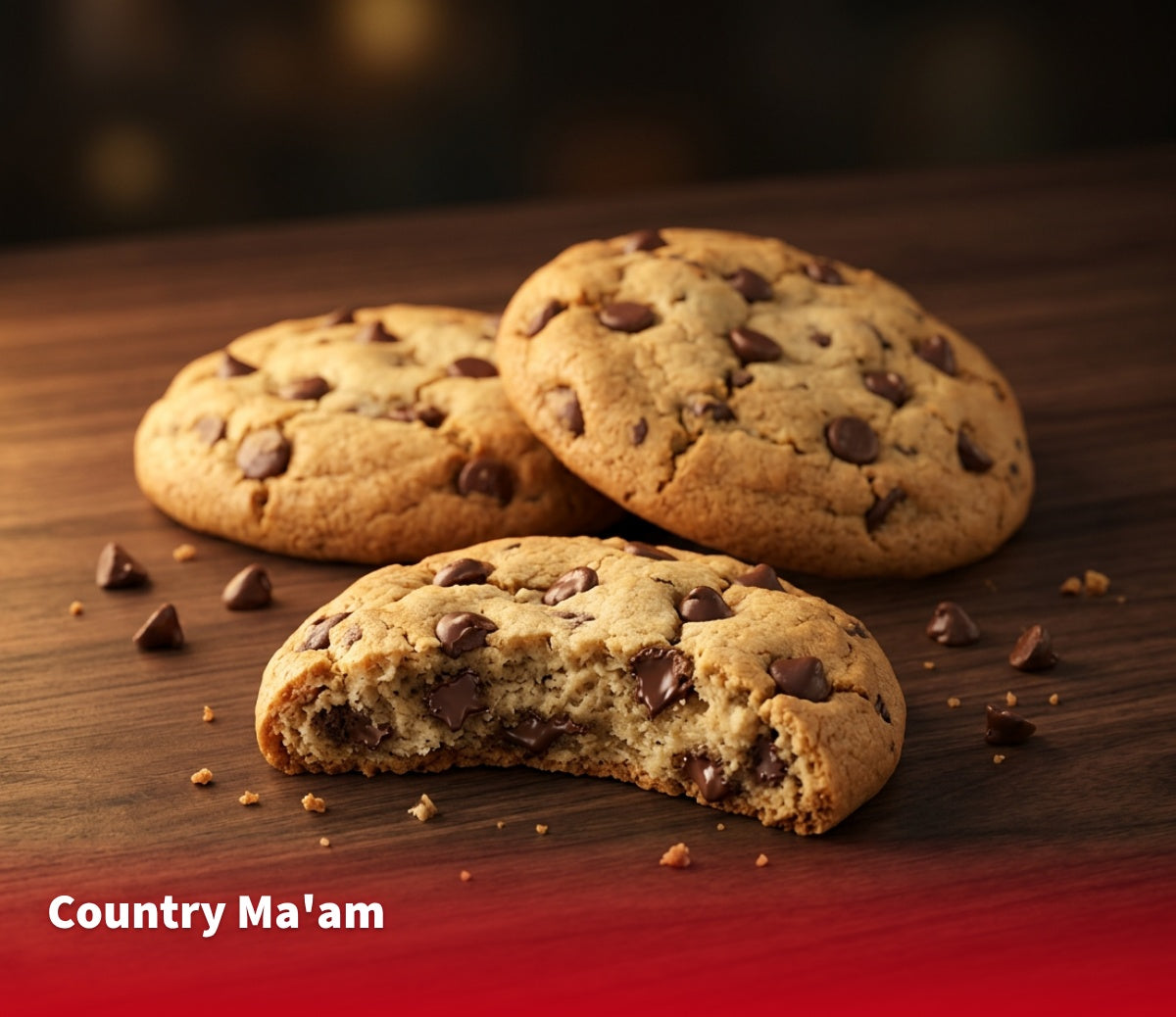
Bite into one and you'll feel a thin, lightly crisp outer shell give way to a moist, fudgy center studded with chocolate chips. It's the texture of a cookie that was pulled from the oven thirty seconds early—except it feels that way straight from the package, days or even weeks after it was baked.
This "outside crispy, inside chewy" dual structure is no accident. It's the result of decades of refinement by Fujiya, one of Japan's oldest confectionery companies, founded in 1910. Where Western cookie makers chase the perfect snap, Fujiya pursued the perfect shittori—a Japanese word that means pleasantly moist and tender, with no English equivalent that quite captures it.
2) The Science Behind the Chewiness
So how does a cookie stay soft in a sealed package for weeks without going stale? The answer lies in a combination of ingredient science and packaging engineering.
Moisture retention technology
Country Ma'am's recipe is carefully balanced to hold water molecules within the cookie's crumb structure. The dough contains ingredients that bind moisture at a molecular level, preventing it from migrating to the surface and evaporating.
The role of trehalose
One key ingredient is trehalose, a natural sugar found in mushrooms, honey, and shrimp. Trehalose has a remarkable ability to stabilize proteins and cell membranes, which is why some organisms use it to survive extreme dehydration. In baking, it acts as a moisture shield—locking water into the cookie's interior and maintaining that just-baked softness long after cooling.
Individual wrapping as quality control
Every single Country Ma'am cookie comes in its own sealed pouch. This isn't just for convenience—it's a critical part of the freshness system. Each pouch creates a microenvironment that prevents moisture exchange with the outside air. Open a bag of ten, and each cookie stays protected until the moment you choose to eat it.
This obsessive attention to texture preservation reflects a broader Japanese philosophy: the consumer's first bite should be as perfect as the baker intended.
3) The Warming Trick: How Japanese Enjoy It Best
Here's something most people outside Japan don't know: Country Ma'am has a secret mode.
The package itself suggests it, and millions of Japanese fans swear by it—warm it up.
Microwave method (20 seconds)
Place an unwrapped Country Ma'am on a plate and microwave it for about 20 seconds. The chocolate chips melt into gooey pools, the center becomes almost molten, and the edges stay just firm enough to hold it all together. It tastes like a cookie that literally just came out of the oven.
Toaster oven method (2 minutes)
For a slightly different experience, toast one for about 2 minutes. The outside develops a golden, crispy shell while the inside turns warm and fudgy. The contrast between the two textures becomes even more dramatic.
This "warming culture" is uniquely Japanese. It transforms an already delicious snack into a tiny moment of luxury—the kind of small ritual that turns an ordinary afternoon into something special. It's not just about taste; it's about the experience of watching chocolate slowly melt and catching that warm, buttery aroma as it fills the room.
4) From Classic to Regional Treasures
Country Ma'am launched with two flavors—Vanilla and Cocoa—and both remain bestsellers more than 40 years later. But Fujiya hasn't stopped there.
The Meister's lineup
The premium "Meister's" series takes Country Ma'am to another level. These use higher-quality chocolate and richer butter, targeting adults who want a more sophisticated version of the cookie they grew up with.
Regional limited editions
Japan's omiyage (souvenir gift) culture has turned Country Ma'am into a canvas for regional creativity. Across Japan, you'll find limited-edition flavors tied to local specialties:
- Hokkaido – Rich milk and cheese varieties
- Kyoto – Uji matcha with a deep, earthy sweetness
- Okinawa – Purple sweet potato (beni-imo)
- Tokyo – Strawberry cheesecake
- Nagoya – Ogura bean paste (azuki)
These regional editions aren't just marketing—they're a genuine expression of local pride. Train station kiosks and airport shops across Japan stock their region's exclusive Country Ma'am, and travelers collect them as edible souvenirs. With roughly a dozen regional varieties available at any given time, hunting for rare flavors has become a hobby in itself.
Conclusion: A Cookie That Invites You to Slow Down
Country Ma'am isn't trying to be the crunchiest cookie or the most indulgent dessert. It occupies a quieter space—a soft, warm, familiar comfort that asks you to pause for just a moment.
The science behind its chewiness is impressive. The warming trick elevates it into something magical. And the regional flavors connect it to the rich tapestry of Japanese food culture.
But at its heart, Country Ma'am is simply an invitation: unwrap one, maybe warm it up, and take a slow, unhurried bite. In a world that moves fast, this little cookie reminds you that the best things are worth savoring.
Ready to experience the chewiness? Explore Country Ma'am products at Tokyo Stash.
Explore more Japanese snacks and culture stories on Tokyo Stash.