
In 1899, a man who had spent years scrubbing floors and stirring sugar in American candy factories returned to Tokyo with a suitcase full of recipes and a single obsession: bring Western sweets to Japan. His name was Taichiro Morinaga, and the company he built from a cramped two-tatami workshop in Akasaka would become one of the most influential confectionery makers in Asian history.
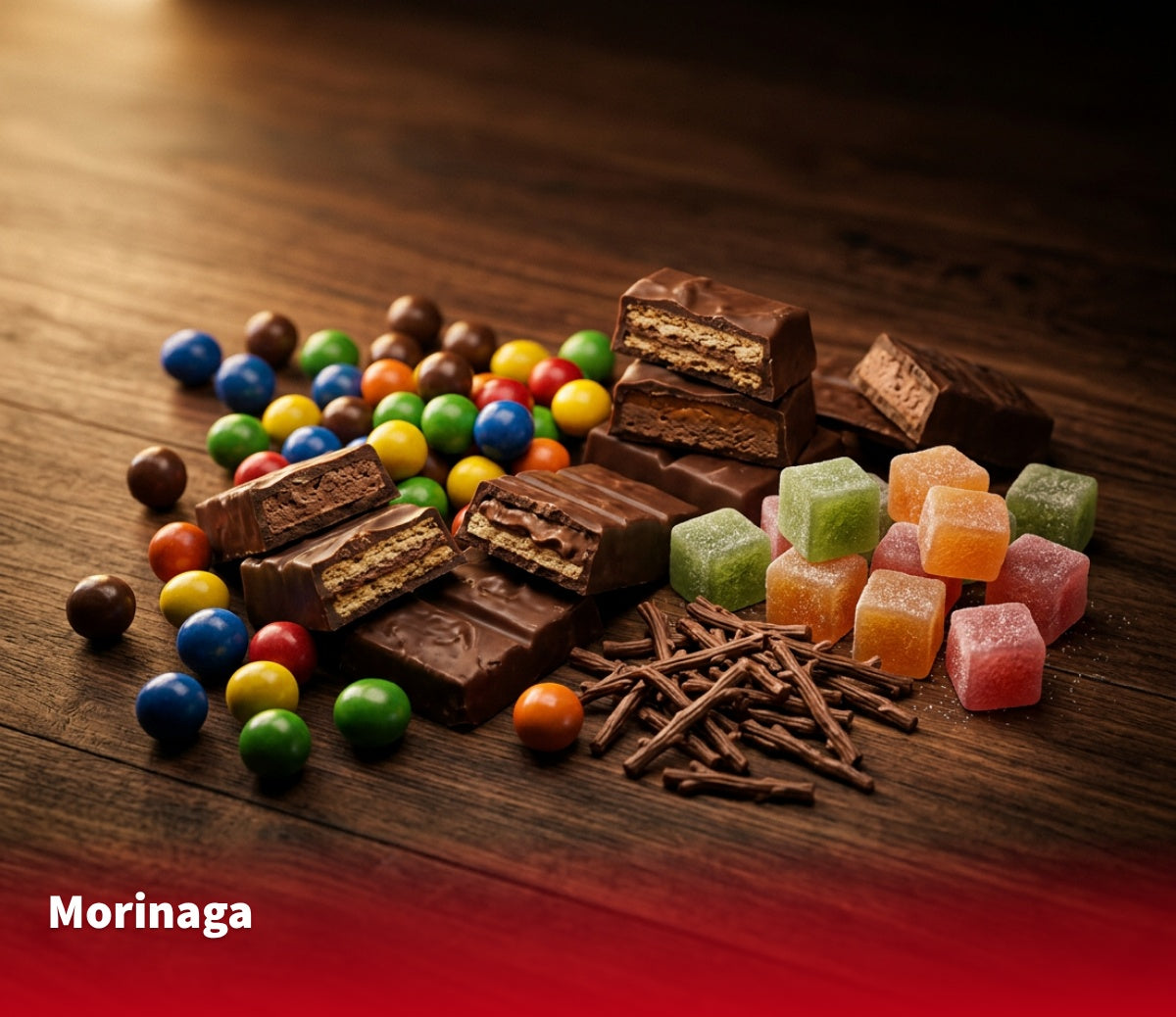
Today, Morinaga makes Chocoball, Hi-Chew, DARS, and Koeda—brands that are household names across Japan and increasingly around the world. But what makes Morinaga different from every other candy company is not what they make. It is how they think about texture.
Want to explore Morinaga's range for yourself? Browse Morinaga products at Tokyo Stash.
What You'll Learn
- 1) The man who brought Western candy to Japan
- 2) Chocoball, Hi-Chew, DARS: the innovation DNA
- 3) The texture philosophy that defines Morinaga
- 4) Morinaga today: 125 years and still experimenting
1) The Man Who Brought Western Candy to Japan
Taichiro Morinaga was born in 1865 in Saga Prefecture on the island of Kyushu. At 24, he did something almost unheard of for a man of his background: he emigrated to the United States. He arrived in California with little money and no English, taking whatever work he could find. Eventually, he landed a job in a confectionery shop, where he discovered a world of caramels, marshmallows, and chocolates that simply did not exist in Meiji-era Japan.
For over a decade—from roughly 1888 to 1899—Morinaga apprenticed in American candy factories, learning the chemistry of sugar crystallization, the art of caramel cooking, and the mechanics of Western confectionery production. When he finally returned to Tokyo, he carried with him not just recipes but a conviction: Japan deserved sweets as sophisticated as anything made in New York or Philadelphia.
He opened his first workshop in 1899 in Akasaka, Tokyo—a space so small it measured just two tsubo (roughly 6.6 square meters). His first product was Western-style caramel, individually wrapped in wax paper. At a time when Japanese sweets meant wagashi—delicate bean paste confections and rice cakes—Morinaga's chewy, milk-flavored caramels were a revelation. They were portable, affordable, and unlike anything most Japanese people had ever tasted.
The iconic Morinaga Milk Caramel, in its distinctive yellow box with the angel logo, launched in 1913 and became Japan's first mass-produced Western-style confection. By the 1910s and 1920s, "Morinaga" was not just a brand—it was a synonym for modern Japanese candy. The yellow caramel box became as recognizable as any symbol in Japanese consumer culture, and it remains in production today, more than 110 years later.
The angel trademark, which Taichiro adopted because he was a devout Christian who saw his mission as bringing "sweetness and joy" to people, has survived wars, economic crises, and complete shifts in consumer taste. It is one of the oldest continuously used logos in Japanese commerce.
2) Chocoball, Hi-Chew, DARS: The Innovation DNA
What separates Morinaga from a nostalgic caramel company is its relentless drive to create entirely new categories of candy. Three products illustrate this better than anything else.
Chocoball launched in 1967 and introduced something no other chocolate brand had attempted: a lottery built into the packaging. On every box of Chocoball, a small illustration of a bird (the Kyoro-chan mascot) appears near the opening tab. Peel it back, and you might find a golden angel or a silver angel. Collect one gold angel (or five silver angels) and mail them to Morinaga, and you receive a prize—a toy can shaped like Kyoro-chan, called the "omocha no kanzume" (toy can). This campaign has run continuously for over 56 years, making it one of the longest-running consumer promotions in the world. Generations of Japanese children have grown up peeling back Chocoball tabs with trembling fingers, hoping for gold. The odds are deliberately kept low—roughly 1 in 500 for gold—which is precisely why the thrill endures.
Hi-Chew arrived in 1975, but its development started four years earlier. Morinaga's R&D team set out to create a candy that replicated the experience of chewing gum but could actually be swallowed—a "chewable candy" with prolonged, satisfying texture. The name says it plainly: "Hi" for high quality, "Chew" for the sensation they were engineering. It took until 1975 to perfect the balance of gelatin, starch, and fruit puree that gives Hi-Chew its signature stretch. The candy was an immediate domestic hit, but its global story took decades to unfold. In the 2000s and 2010s, Hi-Chew expanded aggressively into the United States, Southeast Asia, and Europe. Today it is sold in over 30 countries and has become, for many international consumers, their first encounter with a Morinaga product. In the US alone, Hi-Chew has become a top-five chewy candy brand—remarkable for a Japanese import competing against homegrown giants.
DARS debuted in 1993 with a deceptively simple concept: 12 pieces of chocolate in a slim box, designed for sharing. The name itself is a mystery that Morinaga has never fully explained—it is "SRAD" spelled backward, and the company has let consumers speculate about its meaning for over 30 years. What is not mysterious is the product's precision. Each DARS piece is engineered for a smooth, slow melt on the tongue. The 12-piece count was chosen deliberately: enough to share with a friend or two, not so many that the box feels impersonal. In a culture where portion control and shareability matter deeply, DARS found a permanent place in office desks and school bags across Japan.
3) The Texture Philosophy That Defines Morinaga
Most candy companies think in terms of flavor. Morinaga thinks in terms of mouthfeel.
This distinction is subtle but fundamental, and it explains why Morinaga's products feel so different from their competitors. When Morinaga develops a new product, the primary question is not "What should it taste like?" but "What should it feel like in your mouth?" Flavor follows texture, not the other way around.
Consider the evidence across their lineup. Chocoball is defined by its shell: a thin, crisp candy coating that yields with a satisfying snap to reveal soft chocolate or caramel inside. The contrast between the hard exterior and the yielding interior is the entire point—the flavor is almost secondary to that moment of crunch-to-melt transition. Hi-Chew is engineered for prolonged chewing resistance. Unlike gum, which maintains its texture indefinitely, Hi-Chew gradually softens and dissolves, releasing waves of fruit flavor as it breaks down. The chewing experience evolves over 30 to 60 seconds—a carefully timed arc from firm to soft to gone. DARS takes the opposite approach: minimal chewing, maximum melt. Each piece is formulated to dissolve smoothly on the tongue at body temperature, producing a creamy, coating sensation that lingers. Koeda ("little branches") are pencil-thin chocolate sticks with a biscuit core that delivers a delicate, almost fragile crunch—designed to shatter lightly rather than require force.
This obsession with texture is not unique to Morinaga—it is a broader pattern in Japanese food culture. The Japanese language has an extraordinarily rich vocabulary for texture: shaki-shaki (crisp-crunchy, like fresh lettuce), mochi-mochi (springy-chewy, like fresh mochi), toro-toro (meltingly soft, like slow-cooked broth), pari-pari (thin and crackly, like nori). Japanese consumers evaluate food along texture dimensions that many Western palates barely register. Morinaga's genius is in translating this cultural sensitivity into mass-market confectionery.
The result is a product line where every item occupies a distinct textural niche. You do not choose between Chocoball and DARS based on whether you want chocolate—you choose based on whether you want a snap, a melt, a chew, or a crunch. This is candy design as sensory engineering, and Morinaga has been practicing it for longer than almost anyone.
4) Morinaga Today: 125 Years and Still Experimenting
Morinaga in 2025 is a company that simultaneously honors its past and pushes into new territory. The yellow Milk Caramel box is still on shelves, virtually unchanged since the 1910s. Chocoball's golden angel lottery still runs with the same rules established in 1967. But alongside these heritage products, Morinaga continues to launch new flavors, formats, and collaborations at a pace that would exhaust most confectionery companies.
Seasonal and limited-edition releases follow the rhythm of Japan's calendar. Strawberry DARS appears in winter. Matcha Chocoball arrives in spring. Regional Hi-Chew flavors rotate through convenience stores with the regularity of train schedules. Each release is a small experiment—a test of whether a new texture-flavor combination resonates with consumers who have been eating Morinaga products since childhood.
The international expansion, led by Hi-Chew, has accelerated in recent years. What was once a curiosity in Asian grocery stores is now stocked in mainstream American retailers. But Morinaga has been careful not to dilute its products for foreign markets. The Hi-Chew sold in a New York bodega uses the same formulation as the one sold in a Tokyo konbini. The texture is non-negotiable.
At Tokyo Stash, we carry products across Morinaga's core brands—Chocoball, DARS, Koeda, and Hi-Chew. Browsing them together reveals something that a single purchase cannot: the range of what one company can do with sugar, chocolate, and an engineer's attention to how things feel in your mouth. From the snap of a Chocoball shell to the slow dissolve of a DARS square, each product is a different answer to the same question Taichiro Morinaga asked when he returned from America in 1899: how do you make something that brings people joy?
A hundred and twenty-five years later, the workshop in Akasaka is long gone. But the angel on the box is the same. And the question has never changed.
Conclusion: The Company That Engineers Joy
Morinaga's story is not about a single iconic product. It is about a philosophy of making—a belief that candy is not just flavor but experience, not just taste but touch. From Taichiro Morinaga's cramped Akasaka workshop to a global presence spanning 30 countries, the company has maintained an almost obsessive focus on how sweets feel in your mouth.
Chocoball taught Japan that candy could be a game. Hi-Chew taught the world that Japanese texture engineering could compete on a global stage. DARS proved that simplicity—12 pieces, one clean flavor, a perfect melt—could be its own kind of innovation. And through it all, the golden angel kept appearing on Chocoball boxes, just rarely enough to keep millions of fingers peeling back tabs in hope.
The next time you bite into a Morinaga product, pay attention not to the flavor first, but to the feeling. The snap. The chew. The melt. That is where 125 years of sweet science lives.
Ready to experience Morinaga's texture philosophy? Explore the full Morinaga collection at Tokyo Stash.
Explore more Japanese snacks and culture stories on Tokyo Stash.