
There is a snack in Japan that you cannot simply walk into a store and buy. You have to go to Hokkaido for it. And even then, you might have to wait in line—sometimes for over an hour—at the airport, only to be told you can buy a maximum of three boxes.
That snack is Jaga Pokkuru, a thick-cut potato stick made by Calbee Potato Inc. that has become one of the most coveted souvenirs in Japan. It is not rare because of limited production runs or clever artificial scarcity. It is rare because the company insists on making it only in Hokkaido, from only Hokkaido-grown potatoes, and selling it almost exclusively on the island where those potatoes were dug from the ground. In a world of global supply chains and next-day delivery, Jaga Pokkuru is a product that stubbornly refuses to be available everywhere.
In this article, we'll explore why Hokkaido is Japan's potato kingdom, what makes Jaga Pokkuru's texture impossible to replicate, how it became the ultimate expression of Japanese souvenir culture, and how you can actually get your hands on it without booking a flight to Sapporo.
Curious about Calbee's snack range? Explore Calbee products available at Tokyo Stash.
What You'll Learn
- 1) Born in the Potato Kingdom
- 2) The texture that can't be replicated
- 3) The omiyage phenomenon
- 4) Getting your hands on Jaga Pokkuru
1) Born in the Potato Kingdom
Hokkaido is to potatoes what Champagne is to sparkling wine. Japan's northernmost main island produces roughly 80% of the nation's entire potato harvest—around 1.7 million tons annually from vast agricultural plains that stretch from Tokachi in the east to Kamikawa in the north. The volcanic soil is rich in minerals, the summers are cool and dry, and the long daylight hours of Japan's subarctic latitudes create ideal growing conditions for starchy, flavorful tubers. No other region in Japan comes close.
It was in this potato heartland that Calbee Potato Inc. was established—a subsidiary of Calbee, Japan's largest snack food company. While parent Calbee operates factories across Japan and internationally, Calbee Potato exists for a specific purpose: to work exclusively with Hokkaido-grown potatoes, processing them on the island where they are harvested. The company operates multiple facilities across Hokkaido, allowing potatoes to move from field to factory with minimal transit time, preserving the freshness and starch content that degrade rapidly after harvest.
In 2003, Calbee Potato launched a new product designed to showcase Hokkaido's potato quality in its purest form. They called it Jaga Pokkuru. "Jaga" is the Japanese shortening of jagaimo (potato), and "Pokkuru" is derived from the Ainu word "pokuru"—roughly meaning a small, round, precious thing. The Ainu are the indigenous people of Hokkaido, and embedding their language into the product name was a deliberate nod to the island's deep cultural roots, not just its agricultural ones.
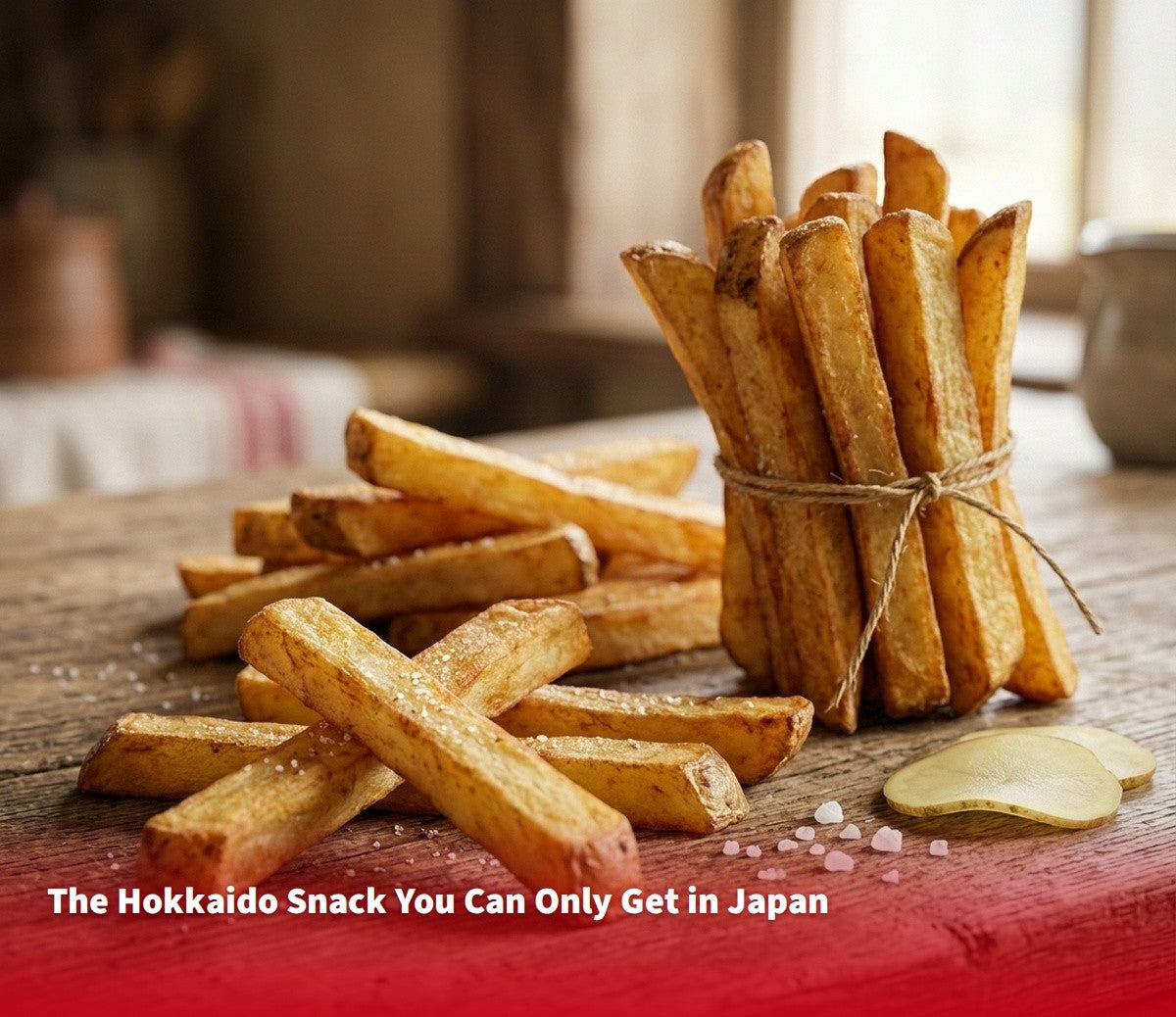
The product itself is deceptively simple: thick-cut potato sticks, fried and seasoned with salt. No exotic flavoring, no elaborate coating, no gimmick. Just potato, oil, and salt. But the specifics matter enormously. Jaga Pokkuru uses 100% Hokkaido-grown potatoes, processed entirely within Hokkaido. The potatoes are not peeled—the skin is left on, contributing both flavor and a subtle visual texture that distinguishes Jaga Pokkuru from any other potato snack on the market. The sticks are cut thicker than standard potato fries or sticks, roughly the width of a pencil, giving each piece substantial heft.
From the very beginning, Calbee Potato made a decision that would define the product's identity: Jaga Pokkuru would only be sold in Hokkaido. Not in Tokyo convenience stores, not in Osaka department stores, not on Amazon Japan. Only on the island where the potatoes were grown and the snack was made. This was not a temporary launch strategy—it was a permanent commitment. More than two decades later, that policy remains essentially unchanged.
The reasoning was partly practical: Jaga Pokkuru's texture is best when fresh, and the product does not contain the heavy preservatives that would extend shelf life for national distribution. But the reasoning was also deeply cultural. In Japan, the most valuable foods are often the ones you can only get in one place. By making Jaga Pokkuru a Hokkaido exclusive, Calbee Potato was not limiting its market—it was creating a legend.
2) The Texture That Can't Be Replicated
If you have eaten a potato stick snack before—Calbee's own Jagabee, for instance, or any of the countless international equivalents—you might wonder what could possibly make Jaga Pokkuru worth the pilgrimage. The answer is in your mouth the moment you bite down.
Jaga Pokkuru's texture is unlike any other potato snack. The exterior is crispy in a way that feels almost architectural—a firm, clean snap that breaks apart with precision rather than crumbling or shattering. But the interior is something else entirely: light, airy, almost fluffy, with a starchy, deeply potato-forward flavor that tastes like the concentrated essence of a freshly baked Hokkaido potato. The Japanese describe this dual sensation as "saku-saku"—a crispy-light texture that is both crunchy and delicate at the same time, a word that has no direct English equivalent but sits somewhere between "crispy" and "airy."
This texture is the result of a production process that Calbee Potato has spent years refining.
The potato varieties
Jaga Pokkuru is made from specific Hokkaido potato cultivars, including Kitaakari and other varieties selected for their unusually high starch content. Hokkaido potatoes, grown in the island's cool climate and mineral-rich volcanic soil, develop more starch and less water than potatoes grown in warmer regions. This higher starch-to-water ratio is critical: it allows the sticks to develop a firm exterior during frying while the interior remains light and porous rather than dense and oily. The difference is not subtle—it is the difference between a potato chip that tastes like oil and one that tastes like potato.
The frying process
The potato sticks are fried at carefully controlled temperatures designed to achieve the saku-saku texture. The process creates a rapid crust on the exterior that seals in moisture momentarily, allowing the interior starch to puff slightly before the moisture escapes. The result is a stick that is crispy on the outside but contains tiny air pockets inside—almost like a miniature, savory puff pastry made of potato. This is fundamentally different from the deep-frying process used for most commercial potato sticks, which tend to produce a uniformly dense, crunchy texture throughout.
Saroma-ko salt
The seasoning is equally deliberate. Jaga Pokkuru is finished with salt harvested from Lake Saroma on Hokkaido's Okhotsk Sea coast. Lake Saroma is Japan's third-largest lake and one of its largest brackish bodies of water, connected to the sea through narrow channels. The salt produced from its waters has a milder, more mineral-rich profile than standard table salt—less sharp, with a faintly sweet undertone that enhances the potato flavor rather than masking it. It is a small detail, but it is the kind of detail that turns a good snack into one that people remember.
Jaga Pokkuru versus Jagabee
The most instructive comparison is with Calbee's own Jagabee, a mainstream potato stick snack sold nationwide across Japan and exported internationally. Jagabee and Jaga Pokkuru look superficially similar—both are stick-shaped potato snacks—but they are fundamentally different products. Jagabee is made from a blend of potato varieties sourced from multiple regions, processed in mainland factories using a standard frying method. The result is a perfectly good snack: evenly crunchy, pleasantly salty, satisfying. But put a Jagabee stick and a Jaga Pokkuru stick side by side, and the difference is immediately apparent. Jaga Pokkuru is thicker, rougher-textured (you can see flecks of potato skin), and has that distinctive saku-saku snap that Jagabee simply does not. The potato flavor in Jaga Pokkuru is deeper, earthier, more concentrated. It is the difference between a good restaurant steak and one from the best butcher in town—same category, entirely different league.
This textural gap is precisely why Jaga Pokkuru cannot simply be "scaled up" for national or international distribution. The texture depends on specific potato varieties grown in specific soil, processed within hours of harvest at facilities designed for exactly this purpose. Move the production to Osaka or Nagoya, use different potatoes, and you get a different product. Calbee knows this. That is why they have never tried.
3) The Omiyage Phenomenon
To understand why Jaga Pokkuru generates airport lines and purchase limits, you first need to understand "omiyage" (お土産, travel souvenirs and gifts)—a social practice so deeply embedded in Japanese culture that it functions almost like a law of gravity.
In Japan, when you travel somewhere—whether for business, vacation, or a weekend trip—you are socially expected to bring back gifts for your coworkers, friends, family, and neighbors. This is not optional politeness; it is a genuine obligation. Return from a trip empty-handed, and people will notice. The omiyage you choose communicates several things at once: where you went, how much thought you put into the selection, and how much you value the relationship with the recipient. A thoughtless omiyage—something generic, available anywhere—sends a subtle but clear message that you did not care enough to find something special.
This cultural framework creates an enormous economic ecosystem. Every train station, airport, and tourist destination in Japan has dedicated omiyage shops selling "gotochi" products—regional specialties that can only be purchased in that specific area. These are not generic gift shop trinkets. They are carefully developed, beautifully packaged food products that represent the pride and identity of their home region. Hokkaido has shiroi koibito (white chocolate cookies). Kyoto has yatsuhashi (cinnamon-flavored mochi). Tokyo has Tokyo Banana. And at the very top of the Hokkaido omiyage hierarchy sits Jaga Pokkuru.
The airport phenomenon
The epicenter of Jaga Pokkuru culture is New Chitose Airport, Hokkaido's main gateway, serving Sapporo and the surrounding region. Walk through the airport's departure terminal and you will find Jaga Pokkuru at multiple shops—but you will also find lines. Not short lines. During peak travel seasons—Golden Week in May, Obon in August, New Year's in January—queues for Jaga Pokkuru can stretch for 30 minutes or more. Signs announce purchase limits: typically 3 to 5 boxes per person. Staff members stand at the front of the line, counting customers and managing inventory. It resembles the launch-day frenzy for a limited sneaker drop more than a snack purchase.
The purchase limits exist because demand consistently outstrips supply. Calbee Potato could, in theory, increase production—but they have chosen not to. The scarcity is partly a natural consequence of using specific Hokkaido potatoes with seasonal harvest cycles, and partly a deliberate choice to maintain the product's prestige. In the omiyage economy, a product that is always available is a product that is not special. Jaga Pokkuru's limited availability is not a problem to be solved—it is the core of its identity.
The gift of effort
Here is the crucial cultural insight that explains why the lines and limits actually increase Jaga Pokkuru's desirability rather than discouraging purchase. In Japanese omiyage culture, the effort you put into acquiring a gift is itself part of the gift. When you hand a box of Jaga Pokkuru to a coworker back in Tokyo, you are not just giving them a delicious snack. You are communicating: "I waited in line at the airport for you. I was limited to three boxes, and I chose to use one of them on you." The scarcity transforms a potato snack into a gesture of care and consideration. Receiving Jaga Pokkuru feels different from receiving a souvenir you know was grabbed mindlessly from a shelf. It carries weight.
This dynamic has turned Jaga Pokkuru into what marketing researchers call a "social currency" product—something whose value is determined not just by what it is, but by what it signals about the relationship between giver and receiver. In Japanese offices, bringing back Jaga Pokkuru from a Hokkaido trip is a power move. It says you understand the culture, you have good taste, and you care about the people around you. Bringing back a generic airport chocolate bar says none of those things.
The gotochi snack ecosystem
Jaga Pokkuru did not create the gotochi (regional specialty) snack phenomenon, but it has become its most famous example. Across Japan, regional snack exclusives have become a category unto themselves. Kit Kat produces regional flavors—wasabi in Shizuoka, purple sweet potato in Okinawa, sake in Niigata. Pretz and Pocky have local editions. Even convenience store chains stock region-specific products that disappear the moment you cross a prefectural border.
But Jaga Pokkuru occupies a unique position in this ecosystem because its exclusivity is not a marketing layer applied to a standard product. It is not "regular Jaga Pokkuru in a special Hokkaido box." The product itself—the potatoes, the salt, the processing—is geographically rooted in a way that most gotochi products are not. You can make a wasabi Kit Kat anywhere; you cannot make Jaga Pokkuru outside of Hokkaido without changing what it is. That authenticity is what keeps it at the top of the omiyage hierarchy, year after year, more than two decades after launch.
4) Getting Your Hands on Jaga Pokkuru
For most of its history, the answer to "How do I get Jaga Pokkuru?" was simple and uncompromising: go to Hokkaido. Visit New Chitose Airport, Sapporo Station, or one of the island's many souvenir shops, wait in line if necessary, buy your limited allocation, and carry it home in your luggage. There was no workaround, no mail-order option, no online store. That was the deal.
In recent years, the landscape has shifted slightly. Online availability has expanded—you can now find Jaga Pokkuru on certain Japanese e-commerce platforms, occasionally on Amazon Japan, and through specialty importers. But there are important caveats.
Premium pricing
When Jaga Pokkuru appears online, it almost always carries a significant markup over the retail price in Hokkaido. A box that costs roughly 900 yen (~$6 USD) at New Chitose Airport might sell for 1,500 to 2,500 yen ($10-17 USD) online, depending on the seller and platform. This premium reflects the effort and cost of purchasing in Hokkaido and reselling through distribution channels that Calbee Potato does not officially support at scale. For international buyers, the markup increases further once shipping is factored in.
How to identify authentic Jaga Pokkuru
With premium pricing comes the risk of counterfeit or misrepresented products. Here is what to look for:
- Brand name: The manufacturer must be listed as Calbee Potato Inc. (カルビーポテト株式会社), not simply "Calbee." This is the Hokkaido subsidiary, and it is the only entity that produces genuine Jaga Pokkuru.
- Hokkaido origin mark: Authentic packaging prominently features Hokkaido imagery and the statement that the product is made in Hokkaido using Hokkaido potatoes.
- Packaging style: Jaga Pokkuru comes in a distinctive box containing individual 18g sachets (typically 10 sachets per standard box). Each sachet is nitrogen-flushed to preserve freshness. Loose or bulk packaging is a red flag.
- Do not confuse with Jagabee: As discussed above, Jagabee is Calbee's mainstream potato stick. It is widely available and significantly cheaper. Some online sellers may inadvertently (or deliberately) conflate the two. If the price seems too good to be true, it is probably Jagabee.
Storage and freshness tips
Jaga Pokkuru is at its best when eaten fresh. The saku-saku texture—that defining crispy-airy bite—is the first thing to degrade over time. Once a sachet is opened, the sticks begin absorbing moisture from the air, and within hours the texture softens noticeably. Even unopened, the product has a relatively short shelf life compared to heavily preserved snacks—typically 3 to 4 months from production. To maximize enjoyment:
- Store unopened sachets in a cool, dry place away from direct sunlight.
- Do not refrigerate—the moisture in a refrigerator will damage the texture.
- Once a sachet is opened, eat it immediately. This is not a snack that rewards saving for later.
- When purchasing online or through importers, check the production date (製造日) or best-before date (賞味期限) carefully. Products that have spent weeks in transit may be significantly closer to expiration.
Jaga Pokkuru versus the competition
Beyond Jagabee, there are other potato snacks in the Japanese market worth understanding in comparison. Jagariko, another Calbee product, is a cup-style potato stick with a hard, crunchy texture and bold seasoning—a fundamentally different eating experience, more akin to a savory biscuit than a potato snack. じゃがビー (Jagabee) offers the closest shape comparison but, as we have covered, lacks the textural complexity and potato depth. Various Hokkaido souvenir shops sell their own potato snacks attempting to capture the same market—Royce's chocolate-coated potato chips are perhaps the most famous alternative—but none replicate the specific saku-saku texture that defines Jaga Pokkuru.
The premium that Jaga Pokkuru commands—both in price and in the effort required to obtain it—is justified by a combination of genuine product quality and cultural significance that no competitor has managed to match. It is not just a snack. It is a piece of Hokkaido, wrapped in nitrogen-flushed foil, waiting to be carried across the country—or across the world—as proof that someone went to Japan's potato kingdom and brought back the best thing they found there.
Conclusion: A Snack That Rewards the Journey
Jaga Pokkuru is an anomaly in the modern snack world. In an industry that prizes scale, availability, and global distribution, here is a product that gains its power from being deliberately hard to get. It is made in one place, from ingredients grown in that one place, and sold almost exclusively in that one place. Everything about it—the Hokkaido potatoes, the Saroma-ko salt, the Ainu-derived name, the airport purchase limits—tells the same story: this belongs to Hokkaido, and Hokkaido does not share easily.
But that stubbornness is precisely what makes it extraordinary. The saku-saku texture that results from specific potatoes fried in specific ways. The deep, earthy flavor that comes from volcanic soil and cool-climate growing seasons. The weight it carries as an omiyage—the knowledge that someone stood in line at New Chitose Airport, accepted their three-box limit, and chose to give one of those boxes to you.
In a world where almost anything can be delivered to your door by tomorrow, Jaga Pokkuru reminds us that some things are worth the journey. And when you finally bite into one—that clean snap giving way to something light and airy and unmistakably, irreplaceably potato—you will understand why millions of travelers consider it the single best reason to visit Hokkaido.
Want to taste Hokkaido's most coveted snack? Explore Calbee products at Tokyo Stash.
Explore more Japanese snacks and culture stories on Tokyo Stash.