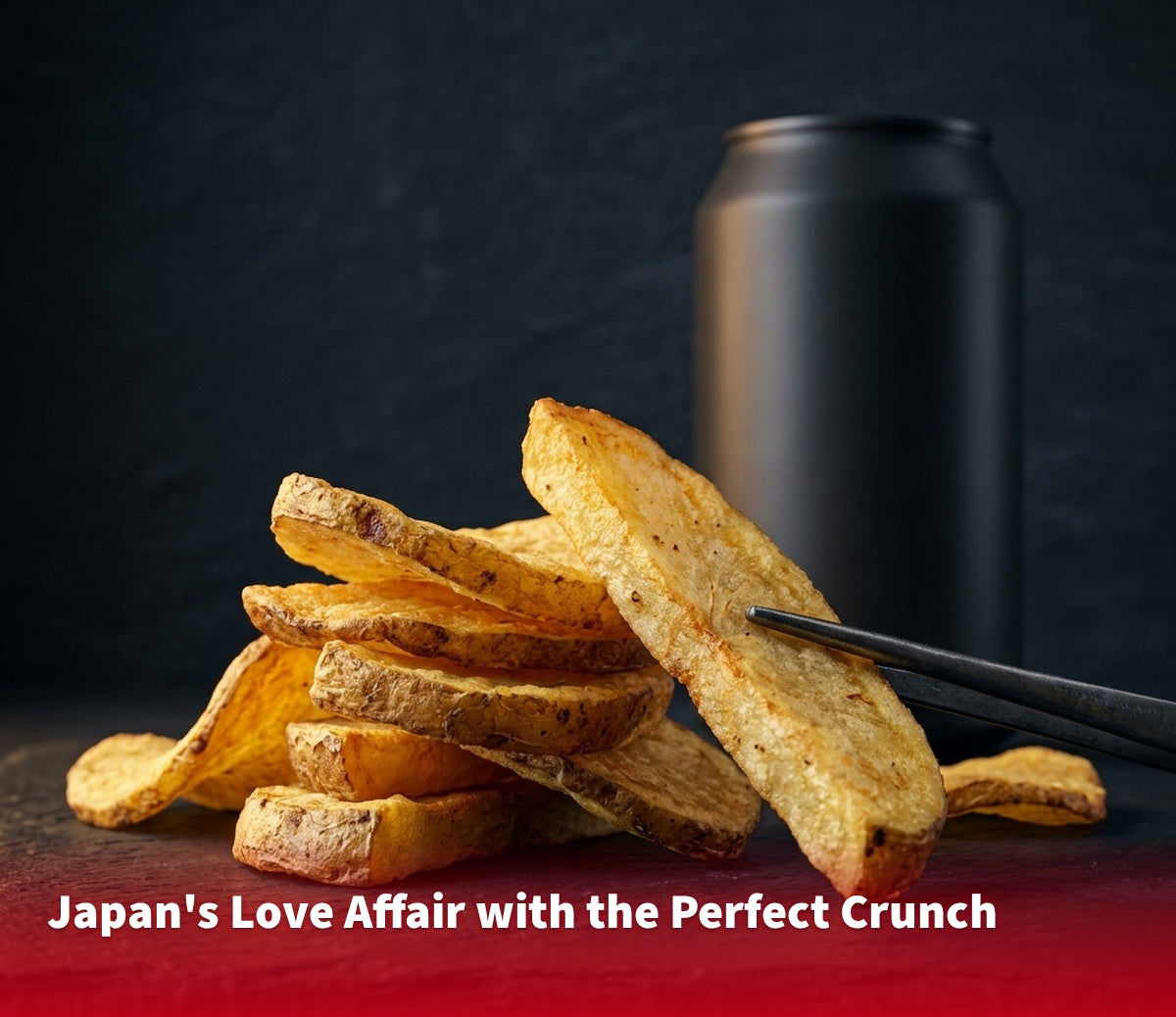

There is a moment, when you bite into a Kataage Potato chip, that separates it from every other chip you have ever eaten. It does not shatter. It does not crumble. It resists. Your jaw meets something dense and unyielding, and for a fraction of a second you wonder if the chip is going to win. Then it gives way with a deep, explosive crack — not the delicate tinkling of a thin chip breaking, but a full-bodied, almost percussive snap that you can feel in your molars.
That moment of resistance — that deliberate, engineered hardness — is the entire point. In a snack market that had spent decades perfecting lightness, thinness, and the gossamer shatter of a standard potato chip, Calbee did something radical in 1993: they made a chip that was hard on purpose. Not stale-hard. Not overcooked-hard. A specific, satisfying, precisely calibrated hardness that turned the act of biting into a sensory event.
This is the story of Kataage Potato — the chip that bet against everything the industry believed about what a potato chip should be, and won.
Want to explore the brand behind the crunch? Browse Calbee products at Tokyo Stash.
What You'll Learn
- 1) The hardness revolution: why Calbee bet against thin
- 2) Kettle-fried: the method behind the crunch
- 3) The beer pairing chip: Kataage after dark
- 4) Seven regional flavors and beyond
1) The Hardness Revolution: Why Calbee Bet Against Thin
To understand why Kataage Potato was revolutionary, you need to understand what the Japanese chip market looked like in the early 1990s. It was, to put it simply, a world obsessed with thinness.
Calbee's own flagship — Potato Chips Usushio (lightly salted) — had defined the category since 1975. These were exactly what you would expect if you grew up eating Lay's or Pringles: thin-cut, light, crispy, engineered to dissolve almost instantly on the tongue. The ideal chip was one you barely had to chew. It shattered against the roof of your mouth, released a burst of salt and potato flavor, and then it was gone. You reached for the next one almost involuntarily. That frictionless, compulsive eating cycle was the goal.
Every major competitor followed the same playbook. Koikeya, Yamayoshi, Bourbon — all of them pursued thinner cuts, lighter textures, more delicate crunch. The assumption, embedded so deeply in the industry that nobody questioned it, was straightforward: thin equals good. A chip that required effort to eat was a chip that had gone wrong somewhere in production.
In 1993, Calbee's product development team asked a question that challenged this orthodoxy head-on: What if the effort was the point?
The premise was counterintuitive but grounded in a real observation about how people actually experienced texture. Thin chips provided instant gratification — a quick burst of crunch followed by rapid dissolution. But that very speed meant the experience was fleeting. You barely registered each individual chip before it was gone. What if, instead, you slowed the experience down? What if each chip demanded your full attention — required you to bite through real resistance, to engage your jaw muscles, to feel the crunch propagate through your teeth before the chip finally surrendered its flavor?
The name they chose announced the concept with almost confrontational directness: Kataage Potato. The word kata (堅) means hard, firm, rigid. Age (揚げ) means fried. Hard-fried. Not "crispy-fried" or "golden-fried" or any of the soft, appetizing adjectives that chip marketing typically relies on. Hard-fried. The name was a promise and a warning: this chip will fight back.
The product itself delivered on that promise in a way that shocked the market. Kataage chips were thick-cut — visibly, obviously thicker than anything else on the shelf. They were dense. They were heavy in the hand. When you held one up to the light, you could not see through it the way you could with a standard chip. And when you bit into one, the texture was unlike anything else in the category. There was genuine resistance, a solidity that made you feel like you were eating something substantial rather than something designed to disappear.
The industry response was skeptical. Conventional wisdom said consumers did not want to work for their snacks. But Calbee had identified a desire that nobody else had bothered to notice — a craving for textural substance, for the satisfaction of biting through something that pushed back. Kataage did not just sell well. It became a phenomenon. Within a few years of its launch, it had carved out an entirely new sub-category in Japanese chip culture: the hard-fried chip, a product class that had not existed before Calbee willed it into being.
Thirty years later, Kataage Potato remains one of Calbee's top sellers — not as a nostalgic holdover, but as an active, growing brand that continues to attract new consumers. The bet against thin was not a gamble. It was a revelation about what people had wanted all along but never had the option to choose.
2) Kettle-Fried: The Method Behind the Crunch
The hardness of Kataage Potato is not achieved by simply cutting potatoes thicker. If that were the case, any home cook with a mandoline could replicate the texture. The secret lies in the frying method — a technique called kama-age (釜揚げ), or kettle-frying, that produces a fundamentally different kind of chip.
Standard commercial potato chips are made by continuous frying. Thin-cut potato slices travel on a conveyor belt through a long trough of oil heated to roughly 170 to 180 degrees Celsius. The process is fast — typically under three minutes from raw slice to finished chip. The high temperature rapidly evaporates surface moisture, creating the characteristic puffed, blistered texture of a conventional chip. The inside stays relatively porous and airy, which is why a thin chip shatters so easily when you bite it. There is very little structural density to resist your teeth.
Kataage uses a different approach entirely. The thick-cut potato slices are fried in smaller batches — not on a continuous conveyor, but in batches within a vessel, a kama (釜, literally "kettle" or "cauldron"). The oil temperature is lower, and the frying time is longer. This combination — lower heat, longer exposure — changes the physics of what happens inside the potato slice.
At lower temperatures, moisture leaves the potato more gradually. Instead of the violent, rapid evaporation that creates air pockets in a standard chip, the water departs slowly and steadily, allowing the starch structure to compact and densify rather than puff up. The result is a chip with significantly less internal air and significantly more solid potato matter per square centimeter. That density is what your teeth encounter as hardness — the chip is not tougher because of a coating or an additive, but because there is simply more potato in each bite.
The longer frying time also concentrates flavor. As moisture leaves the potato, the sugars and starches that remain undergo more extensive Maillard reactions — the same browning chemistry that gives seared steak its crust and toasted bread its aroma. A Kataage chip has a deeper, more complex potato flavor than a standard thin-cut chip, precisely because the frying process has had more time to develop those flavors. The taste is roastier, nuttier, more intensely "potato" in a way that is hard to describe until you have tasted both side by side.
Western readers may recognize a parallel here. The kettle-chip tradition in the United States — brands like Cape Cod, Kettle Brand, and Utz — uses a similar batch-frying concept. These chips are thicker and crunchier than mainstream chips like Lay's or Ruffles, and they have built a loyal following based on that textural distinction. But Kataage takes the concept further. The cuts are thicker. The frying time is longer. The moisture removal is more extreme. Where an American kettle chip is pleasantly firm, a Kataage chip is genuinely, unmistakably hard. The gap between a Kettle Brand chip and a Lay's Classic is noticeable. The gap between a Kataage chip and a Lay's Classic is a chasm.
And then there is the sound. This is not a minor detail — it is central to the Kataage experience. In Japanese food culture, the sound of eating is not an embarrassment to be muffled; it is an integral part of sensory pleasure. Slurping ramen is expected. The crisp snap of fresh tempura batter is a sign of quality. And the crunch of a chip is not background noise — it is information. It tells you about freshness, texture, and craftsmanship.
Kataage's crunch produces what Japanese onomatopoeia calls a bari-bari (バリバリ) sound — a loud, aggressive, almost violent crunching that is fundamentally different from the light pari-pari (パリパリ) of a thin chip. Pari-pari is delicate, papery, gentle. Bari-bari is forceful and emphatic. It is the sound of something substantial being broken by deliberate effort. When you eat Kataage in a quiet room, people notice. The crunch announces itself. And for Kataage's devoted fans, that volume is not a drawback — it is part of the satisfaction. The louder the crunch, the better the chip. The audible feedback loop — bite, crack, chew, repeat — becomes almost meditative in its rhythm.
Calbee understood from the beginning that Kataage's texture was not just a product feature but an identity. Every piece of marketing, every package design, every product extension has reinforced the same message: this chip is hard, and the hardness is the reason you are here. It is a remarkably disciplined position for a snack brand. Where competitors chase novelty through ever more exotic flavors and gimmicks, Kataage's promise has remained unchanged for three decades: we are the hard chip.
3) The Beer Pairing Chip: Kataage After Dark
In Japan, the phrase otsumami (おつまみ) refers to small dishes eaten alongside alcoholic drinks — not a full meal, but a series of bites designed to complement and extend the drinking experience. Otsumami culture is ancient, rooted in the izakaya tradition of small plates shared over sake and beer. Edamame, yakitori, dried squid, pickled vegetables — these are the classics. But in the modern era, packaged snacks have earned their place at the table, and no chip occupies the otsumami category more convincingly than Kataage Potato.
The pairing works on multiple levels, and understanding why reveals something important about how Japanese consumers think about the relationship between food and drink.
Duration. A thin chip is gone in one bite. You eat it, and it is over. Your hand reaches for the next one within seconds. This is fine for casual snacking, but it is wrong for drinking. When you are nursing a beer over 30 or 40 minutes, you want each bite to last. Kataage's density means each chip takes longer to eat. You bite, you chew, you work through the resistance, and by the time you swallow, a meaningful interval has passed. The chip slows you down, matching the unhurried pace of after-work drinking. One small bag of Kataage can accompany two or three beers without running out — a feat that a bag of thin chips cannot manage.
Flavor intensity. Beer has strong, complex flavors — the bitterness of hops, the yeast-forward richness of a Japanese lager, the carbonation that scrubs and refreshes the palate. A delicate, lightly salted thin chip gets overwhelmed by all of that. Its subtle potato flavor disappears beneath the beer's assault. Kataage, with its concentrated, deeply roasted potato flavor and bold seasoning, stands its ground. The chip's intensity matches the beer's intensity. Neither overpowers the other. They coexist as equals, which is the definition of a good pairing.
Textural contrast. Beer is liquid, cool, and effervescent. The most satisfying otsumami provide a counterpoint — something solid, warm (in temperature terms, room temperature), and resistant. The hard crunch of Kataage creates a stark textural contrast against the smoothness of beer, making each sip feel more refreshing and each bite feel more substantial. This back-and-forth between crunch and liquid is deeply pleasurable in a way that is difficult to articulate but immediately obvious when experienced.
Calbee recognized Kataage's affinity for beer early on and has leaned into it with deliberate marketing strategy. The Black Pepper flavor — coarsely ground black pepper over the classic hard-fried potato base — was developed explicitly as a beer companion. The pepper adds a slow-building heat that amplifies the thirst cycle: bite, crunch, heat, sip, relief, repeat. It is, by wide consensus among Japanese snack enthusiasts, the quintessential beer chip. Walk into any Japanese convenience store after 6 PM and watch what people pick up alongside their canned beer. Black Pepper Kataage will be in an outsized proportion of those baskets.
This adult positioning is no accident. Calbee has carefully segmented its chip brands by occasion and demographic. Standard Potato Chips — the thin, light, classic line — are positioned for broad, family-friendly consumption. The packaging is bright and cheerful. The flavors are gentle and approachable. They are afternoon snacks, lunchbox additions, picnic food. Kataage occupies a different territory entirely. Its packaging uses darker colors — deep blues, blacks, golds. The typography is more restrained. The imagery suggests evening, sophistication, deliberation. It is not marketed to children and teenagers. It is marketed to adults who drink.
This extends to retail placement. In Japanese convenience stores — the true nerve center of the country's snack ecosystem — Kataage is frequently positioned near the beer cooler, not in the main snack aisle. Stores like 7-Eleven, Lawson, and FamilyMart have become increasingly sophisticated about adjacency merchandising, placing complementary products near each other to encourage bundled purchases. The beer-and-Kataage pairing is one of the most reliable combinations in the Japanese konbini playbook.
The evening consumption pattern also connects to a broader cultural phenomenon: hitori nomi (ひとり飲み, solo drinking). In Japan, drinking alone is not stigmatized the way it sometimes is in Western cultures. It is seen as a legitimate form of relaxation — a quiet moment of self-care after a long workday. The convenience store makes this easy: pick up a tall can of Asahi or Suntory, grab a bag of Black Pepper Kataage, and settle in for an hour of solitude. The chip's slow, deliberate eating pace and its bold, assertive flavor profile make it the ideal companion for this particular ritual. It is not party food. It is not sharing food. It is your food, for your evening, at your pace.
4) Seven Regional Flavors and Beyond
Kataage Potato's identity is built on a paradox. The brand's core promise — hardness, density, the crunch that fights back — is unchanging. But within that fixed textural framework, Calbee has built an extraordinary range of flavors, from permanent staples to regional exclusives to limited-edition experiments that appear for a few weeks and vanish.
The permanent lineup anchors the brand. Usushio (うすしお, light salt) is the original and the purest expression of Kataage's philosophy. The seasoning is minimal — just enough salt to highlight the concentrated potato flavor that the kettle-frying process creates. If you want to understand what Kataage is about at its most fundamental level, Usushio is where you start. Every other flavor is a variation on this theme.
Black Pepper, as discussed, is the beer companion. The coarsely ground pepper delivers a slow heat that builds with each chip, creating a momentum that makes the bag difficult to put down. Consomme rounds out the core trio — a savory, faintly sweet seasoning inspired by the French stock that Japanese cuisine adapted decades ago into its own distinct flavor category. Japanese consomme flavor is not what a French chef would recognize; it is gentler, more umami-forward, with a hint of onion sweetness that makes it oddly comforting.
But the real adventure begins with the gotochi (ご当地, regional) editions — limited flavors tied to specific Japanese regions and sold primarily in those areas.
Kansai Dashi-Joyu (関西だし醤油) captures the flavor soul of western Japan. Dashi — the kelp-and-bonito stock that underpins virtually all Japanese cooking — is combined with joyu (soy sauce) in the Kansai style, which is lighter and more delicate than the darker, stronger soy sauce favored in Tokyo and eastern Japan. The result is a chip seasoned with deep umami but none of the heaviness you might expect from soy sauce. It tastes like the broth at the bottom of a perfect bowl of udon — savory, clean, and quietly complex. This flavor is a love letter to Osaka, Kyoto, and the entire Kansai culinary tradition.
Kyushu Yuzu-Kosho (九州柚子胡椒) represents the bold, assertive flavors of Japan's southwestern island. Yuzu-kosho is a condiment made from yuzu citrus peel, chili peppers, and salt — fermented together into a paste that is simultaneously citrusy, spicy, and salty. It is one of those Japanese ingredients that, once you have tasted it, you wonder how you ever ate without it. On a Kataage chip, yuzu-kosho's bright acidity and gentle heat cut through the chip's dense potato richness, creating a pairing that feels both surprising and inevitable.
Hokkaido Butter (北海道バター) draws on the island's legendary dairy. Hokkaido's butter has a richness and sweetness that Japanese consumers prize above all other domestic dairy, and the flavor translation onto a hard-fried chip is remarkably faithful. The butter seasoning does not taste artificial or heavy-handed. It tastes like someone melted a pat of real Hokkaido butter onto a freshly fried chip — creamy, slightly sweet, and luxuriously rich without being greasy. Of all the gotochi editions, this is often the most popular with first-time tasters, because the flavor reference point — butter on a potato — is universal and immediately satisfying.
These regional flavors serve multiple purposes simultaneously. For locals, they are a source of pride — an affirmation that their region's culinary identity is important enough to be celebrated on a national brand. For travelers, they function as omiyage (お土産, souvenir gifts) — edible postcards that carry the taste of a place back home. For Calbee, they drive repeat purchases and create reasons for consumers who already own the Usushio and Black Pepper to try something new without leaving the Kataage family.
Beyond the gotochi editions, Calbee regularly releases seasonal and limited-edition Kataage flavors that rotate through convenience stores on cycles of roughly four to eight weeks. These might be collaborations with seasoning brands, tie-ins to seasonal ingredients, or experiments that test whether a new flavor profile works with the hard-fried format. Some of these limited runs become so popular that they earn a permanent or semi-permanent place in the lineup. Others disappear after a single production run, becoming the kind of snack-world ephemera that collectors and food bloggers document with something approaching archaeological devotion.
The premium sub-line, Kataage PRIDE POTATO, pushes the brand further upmarket. PRIDE POTATO uses select potato varieties and refined seasoning blends, positioning itself as a connoisseur's chip — the kind of product you buy when you want to treat the experience of eating a potato chip as something worthy of genuine attention. The packaging is more restrained, the price point higher, and the flavors more sophisticated. It is Kataage's answer to the premiumization trend sweeping Japanese food culture, where consumers increasingly want to pay more for better versions of everyday products.
What is remarkable about Kataage's flavor expansion is how completely the core identity survives every variation. Whether you are eating Usushio or Yuzu-Kosho, Hokkaido Butter or PRIDE POTATO, the first thing you notice is always the same: the hardness. The thick cut. The dense, resistant texture. The bari-bari crunch. The flavor changes; the experience does not. Calbee has managed something that few food brands achieve — building a diverse, evolving product family on a single, non-negotiable textural principle. The hardness is not one attribute among many. It is the brand.
Conclusion: The Crunch That Became a Category
Kataage Potato's story is, at its core, a story about the courage of doing the opposite. In 1993, every signal in the market said chips should be thin, light, and effortless to eat. Calbee made a chip that was thick, dense, and required genuine effort. The industry said consumers wanted frictionless snacking. Calbee discovered that some consumers wanted friction — that the resistance was not a flaw but a feature, and that the satisfaction of biting through something solid ran deeper than the pleasure of something that dissolved on contact.
Three decades later, Kataage has not softened. It has not compromised. The chip is still hard. The crunch is still loud. The bari-bari still echoes. And every evening, in convenience stores across Japan, people reach for a bag of Black Pepper Kataage alongside their beer, settling into the slow, deliberate rhythm of crunch-sip-crunch that has become one of the small, reliable pleasures of Japanese daily life.
The next time you hold a Kataage chip between your fingers, notice its weight. Feel its density. And when you bite down, pay attention to that moment of resistance — that fraction of a second when the chip pushes back before it gives way. That moment is not an accident. It is thirty years of engineering, a single audacious bet, and an entire philosophy of snack-making, compressed into one very hard, very satisfying crunch.
Ready to experience the crunch for yourself? Explore Calbee's Kataage Potato and more at Tokyo Stash.
Explore more Japanese snacks and culture stories on Tokyo Stash.