
Every January, something unusual happens in Japan's convenience stores. Alongside the usual chocolate displays, KitKat boxes appear with handwritten messages scrawled across their packaging. Students line up not for the taste, but for the luck.
In a country where a chocolate bar doubles as a good luck charm, where a single brand has released over 400 flavors, and where matcha-flavored wafers outsell the original chocolate, KitKat's Japanese story is unlike anything its British creators could have imagined. This is not a tale of corporate marketing genius. It is a story of a happy linguistic accident, a nation's gift-giving obsession, and one flavor that changed everything.
Curious about the matcha flavor that started a revolution? Browse KitKat products at Tokyo Stash.
What You'll Learn
- 1) How a pun turned chocolate into a lucky charm
- 2) The strategy behind 400+ flavors
- 3) Why this only works in Japan
- 4) The matcha flavor that changed everything
1) How a Pun Turned Chocolate Into a Lucky Charm
The story begins not in a Nestle boardroom, but in a hotel lobby in Kyushu.
In the mid-1990s, a hotel manager in Fukuoka noticed a peculiar pattern. Every winter, around January and February, guests—mostly families with teenagers—kept buying KitKats from the hotel gift shop. When he asked why, the answer was always the same: "Kitto katsu" sounds like "kitto, katsu"—a Japanese phrase meaning "you will surely win."
This was not something Nestle Japan had planned. The connection was organic, born from how Japanese ears heard a foreign brand name. In the Kyushu dialect, the phrase carried an even stronger resonance. Parents were handing KitKats to their children before university entrance exams—one of the most stressful rites of passage in Japanese life—as edible talismans.
When Nestle Japan's marketing team caught wind of this grassroots tradition, they did something smart: instead of inventing a campaign, they amplified what was already happening. In 2002, they launched the first official "Kit Kat for Exam Season" packaging, printed with encouraging messages. By 2003, they introduced mail-able KitKat boxes—special packaging shaped like a postcard that could be sent through Japan Post. Families, friends, and even teachers began mailing KitKats to students with handwritten wishes on the box itself.
Today, the exam season KitKat is an institution. Every year between December and February, limited-edition packages appear with spaces for personal messages. Some shrines have even stocked KitKats alongside traditional omamori (protective amulets). The tradition has expanded beyond exams to job interviews, driving tests, and sports tournaments. A chocolate bar that started as a British teatime biscuit became, in Japan, something closer to a prayer.
2) The Strategy Behind 400+ Flavors
If the "kitto katsu" phenomenon gave KitKat cultural relevance, the flavor strategy gave it commercial immortality.
The architect of Japan's KitKat flavor revolution was Takagi Yasumasa, a product developer at Nestle Japan who understood something fundamental about Japanese consumers: they do not want the same thing every day. In a culture where convenience stores rotate their entire snack lineup every few weeks and seasonal limited editions drive foot traffic, a single flavor of anything is a death sentence for excitement.
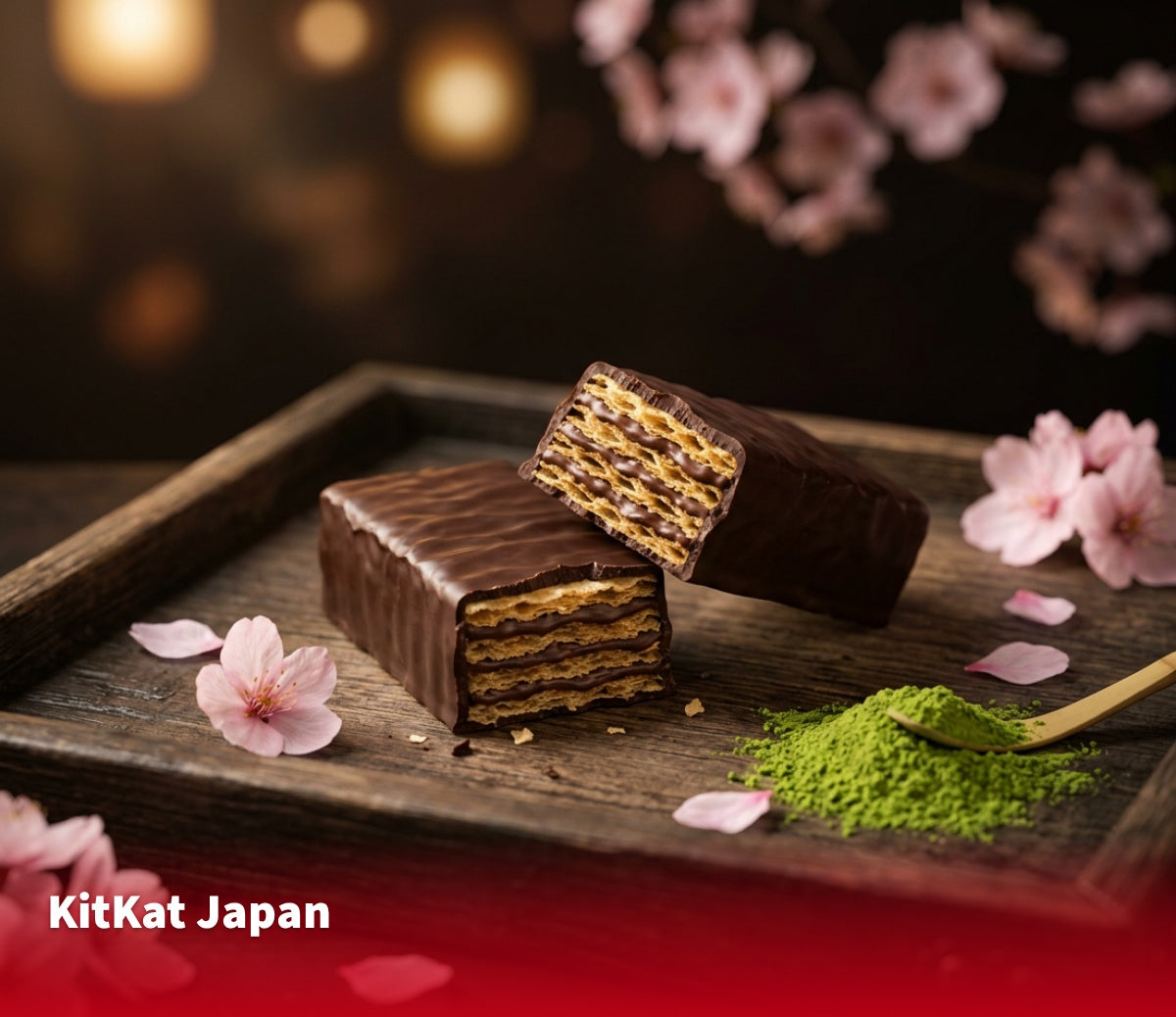
Takagi's first big experiment was strawberry KitKat, launched in 2003. It sold well, but the real breakthrough came with matcha (green tea) KitKat, developed in collaboration with Kyoto's tea culture. The bitterness of real matcha powder against the sweetness of white chocolate was an instant sensation. It proved that KitKat could be more than candy—it could be a vehicle for Japanese flavors.
What followed was an avalanche. Nestle Japan began treating KitKat the way traditional wagashi (Japanese confectionery) makers treat their seasonal offerings. Spring brought sakura (cherry blossom). Summer introduced citrus yuzu. Autumn delivered chestnut. Winter circled back to rich chocolate and strawberry. But the real genius was the regional flavor program.
Japan's 47 prefectures each have signature foods, and KitKat mapped its flavors onto this geography. Hokkaido got melon and Yubari cantaloupe. Kyoto claimed premium matcha with Uji tea. Okinawa received beni-imo (purple sweet potato). Tokyo was paired with strawberry cheesecake. Shinshu offered apple. Yokohama introduced strawberry cheesecake. Each flavor was sold primarily in its home region, turning KitKat into a collectible souvenir.
By 2024, Nestle Japan had produced over 400 distinct flavors. Some were serious (sake, roasted tea, wasabi). Some were playful (baked potato, melon with mascarpone). Some were collaborations with renowned patissiers—most notably Takagi Yasumasa's partnership with Le Patissier Takagi for the premium "Chocolatory" line, where single bars sold for 300 to 500 yen each. The sheer variety transformed KitKat from a mass-market snack into Japan's most versatile confectionery platform.
3) Why This Only Works in Japan
Outside Japan, KitKat is a vending machine chocolate bar. Inside Japan, it is a souvenir, a gift, a lucky charm, and a collectible. The difference comes down to three cultural forces that have no real equivalent in the West.
The first is omiyage—the Japanese tradition of bringing back gifts from every trip. When you travel to Hokkaido, you are expected to return with something for your coworkers, your neighbors, your family. This is not optional; it is a social obligation woven into daily life. Regional KitKat flavors slotted perfectly into this tradition. A box of Hokkaido melon KitKats from New Chitose Airport costs around 800 yen, looks beautiful, and is individually wrapped for easy distribution at the office. It is the ideal omiyage.
The second force is individual wrapping. Every single KitKat Mini in Japan comes in its own sealed packet. To Western eyes, this seems like excessive packaging. To Japanese consumers, it is essential. Individual wrapping means each piece can be shared without anyone touching the others. It means you can tuck one into a lunch bag, hand one to a friend, or place one on a colleague's desk. This shareability is not a packaging detail—it is a design philosophy.
The third force is seasonal rotation. Japanese consumers expect novelty. The convenience store model—where products cycle in and out on roughly monthly schedules—has trained shoppers to buy now or miss out. Limited-edition KitKat flavors tap directly into this psychology. When Nestle releases a sakura-flavored KitKat in March, consumers know it will vanish by April. This scarcity creates urgency, social media buzz, and repeat visits.
Together, these three forces—omiyage obligation, individual wrapping, and seasonal scarcity—created an ecosystem where a single chocolate brand could sustain 400+ flavors. In the United States or Europe, where candy is bought for personal consumption and novelty flavors are viewed with suspicion, this model would collapse. In Japan, it thrives because KitKat understood something essential: the snack is not just about eating. It is about giving, sharing, and connecting.
4) The Matcha Flavor That Changed Everything
Of the 400+ flavors, one stands above the rest. Not sake. Not strawberry. Not any of the exotic regional editions. The flavor that redefined KitKat in Japan—and eventually the world—is matcha.
When matcha KitKat first appeared in the early 2000s, it was positioned as a novelty: a limited regional flavor tied to Kyoto's tea heritage. The combination of Uji matcha powder with white chocolate produced a flavor profile that was bitter, sweet, and deeply aromatic—nothing like the cloying sweetness of standard chocolate. Japanese consumers recognized it instantly as something that belonged to their palate, not an imported taste.
The numbers tell the story. By the 2010s, matcha had overtaken milk chocolate as the best-selling KitKat variety in Japan. Not a seasonal spike. Not a limited-edition curiosity. The permanent, year-round, top seller. In a country that invented the product category of matcha-flavored sweets, KitKat's version became the benchmark.
The impact rippled outward. International tourists visiting Japan began buying matcha KitKats by the armful—not as novelties, but as the definitive Japanese souvenir snack. Duty-free shops at Narita and Kansai airports stacked them floor to ceiling. Social media posts from travelers made matcha KitKat one of the most photographed snacks in the world. Nestle eventually began exporting matcha KitKat to select international markets, where it became a gateway product—the first Japanese snack many Western consumers ever tried.
What matcha KitKat proved was that Japanese taste innovation was not a niche curiosity. It was commercially powerful enough to reshape a global brand's identity in its second-largest market. The flavor that started as a Kyoto experiment became the reason millions of people associate KitKat with Japan rather than with England, where Rowntree's first manufactured it in 1935.
Conclusion: More Than a Chocolate Bar
KitKat's Japanese journey is a story about listening. Nestle did not invent the "kitto katsu" tradition—they noticed it and honored it. They did not force 400 flavors onto a reluctant market—they studied how Japanese people buy, give, and share, then built a product system around those habits.
The result is a chocolate bar that functions as a lucky charm during exam season, a souvenir from every corner of Japan, a vehicle for seasonal flavors, and—in its matcha incarnation—a cultural ambassador that introduced the world to Japanese snack innovation.
Next time you unwrap a matcha KitKat, consider what you are holding. It is not just a wafer covered in green tea chocolate. It is a linguistic accident, a gift-giving tradition, a regional identity, and a quiet revolution in how the world thinks about Japanese flavor—all compressed into a single, snappable bar.
Ready to taste the matcha revolution? Shop KitKat at Tokyo Stash and discover why Japan made this chocolate bar its own.
Explore more Japanese snacks and culture stories on Tokyo Stash.