
Pick up a bar of Hershey's or Cadbury, and your instinct is to bite. Snap off a piece, chew, swallow. That's how most of the world eats chocolate.
Now try a piece of Japanese chocolate. Place it on your tongue. Don't chew. Just wait. Within seconds, it begins to dissolve—slowly, smoothly, releasing waves of cocoa flavor as it liquefies against the roof of your mouth. The experience is so different that it almost feels like a different food.
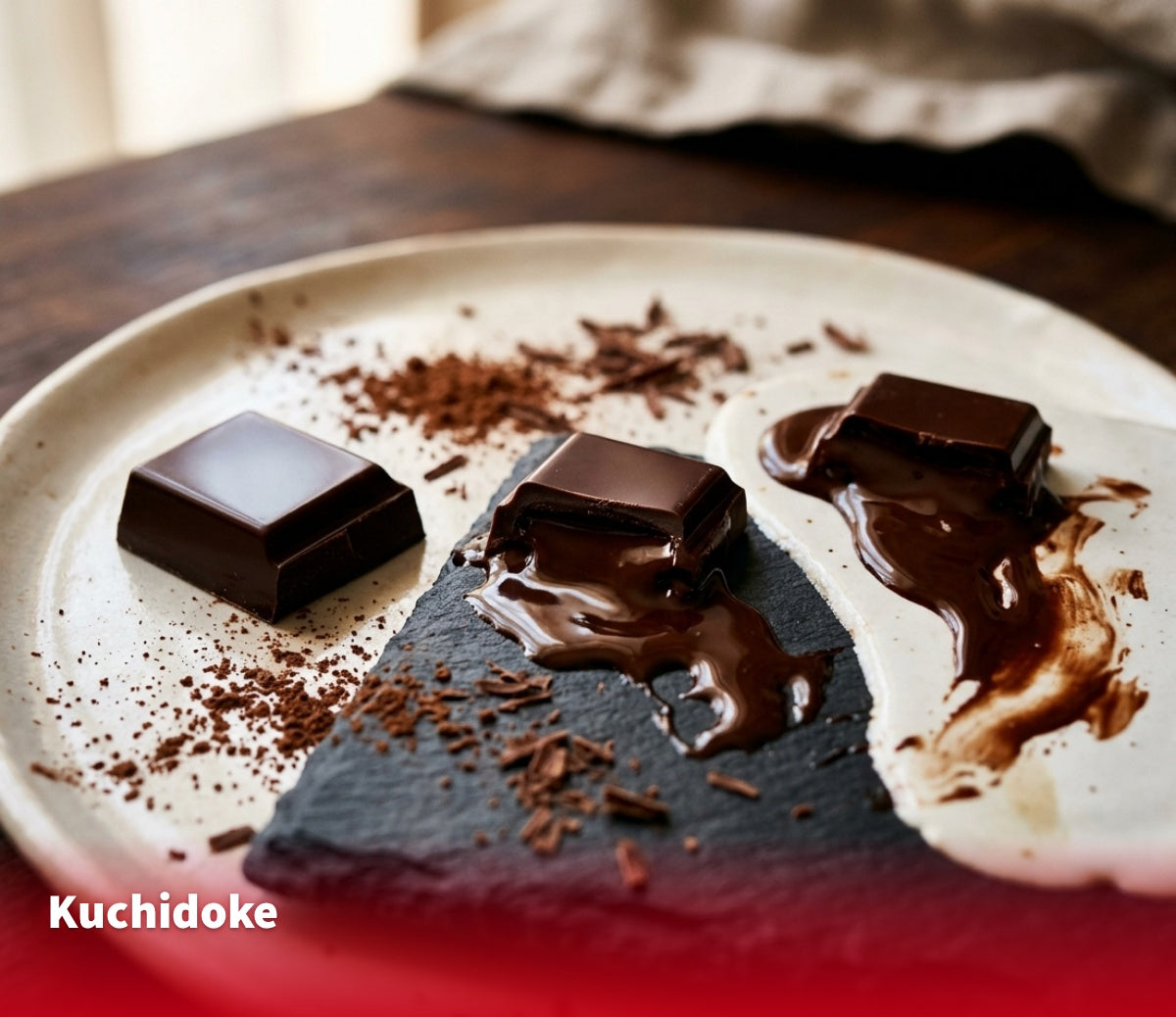
This isn't an accident. Japanese chocolate is engineered to melt before you chew. The Japanese have a word for this: "kuchidoke" (mouth-melt)—and it is the single most important design principle in Japanese chocolate making.
Curious to taste the difference? Browse Japanese chocolate at Tokyo Stash.
What You'll Learn
- 1) "Kuchidoke"—the concept that has no English name
- 2) The science: conching, tempering, and the 34°C secret
- 3) Three products, three ways to experience the melt
- 4) Why Japan became obsessed with mouth-melt
1) "Kuchidoke"—The Concept That Has No English Name
English has "melt-in-your-mouth." French has "fondant." But neither captures what the Japanese mean by "kuchidoke" (口どけ). The word combines kuchi (mouth) and tokeru (to melt), and it describes not just a sensation but a philosophy of how chocolate should be experienced.
In the Western tradition, chocolate's job is to deliver flavor efficiently. You bite, chew, taste, swallow. Texture matters—nobody wants gritty or waxy chocolate—but the emphasis is on the taste profile: how bitter, how sweet, how much cocoa.
Japanese chocolate makers approach the problem from the opposite direction. For them, the experience of dissolving is the product. Flavor is important, but it is secondary to the tactile journey of chocolate transforming from solid to liquid on your tongue.
This is why Japanese packaging constantly features the word kuchidoke. When Meiji promotes its premium line, they lead with "exceptional kuchidoke," not "rich cocoa flavor." When Morinaga describes DARS, the first claim is about its melt, not its taste. The hierarchy is clear: melt first, flavor second.
The difference becomes obvious when you compare. Hand someone a Hershey's Kiss, and they'll chew immediately. Hand them a piece of Meiji THE Chocolate and tell them to let it sit. The chocolate softens within 5 seconds. By 15 seconds, it has spread into a velvety layer across the palate. By 30 seconds, flavor notes emerge that chewing would have destroyed—subtle fruit, gentle roast, a faint floral finish. The chocolate is communicating, but only if you're patient enough to listen.
2) The Science: Conching, Tempering, and the 34°C Secret
Kuchidoke is not magic. It is chemistry, physics, and decades of manufacturing precision.
Conching: the long stir
"Conching" is the process of continuously mixing and aerating melted chocolate. Invented by Rodolphe Lindt in 1879, it remains one of the most critical steps in production. During conching, rough cocoa particles are ground finer, harsh acids evaporate, and fat molecules redistribute evenly.
Here's where the gap appears. Western producers typically conch for 12 to 24 hours—enough for smooth, palatable chocolate. Japanese manufacturers like Meiji and Morinaga routinely conch premium products for 48 to 72 hours or more. The extended process reduces particle size below 20 microns—smaller than your tongue can detect as individual grains. The result is a texture so smooth it feels like liquid silk before it even melts.
Tempering: crystal architecture
"Tempering" is the controlled heating and cooling of chocolate to form a specific crystal structure. Cocoa butter can solidify into six crystal forms, but only Form V produces the satisfying snap, glossy sheen, and smooth melt of good chocolate.
Japanese factories monitor temperature transitions in fractions of a degree, using proprietary cooling tunnels that guide crystallization with extraordinary control. The result: chocolate that snaps cleanly when broken but begins to melt the instant it contacts your tongue—because Form V crystals are calibrated to destabilize at 34°C, the surface temperature of the human tongue.
Western chocolate often sits at 35-36°C, meaning a few extra seconds before it softens in the mouth. Japanese chocolate starts melting the moment it touches you.
Fat bloom: the white powder myth
White spots on chocolate? That's "fat bloom"—cocoa butter that migrated to the surface and recrystallized. It looks alarming but is purely cosmetic. The chocolate is perfectly safe and usually tastes the same. Japanese packaging often includes a note explaining this, reflecting the kuchidoke mindset: what matters is not appearance but how it feels in your mouth.
3) Three Products, Three Ways to Experience the Melt
Theory is useful, but kuchidoke is a physical experience. Here are three products that demonstrate it differently—with a specific instruction for each.
DARS: the 12-piece meditation
DARS by Morinaga is 12 individually molded chocolate pieces designed for one ritual: place a piece on your tongue and let it melt without chewing. A single piece takes 40 to 60 seconds to dissolve, with flavor unfolding in stages—initial sweetness, deeper cocoa, then a clean milky finish.
Try this: Eat the first piece by chewing normally. Eat the second by letting it melt completely. The melted piece will taste richer and more complex, because slow dissolving lets flavor compounds contact more taste receptors over a longer period.
Meiji THE Chocolate: origin as melt
Meiji THE Chocolate highlights single-origin cacao from Venezuela, Brazil, the Dominican Republic, and Peru. Each variety uses extended conching and precision tempering, but terroir creates strikingly different melt profiles. Venezuelan cacao melts quickly with bright, fruity notes. Brazilian melts more slowly with nutty, earthy undertones. The differences are dramatic—if you let the chocolate melt instead of chewing.
Try this: Place two different varieties on opposite sides of your tongue and let both melt simultaneously. The contrast in speed and flavor will teach you more about cacao terroir in 60 seconds than any book.
Alfort: the two-layer puzzle
Alfort by Bourbon is chocolate on a biscuit—two materials dissolving at different rates. Most people bite through both layers at once. Instead, place it chocolate-side down on your tongue. The chocolate melts directly against your body heat while the biscuit stays cool and intact above. After 10 to 15 seconds, the chocolate has dissolved and you're left with a butter biscuit infused with lingering cocoa. Then you chew. Two textures, experienced sequentially instead of simultaneously.
Try this: Eat one Alfort biscuit-side down (the normal way) and one chocolate-side down. Same product, entirely different sensation.
4) Why Japan Became Obsessed with Mouth-Melt
The kuchidoke obsession grows from roots that predate chocolate's arrival in Japan by centuries.
The wagashi inheritance
Long before chocolate reached Japan, the country had already perfected "wagashi" (traditional Japanese sweets). The finest wagashi—nerikiri (sculpted bean paste), yokan (jellied bean paste), mochi (pounded rice cake)—are defined by texture: smooth, yielding, dissolving. A good nerikiri collapses on the tongue without resistance. A great yokan releases sweetness in a slow, measured wave.
When Japanese confectioners started working with chocolate, they brought this sensibility with them. They didn't ask "How do we make chocolate taste good?" They asked "How do we make it feel the way our best wagashi feels?" The answer was kuchidoke.
The culture of savoring small portions
Japanese eating culture emphasizes small quantities enjoyed attentively: tiny sake cups, individual sushi pieces, a single wagashi alongside matcha. The word "hitokuchi" (one mouthful) suggests that a single bite should be a complete experience. If each piece must deliver a long, complex journey, then a chocolate that dissolves over 60 seconds provides far more sensation than one chewed and swallowed in 10. Kuchidoke is an engineering solution to this cultural expectation: make every piece last.
Texture vocabulary as driver
Japanese has one of the richest texture vocabularies of any language. Words like toro-toro (silky-melt), saku-saku (light-crisp), and fuwa-fuwa (fluffy-soft) aren't poetic extras—they're standard descriptors consumers use daily. This precision creates a feedback loop: because consumers can name fine textural differences, manufacturers must deliver them. Because manufacturers deliver, expectations keep rising. The result is an arms race of smoothness that has pushed Japanese chocolate to melt precision few other countries can match.
Conclusion: One Simple Change That Transforms Everything
Everything in this article comes down to a single action: the next time you have a piece of Japanese chocolate, don't chew it.
Place it on your tongue. Close your mouth. Wait. Let your body heat do the work. Feel the chocolate soften, spread, and dissolve. Notice the flavors at 10 seconds, at 30, at a full minute—flavors that chewing would have destroyed.
This is what Japanese chocolate makers have been designing for. Not a snack you eat quickly, but a small moment of attention. A few seconds of patience that turn an ordinary piece of chocolate into something genuinely new.
Kuchidoke isn't just a technique. It's an invitation to slow down and discover that the best part of chocolate was always there—you just had to stop chewing long enough to find it.
Ready to experience kuchidoke for yourself? Explore our chocolate collection at Tokyo Stash.
Explore more Japanese snacks and culture stories on Tokyo Stash.