
You are standing in a Japanese convenience store, holding a bag of chips you have never seen before. The packaging is covered in Japanese characters you cannot read. But right there on the front, in big, playful katakana, you spot the word サクサク. You have no idea what it says. So you do what most people do: you pick the one with the most appealing photo and hope for the best.
What if you could read that one word and know, before opening the bag, exactly how the snack would feel in your mouth? Not the flavor. The texture. That word—saku-saku—is telling you this snack will shatter into light, airy layers the moment your teeth hit it. It is a promise printed right on the package. And it is just one of more than fifty words Japanese uses to describe how food feels.
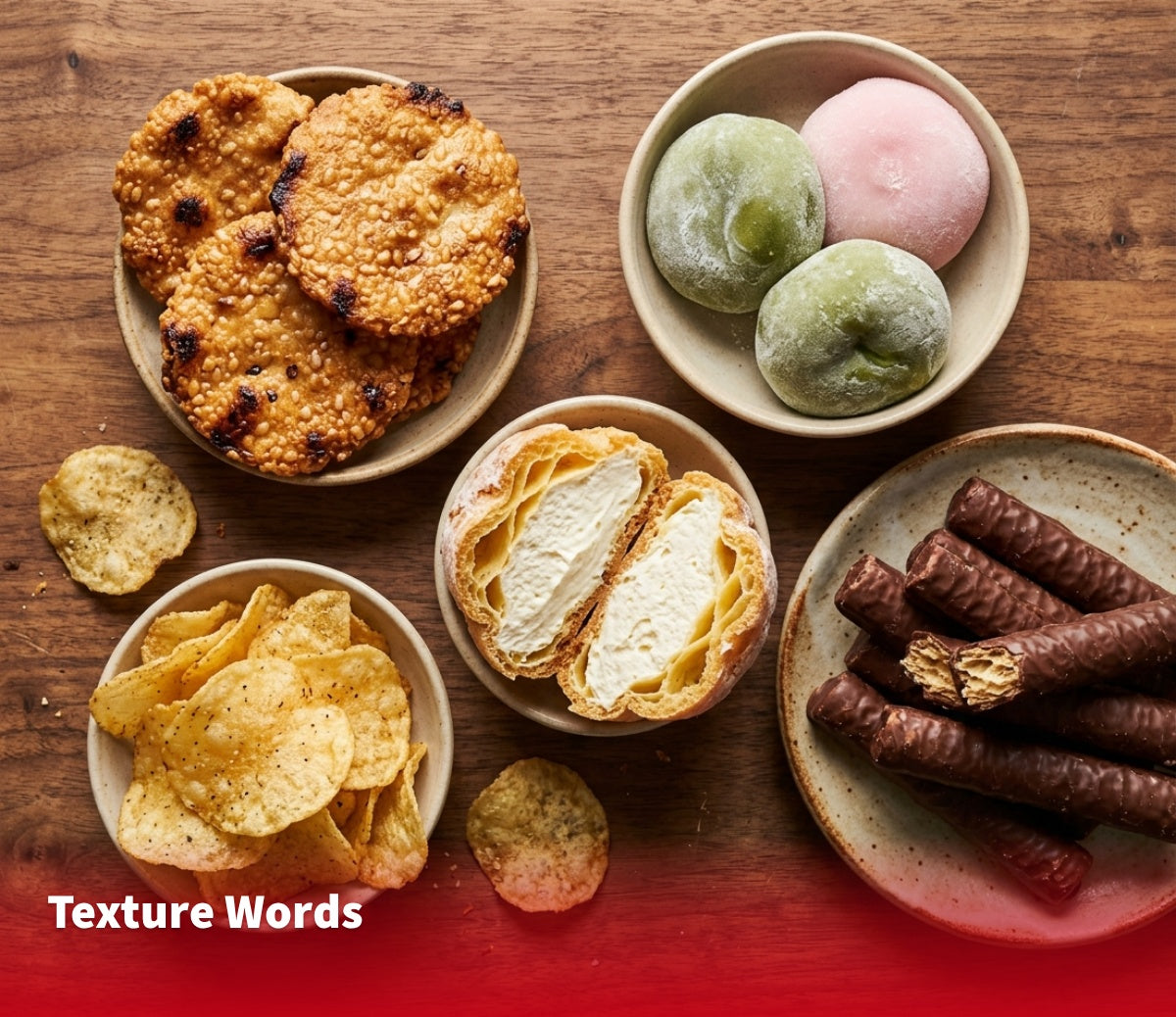
English has "crunchy" and "chewy." Maybe "crispy" on a good day. Japanese has an entire vocabulary dedicated to the way food behaves between your teeth—and snack makers put these words front and center on their packaging because Japanese consumers choose products by texture as much as by flavor. Once you learn even a handful of these words, every Japanese snack aisle becomes readable. This is your guide.
Ready to put your new vocabulary to work? Browse Japanese snacks at Tokyo Stash and see how many texture words you can spot on the packaging.
What You'll Learn
- 1) Why Japanese has 50+ words for texture (and English has about 3)
- 2) The crunchy family: saku-saku, pari-pari, kari-kari, zaku-zaku
- 3) The soft family: mochi-mochi, fuwa-fuwa, toro-toro, shittori
- 4) How to read texture clues on any Japanese package
1) Why Japanese Has 50+ Words for Texture (and English Has About 3)
Every language describes food. But Japanese does something unusual: it gives texture the same weight as flavor. In English, when someone asks how a cookie tastes, you answer with flavor words—sweet, buttery, chocolatey. In Japanese, the first response is just as likely to be about feel. "Saku-saku da yo" (it's saku-saku) is a complete and satisfying answer. No flavor information at all, and the listener nods, fully satisfied.
Linguists have a term for the type of words that make this possible: onomatopoeia. But calling Japanese texture words "onomatopoeia" undersells them badly. In English, onomatopoeia means words that imitate sounds—buzz, splash, crack. Japanese has those too. But it also has an enormous category called "gitaigo" (擬態語)—words that describe states, sensations, and textures through sound symbolism. These are not imitating a noise you can hear. They are translating a physical sensation into a sound pattern your mouth can reproduce.
When you say "mochi-mochi," your lips press together and release in a rhythm that physically mimics the act of chewing something soft and elastic. When you say "pari-pari," the sharp "p" and quick "ri" create a staccato that mirrors the snap of a thin, brittle sheet. The words do not just describe texture—they perform it.
This is not a quirk of Japanese. It is a core feature. Research published in the Journal of Texture Studies found that Japanese has over 445 onomatopoeic expressions related to food texture—more than four times the number in English, French, or Chinese. The reason goes deep into how Japanese culture relates to eating. Traditional Japanese cuisine (washoku) has always treated texture as a distinct dimension of the dining experience, equal to taste, aroma, and presentation. A bowl of udon noodles is praised for being "tsuru-tsuru" (slippery-smooth). A piece of tempura must be "saku-saku" (light and crisp). A mochi rice cake that is not "mochi-mochi" (stretchy and soft) has failed at its single most important job.
The snack industry absorbed this vocabulary completely. Walk down any Japanese snack aisle and you will see texture words printed on packages as prominently as flavor descriptions. Calbee potato chips announce their crunch type. Fujiya cookies promise their chewiness. Consumers scan these words the way English-speaking shoppers scan "spicy" or "mild." The texture word is not decoration. It is a purchase signal.
2) The Crunchy Family: Saku-Saku, Pari-Pari, Kari-Kari, Zaku-Zaku
In English, "crunchy" is a catch-all. Potato chips are crunchy. Granola is crunchy. A raw carrot is crunchy. But these three things feel completely different in your mouth. Japanese separates them with surgical precision. Here are the four most common crunchy-family words you will find on Japanese snack packaging, and what each one promises.
"Saku-saku" (サクサク) — This is the most common texture word in Japanese snacking, and it describes a light, airy crunch that collapses effortlessly. Think of a perfectly fried tempura coating, or the thin wafer layers inside a KitKat. The crunch is delicate, almost fragile—your teeth barely have to work. Saku-saku snacks shatter into layers rather than resisting your bite. When you see サクサク on a package of cookies, crackers, or coated snacks, expect something that feels like biting through thin, crispy strata of air and crumb. Calbee's Jagariko potato sticks advertise their saku-saku texture prominently—each stick has a hollow center that gives it that layered, collapsing crunch.
"Pari-pari" (パリパリ) — Pari-pari is harder, thinner, and more brittle than saku-saku. Imagine biting into a sheet of dried seaweed, or the skin of a perfectly roasted Peking duck. Pari-pari things crack sharply and cleanly—they do not crumble or shatter into pieces the way saku-saku things do. They snap. You will find this word on nori (seaweed) snacks, thin rice crackers, and any product where a flat, brittle sheet is the main texture event. If a bag of senbei (rice crackers) says パリパリ, you know they will be thin, crisp, and snappy, as opposed to the thick, hard crunch of a traditional senbei.
"Kari-kari" (カリカリ) — Kari-kari describes a hard, dense crunch—the kind that requires real jaw effort. This is the crunch of a crouton, a twice-baked rusk, or a hard pretzel. Where saku-saku collapses easily and pari-pari snaps cleanly, kari-kari resists. Your teeth have to work through it. The satisfying part is the sustained resistance followed by the final give. Kari-kari is commonly used for nuts, hard candy coatings, and heavily baked snacks. Kakinotane—the crescent-shaped rice crackers that are Japan's most popular beer snack—are quintessentially kari-kari: small, hard, and densely crunchy with every bite.
"Zaku-zaku" (ザクザク) — Zaku-zaku is the roughest, most aggressive crunch in the family. It suggests large, coarse, irregular pieces crunching against each other—like digging a shovel into gravel. In snack terms, zaku-zaku describes chunky granola, thick-cut potato chips with visible ridges, or chocolate bars loaded with large cookie pieces. The "z" sound (written with the dakuten mark that turns サ into ザ) signals heaviness and force. When Bourbon releases a chocolate bar with zaku-zaku texture, expect big, craggy cookie chunks that give real resistance, not a polite crumble.
Here is a quick reference to carry with you:
- サクサク (saku-saku) — Light, layered, airy crunch (wafers, tempura, light cookies)
- パリパリ (pari-pari) — Thin, brittle, sharp snap (seaweed, thin crackers, crispy shells)
- カリカリ (kari-kari) — Hard, dense, sustained crunch (nuts, rusks, hard rice crackers)
- ザクザク (zaku-zaku) — Rough, coarse, chunky crunch (granola, ridged chips, cookie pieces)
3) The Soft Family: Mochi-Mochi, Fuwa-Fuwa, Toro-Toro, Shittori
If the crunchy family is about how things break apart, the soft family is about how things hold together. These words describe textures that yield, stretch, melt, or cling—and they are just as precisely differentiated. Learning these four will cover the vast majority of soft-textured snacks you will encounter.
"Mochi-mochi" (もちもち) — Named after mochi, the pounded rice cake that is one of Japan's most ancient foods, mochi-mochi describes a soft, elastic, slightly sticky chewiness. It is the texture of fresh mochi, but also of gummy candies, chewy bread, and soft dumplings. The key quality is bounce-back—when you press into a mochi-mochi snack with your teeth, it compresses, then springs back before finally giving way. It is satisfying in a way that is almost addictive. You will find もちもち on packages of Japanese-style gummy candies, chewy rice cakes, and products like Daifuku (mochi filled with sweet bean paste). If you have tried UHA Mikakuto's Puccho or Kororo gummy candies, you have felt mochi-mochi in action—that dense, bouncy resistance that is nothing like the soft give of a Western gummy bear.
"Fuwa-fuwa" (ふわふわ) — While mochi-mochi is dense and elastic, fuwa-fuwa is its opposite: weightless, cloud-like softness. Think of cotton candy, angel food cake, or a perfectly steamed Japanese milk bread (shokupan). Fuwa-fuwa things feel like they might float off your plate. There is almost no resistance when you bite—they compress into nearly nothing, then dissolve. Glico's Caplico is a textbook fuwa-fuwa snack: the aerated chocolate-and-cream filling inside the cone has been whipped so full of air that it melts the moment it touches your tongue. When a Japanese snack says ふわふわ, expect something so light it barely registers as solid.
"Toro-toro" (とろとろ) — Toro-toro describes a thick, melting, almost liquid softness—the texture of something that was solid but is surrendering to warmth or richness. The word comes from the same root as "toro" (the fatty tuna belly that melts on the tongue at a sushi counter). In snacks, toro-toro refers to molten centers, rich cream fillings, or chocolate that melts in slow, velvety waves. You will see とろとろ on filled chocolates, cream-centered cookies, and caramel confections. When a Meiji chocolate truffle says toro-toro, it is promising a center that oozes rather than holds its shape—a controlled, luxurious melt.
"Shittori" (しっとり) — Shittori is perhaps the hardest texture word to translate into English. It describes something that is moist, tender, and cohesive—not wet, not dry, but perfectly, pleasantly damp. The closest English approximation might be "moist," but that word carries none of the elegance that shittori conveys in Japanese. A shittori cake is dense but tender. A shittori cookie does not crumble—it breaks cleanly but softly, holding its moisture without being gummy. Fujiya's Country Ma'am is the most famous shittori snack in Japan: a cookie that remains soft and pliant for weeks inside its wrapper, defying the normal expectation that cookies go stale. When you see しっとり on a package, expect a baked good that prioritizes tender moisture over any kind of crunch.
And a few bonus words you may encounter:
- ねっとり (nettori) — Dense, sticky, clinging (sweet potato paste, thick bean fillings)
- つるつる (tsuru-tsuru) — Slippery-smooth (noodles, jelly desserts)
- ぷるぷる (puru-puru) — Jiggly, wobbly (jelly, pudding, soft gummies)
- カチカチ (kachi-kachi) — Rock-hard (frozen treats, hard candy)
4) How to Read Texture Clues on Any Japanese Package
Here is the practical part. You do not need to read Japanese fluently to decode texture words on snack packaging. You need to recognize a few visual patterns.
Step 1: Look for repeated characters
Almost all Japanese texture words are doubled sounds. Saku-saku. Mochi-mochi. Pari-pari. This means on a package, you are looking for a short cluster of characters that repeats itself. If you see a two- or three-character group followed by the same group again, you have almost certainly found a texture word. This pattern is distinctive enough to spot even if you cannot read a single character of Japanese.
Step 2: Learn the katakana for the big four crunchy words
Crunchy-family words are almost always written in katakana—the angular, sharp-looking Japanese script (as opposed to the rounder hiragana). Here is your cheat sheet:
- サクサク — Look for: two identical three-stroke characters (サク) repeated
- パリパリ — Look for: a character with a small circle in the upper-right corner (パ), repeated pattern
- カリカリ — Look for: similar to パリパリ but without the small circle above the first character
- ザクザク — Look for: like サクサク but with two small lines (dakuten) in the upper-right of the first character
Step 3: Learn the hiragana for the big four soft words
Soft-family words are usually written in hiragana—the rounder, more flowing script. This visual difference is actually helpful: angular writing on a package signals crunchiness, while rounder writing signals softness. Snack designers use this visual psychology deliberately.
- もちもち — Look for: a rounded character (も) plus a small character (ち), repeated
- ふわふわ — Look for: a character that looks like a lowercase "h" with a loop (ふ), plus わ, repeated
- とろとろ — Look for: two small rounded characters (と + ろ), repeated
- しっとり — Look for: this one does NOT repeat; it is four characters ending in り
Step 4: Use context clues from the product type
Even without reading a single word, you can make educated guesses. Thin, flat-looking products in crinkly bags are likely to feature pari-pari or saku-saku. Round, puffy-looking items are probably fuwa-fuwa. Anything that looks like it contains mochi or rice cake will almost certainly say mochi-mochi. Dense baked goods in individual wrappers are often shittori. The texture word, when you find it, will confirm what the product shape already suggests.
Step 5: Combine texture + flavor for the full picture
Once you can identify the texture word, you have half the story. The other half—flavor—often appears as an image on the package (strawberry illustration, matcha green coloring, cheese photograph). Together, texture word plus flavor image gives you a remarkably accurate preview of what is inside. You do not need to read the ingredients list or the product name. サクサク + a picture of chocolate tells you everything: light, crispy, chocolate-coated. もちもち + a picture of strawberries means chewy, stretchy, strawberry-flavored.
Try it on your next order. Before you open any package, look for the texture word. Make your prediction. Then taste and see how close you were. Most people are surprised at how accurately these words deliver on their promise. Japanese snack makers do not use texture words loosely. When the package says saku-saku, you will get saku-saku. It is a contract between the maker and the eater, and breaking it would be unforgivable.
Conclusion: A New Way to Read Every Package
The Japanese language did something remarkable with food texture: it gave every subtle mouth-feel its own word. Not vague approximations, but precise, evocative terms that let two people communicate exactly how a snack will feel before either one takes a bite.
For English speakers, this vocabulary is not just a linguistic curiosity. It is a practical tool. The twelve words covered in this article appear on the packaging of nearly every snack sold in Japan. Learn even four or five of them, and you transform from a shopper guessing at random into someone who can read the most important promise any snack package makes: how it will feel in your mouth.
The next time you hold a Japanese snack package, look past the illustrations and the brand name. Find the repeated characters. Match the pattern to your mental cheat sheet. And before you tear it open, say the word out loud. Saku-saku. Mochi-mochi. Pari-pari. Feel how the word itself imitates the texture. Then bite, and discover that the package was telling you the truth all along.
Ready to test your new skills? Explore our full collection of Japanese snacks at Tokyo Stash and decode the textures for yourself.
Explore more Japanese snacks and culture stories on Tokyo Stash.