
Walk into a Japanese supermarket or convenience store, and you may encounter a choice that looks delightfully small but carries decades of feeling: Kinoko no Yama or Takenoko no Sato. Both are Meiji chocolate snacks. Both are familiar childhood treats. Both combine chocolate with something baked and crunchy. Yet ask a Japanese snack fan which is better, and you may be invited into one of the country's most cheerful long-running arguments.
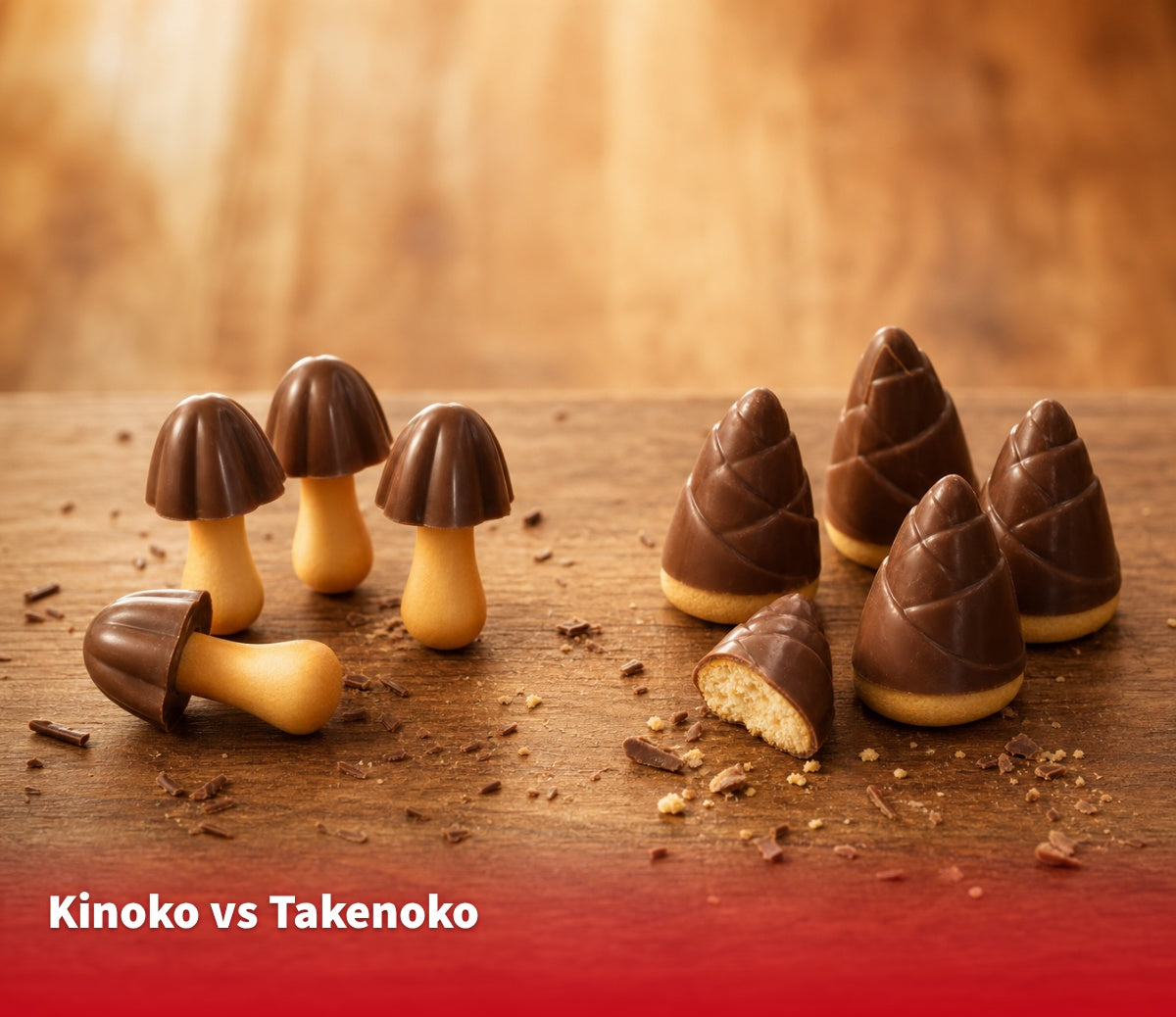
Kinoko no Yama means "Mountain of Mushrooms." Its pieces look like tiny mushrooms: a chocolate cap perched on a slim, crisp cracker stem. Takenoko no Sato means "Bamboo Shoot Village." Its pieces resemble little bamboo shoots, with chocolate wrapped around a more substantial cookie base. The names evoke a miniature storybook landscape—mountains, villages, mushrooms, and shoots—before you have even opened the box.
The rivalry is often called the "kinotake war" (きのたけ戦争), using shortened forms of kinoko (mushroom) and takenoko (bamboo shoot). It is not a serious conflict, of course. It is a playful question of preference that has become part of Japanese snack culture: do you want a clean snap and a chocolate-first bite, or a richer, cookie-forward crunch? In this article, we will trace how two cute shapes became a national debate—complete with official elections—and help you decide which side you are on.
Want to taste the rivalry yourself? Explore Meiji products available at Tokyo Stash.
What You'll Learn
- 1) Two shapes, one delicious family history
- 2) How a snack preference became the "kinotake war"
- 3) The real argument: snap, crumble, chocolate, and melt
- 4) What the rivalry says about Japanese snack culture
- 5) Beyond the original: seasonal, regional, and limited flavors
1) Two Shapes, One Delicious Family History
Kinoko no Yama arrived first, launched by Meiji in 1975. Its idea was unusually whimsical for its era: rather than selling chocolate as a bar or a simple bite, Meiji paired a molded chocolate top with a baked cracker stem and made the whole piece look like a mushroom. The result is instantly recognizable. It is also practical. You can hold the cracker stem while eating the chocolate cap, making the snack feel a little like a tiny chocolate lollipop.
Four years later, in 1979, Meiji introduced Takenoko no Sato as Kinoko's sibling product. The company had to take a different approach to the baked portion. Kinoko no Yama relies on a crisp cracker-like stem, while Takenoko no Sato uses cookie dough shaped into its distinctive layered bamboo-shoot form. The two snacks were therefore related from the start, but they were never identical.
That difference matters. Kinoko no Yama feels light, neat, and slightly graphic: a rounded cap, a thin stem, and a clear separation between chocolate and cracker. Takenoko no Sato is more compact and substantial. Its ridged, conical silhouette suggests layers, and its cookie base gives each piece more of a biscuit-snack character.
For overseas snack shoppers, it can be useful to think of them as two answers to the same question: how should chocolate and a baked snack share one bite? Kinoko answers with contrast. Takenoko answers with integration. Neither is simply a copy of the other, and that is exactly why both have lasted for generations.
2) How a Snack Preference Became the "Kinotake War"
The rivalry did not become famous because the products are enemies. It became famous because Meiji and its fans treated a small difference in taste as an opportunity for participation. Choosing a side is easy, harmless, and surprisingly revealing. A person may say they are "Team Kinoko" because they love the snap of the cracker or the way they can eat the chocolate cap first. Another may insist on "Team Takenoko" because the cookie feels more satisfying and the flavor seems more rounded.
In Japan, this kind of friendly binary question travels well. It works at school, at work, online, and among families: curry rice or ramen, smooth or chunky red bean paste, sweet or salty—and Kinoko or Takenoko. The answer is personal, but the question gives people a shared language for teasing, reminiscing, and comparing tastes.
Meiji leaned into this energy with increasingly elaborate campaigns. An early Kinoko–Takenoko election campaign was held in 2001, with Takenoko no Sato emerging as the winner. The company did not let that settle the argument. Instead, it helped give the rivalry a continuing storyline, with characters, mock political messaging, promotions, and new reasons for fans to declare their allegiance.
The most theatrical chapter came with Meiji's official "National General Election" (国民総選挙) of 2018. Framed in the language of a real election, the campaign ran for months and featured three groups: the Kinoko party, the Takenoko party, and a "Both" party for people who wanted the two snacks to prosper together. Fans could vote through campaign channels and product promotions, while the brands offered manifesto-style promises about what they would create if they won.
Takenoko's party won the 2018 election. Far from ending the story, the result created the perfect setup for a rematch: Meiji held another National General Election in 2019, and this time Kinoko's party won. The alternating victories are a useful reminder that the rivalry works best when nobody is permanently defeated. The point is not to establish a universal truth. The point is to keep the conversation—and the snack aisle—interesting.
3) The Real Argument: Snap, Crumble, Chocolate, and Melt
A rivalry needs a reason to exist, and with Kinoko and Takenoko the reason is texture.
Kinoko no Yama is built around a crisp cracker stem. Bite into it and the experience tends to feel more sharply divided: smooth chocolate first, then a light, dry snap from the baked stem. Some fans enjoy holding the stem and nibbling the chocolate cap separately. Others bite through the whole piece at once and like the contrast between the chocolate's softness and the cracker's clean crunch.
Takenoko no Sato offers a different rhythm. Its cookie base is thicker and more crumbly than Kinoko's stem. That can make the bite feel denser and more integrated, with the baked portion staying present alongside the chocolate rather than appearing as a narrow handle underneath it. Takenoko fans often value this more substantial cookie character; it can make the snack feel closer to a chocolate biscuit than a molded chocolate treat.
Chocolate-to-base balance is one of the most common points of debate, but it is better understood as a matter of perception than as a fixed mathematical ratio. Kinoko's large, visible cap can make the chocolate seem more prominent at the beginning of the bite. Takenoko's wider cookie body can make the baked component feel more involved from start to finish. Meiji itself has revised the balance between chocolate and baked snack over the years, so the experience can also vary slightly across product renewals and special editions.
The way each snack melts is part of the appeal, too. The chocolate in both products softens with warmth, but the supporting base changes the sensation. With Kinoko, the stem gives your fingers a dry place to hold while the cap softens in the mouth. With Takenoko, the cookie's more substantial structure makes the chocolate and biscuit feel like a single layered bite. If you prefer a distinct chocolate moment followed by a crisp finish, Kinoko may win you over. If you like a more buttery, cookie-led impression, Takenoko may be your side.
This is why the debate can become so animated even though both snacks are sweet, chocolatey, and made by the same company. Fans are not arguing over a label alone. They are choosing a texture, an eating style, and a tiny ritual.
4) What the Rivalry Says About Japanese Snack Culture
Japanese snack culture often values small pleasures in great detail. A package may contain many bite-sized pieces rather than one large serving. Texture is not an afterthought: crisp, crunchy, airy, flaky, chewy, and melting sensations are often central to how a snack is described and remembered. Kinoko no Yama and Takenoko no Sato are a particularly clear example because their flavors are closely related while their textures are distinct.
The rivalry also shows how a familiar snack can become cultural shorthand. For longtime fans, these products carry memories of childhood lunch breaks, family shopping trips, or sharing treats with friends. For newcomers, they offer an easy way into Japanese snack conversation. You do not need specialized knowledge to join in. Buy a box of each, taste them side by side, and decide which texture makes you happiest.
Meiji's marketing is a major part of why this friendly dispute has endured. Instead of pretending the two brands must compete silently on a shelf, the company has turned their coexistence into entertainment. There have been party campaigns, mock manifestos, fan voting, mascot characters, collaborations, and products designed as the result of a winning side's promise. The marketing works because it takes the fans' preferences seriously enough to celebrate them, but never so seriously that choosing both feels like a betrayal.
That combination of affection and absurdity is especially effective in Japan's limited-edition snack world. A familiar product can be refreshed with a seasonal ingredient, a new color, a dessert-inspired flavor, or a regional story. Fans are invited to compare not only the original Kinoko and Takenoko, but also the newest versions. The rivalry therefore becomes a framework for discovering products rather than a barrier between them.
In the end, the "war" is really a shared game. It gives people permission to have a strong opinion about something joyful and low-stakes. That may be one of the sweetest things about it.
5) Beyond the Original: Seasonal, Regional, and Limited Flavors
The standard milk-chocolate versions are the essential starting point, but they are only part of the story. Over the decades, Meiji has regularly used Kinoko no Yama and Takenoko no Sato as canvases for limited flavors. Strawberry versions of both appeared as early as the 1990s, establishing a pattern that remains familiar in Japanese confectionery: a well-loved original can return in a new seasonal or dessert-like form without replacing the classic.
Some editions lean into the calendar. Winter-themed products and cold-weather flavors have appeared, and Takenoko no Sato has been sold in a limited Earl Grey Milk Tea flavor designed for the cooler season. These releases show how flavor can suggest a mood as much as an ingredient. Tea, milk, caramel, vanilla, and berry flavors can make a familiar chocolate snack feel appropriate for a different time of year.
Other releases explore more grown-up or dessert-inspired territory. Meiji has sold adult-oriented versions with less sweetness and more emphasis on the baked component or cocoa character. Dessert and ice-cream inspired collaborations have given fans new reasons to revisit the two shapes. A special flavor can even become another debate: not just "Kinoko or Takenoko?" but "Which base works better with vanilla?" or "Which one carries a tea-flavored chocolate more successfully?"
Japanese ingredients have also entered the rivalry. Meiji has paired the two snacks with celebrated regional matcha traditions—Uji matcha from Kyoto for Kinoko no Yama and Nishio matcha from Aichi for Takenoko no Sato—bringing a gently bitter, aromatic green-tea note to each shape. More recently, flavors built on kinako (roasted soybean flour) and kuromitsu (dark sugar syrup) have appeared under playfully altered product names, and region-limited editions occasionally surface as well. Limited editions may be seasonal, campaign-based, or sold only in a specific area, so the package in front of you is always the best guide.
Conclusion: Pick a Side—or Don't
Kinoko no Yama and Takenoko no Sato are more than two chocolate snacks with cute shapes. They are a miniature lesson in how much texture, memory, marketing, and playful disagreement can matter in Japanese confectionery.
Start with the original pair. Try Kinoko no Yama for its chocolate cap and crisp cracker stem. Try Takenoko no Sato for its chocolate-coated cookie body and fuller crunch. Then pick a side—or proudly join the "both" camp. In Japan's sweetest rivalry, the most satisfying outcome is having another piece.
Ready to join the debate? Explore Meiji products—including Kinoko no Yama and Takenoko no Sato—at Tokyo Stash.
Explore more Japanese snacks and culture stories on Tokyo Stash.