
Pick up a bag of Japanese gummies and read the front of the package. There is a good chance the largest words on it are not describing a flavor. They are describing a sensation: how hard it will be, how much it will bounce back, whether it pops, stretches, or resists.
This is the part of the Japanese candy aisle that surprises visitors most. In many markets, gummies are differentiated by fruit and by shape, and texture is more or less a constant. In Japan, texture is the competition. A shelf of gummies is less a row of flavors than a spectrum of bites—and the packaging is written to help you choose which kind of chewing you are in the mood for.
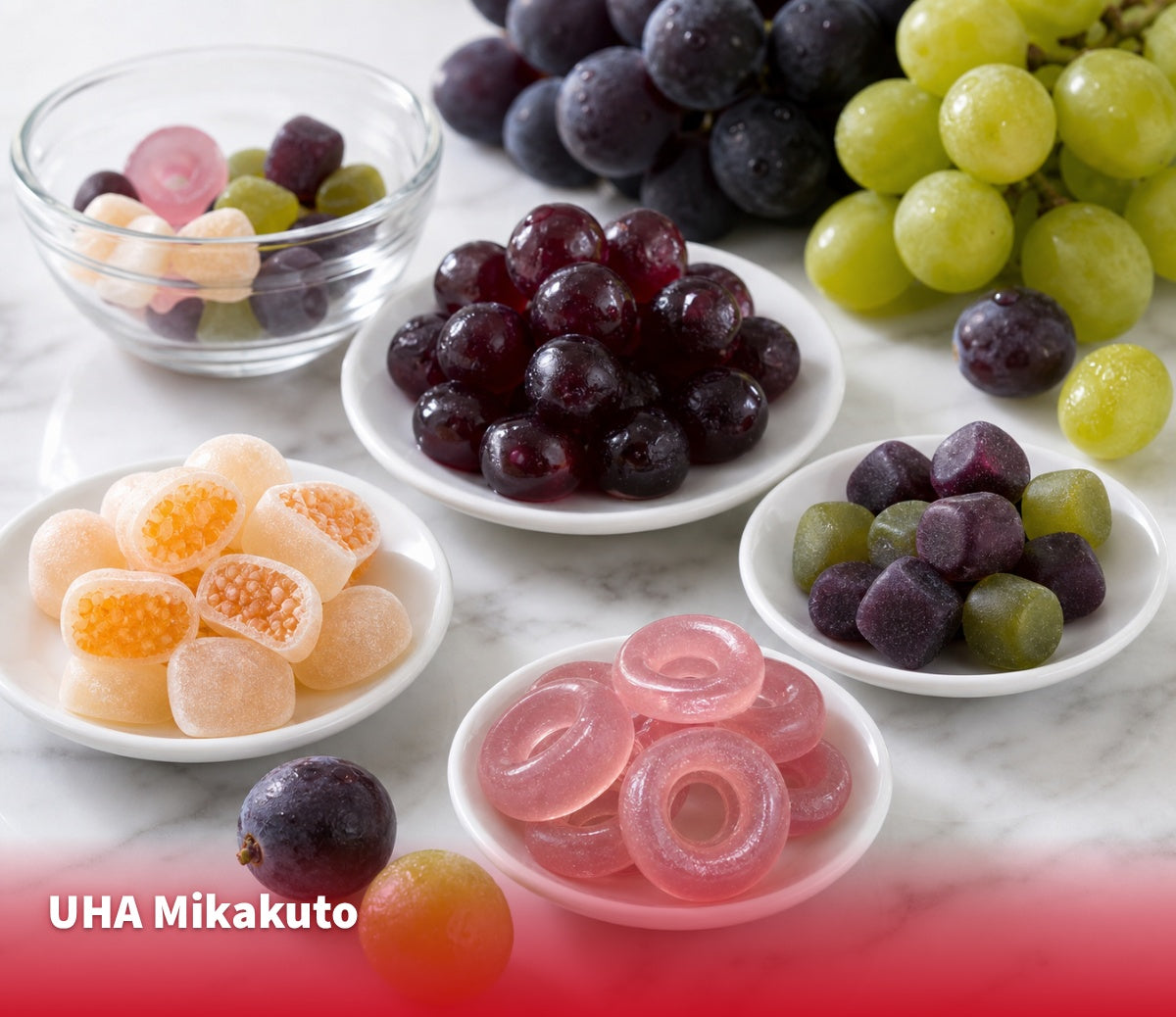
Few companies illustrate this better than UHA Mikakuto (UHA味覚糖), whose product range moves from a gummy engineered to burst like fruit to one built to be genuinely hard work.
Curious how they feel? Explore UHA Mikakuto gummies—Cororo, Puccho, Mochido and Ninja Meshi—at Tokyo Stash.
What You'll Learn
- 1) The small words that describe a big sensation
- 2) UHA Mikakuto: a candy company built for unexpected bites
- 3) Four ways to chew
- 4) What actually distinguishes Japan's gummy shelf
- 5) How to run a texture tasting
1) The Small Words That Describe a Big Sensation
Japanese has an unusually rich and widely understood vocabulary for describing how food feels in the mouth, and confectionery marketing uses it freely. Research on Japanese food description documents a large set of these texture terms, including several that turn up constantly on candy packaging.
The ones worth knowing:
- "Mochimochi" (もちもち) — springy and chewy, with the elastic pull associated with pounded rice cake
- "Punipuni" (ぷにぷに) — soft, squishy, gently bouncy
- "Shittori" (しっとり) — moist and supple
- "Katai" (かたい) — hard
- "Danryoku" (弾力) — elasticity, bounce, resistance that pushes back
These are not scientific measurements. They are vivid promises about what is going to happen when you bite. And because they are commonly understood, a manufacturer can put one on the front of a bag and expect a shopper to know exactly what is being offered.
It is tempting to explain all this as "Japanese people care more about texture than other people do." That claim is too broad to support and flattens a large and varied consumer culture. The more defensible—and more interesting—version is that Japanese food language and packaging make texture unusually visible and easy to discuss. When a whole vocabulary exists for a quality, that quality becomes something products can compete on.
2) UHA Mikakuto: A Candy Company Built for Unexpected Bites
UHA Mikakuto was established on 18 October 1949 and is headquartered in Chuo Ward, Osaka. Its own history begins with a candy wholesaling business, and today its range spans hard candy, soft candy, gummies, and gummy supplements.
The initials are worth knowing because they explain a great deal about the product strategy: UHA stands for "Unique Human Adventure," a company phrase about originality and taking on challenges.
Whether or not you find corporate slogans persuasive, the range does behave that way. Instead of treating gummies as one uniform category with rotating flavors, UHA repeatedly makes the format the story—the structure of the candy, and the sequence of sensations it produces, are what a given product is actually selling. That makes the company a useful lens on Japanese texture-led confectionery, without needing to claim it invented every format it sells.
3) Four Ways to Chew
Cororo (コロロ), launched in April 2014, is the fruit-analogy one. UHA describes it as a gummy with a new, fruit-like texture, and the key structural detail is that it is wrapped in a thin collagen skin. That skin gives a moment of resistance before it gives way, so the first bite is a small burst rather than a squeeze. The obvious comparison is biting through the skin of a grape into the pulp—which is exactly the effect being aimed at.
One precision point: it is not accurate to describe Cororo as fruit juice inside a jelly membrane. The published description is a juicy gummy enclosed by a thin, bovine-derived collagen skin, and specific premium varieties may add fruit pieces or jelly-like inclusions.
Puccho (ぷっちょ), launched in 2000, puts one chewy confection inside another. The body is a soft, taffy-like candy with a smooth pull; embedded in it are small gummy pieces that interrupt that pull with little pops of resistance. The result is not simply "chewy"—it is a texture that changes as you work through it. That idea of building contrast into a single bite recurs across the Japanese candy shelf.
Mochido (モチド) chases mochimochi: a dense, bouncy, distinctly elastic chew. It is a donut-shaped gummy, and its listed ingredients include rice flour alongside gelatin. Two honest caveats: the current official product page does not establish a launch year, and the product does not claim to reproduce traditional mochi exactly. "A candy interpretation of mochi texture" is a more accurate description than "mochi gummy."
Ninja Meshi (忍者めし) goes the other direction entirely and makes hardness the attraction. UHA positions it as a hard gummy for the "modern ninja"—a compact snack for a small hunger. The line extends into deliberately tougher variants: Ninja Meshi Kō (鋼, "steel") emphasizes greater hardness and chew, while Ninja Meshi Tetsu no Yoroi (鉄の鎧, "iron armor") adds a hard sugar coating that cracks before you reach the dense gummy centre. In a nice piece of literalism, the Iron Armor product also lists iron among its ingredients.
The "energy replenishment" framing around Ninja Meshi is best read as portable-snack imagery rather than a substantiated sports-nutrition claim. What is genuinely notable is the design philosophy: the effort of chewing is treated as the entertainment, not as a flaw to be minimized.
4) What Actually Distinguishes Japan's Gummy Shelf
The honest summary is that a Japanese gummy assortment is better described as a texture spectrum than as a collection of flavors.
Hard and high-elasticity products are unusually visible because they offer things a shopper can understand instantly: longer chewing time, a clear sensory identity, and a claim that fits on the front of a bag. A product promising a serious chew is making a specific, checkable promise in a way that "strawberry flavour" is not.
That does not mean every Japanese gummy is hard—Cororo and Puccho are proof of the opposite—nor that gummies everywhere else are identical. The useful contrast is with an expectation many overseas shoppers arrive with: that gummy texture is basically fixed, and only the flavor changes. Japanese products invite you to choose your chew as deliberately as your flavor.
5) How to Run a Texture Tasting
The most enjoyable way to understand any of this is to taste four products in a deliberate order, so that texture rather than flavor becomes the thing you are comparing.
Try them in this sequence: Cororo first, for the juicy skin-then-burst; then Puccho, for the layered soft-chew-plus-pops; then Mochido, for the springy mochi-like pull; and finish with Ninja Meshi, for the sustained hard chew. Where you can, pick the same or a similar fruit flavor across all four. That way the flavor stays roughly constant and the differences you notice are structural.
Then try to describe each one out loud in your own words. It sounds slightly silly, but it is the entire cultural point of the article: once you have language for texture, you start noticing it, and the shelf stops looking like variations on one product.
Two practical notes. Store gummies sealed in a cool, dry place away from heat and humidity, since they soften, stick together, and lose their intended texture when warm. Counter-intuitively, refrigeration is not automatically the fix—UHA notes that chilling can make soft candy harder and alter both flavor and texture.
And an important one for many readers: UHA states that its products may use gelatin derived from pork, fish, or cattle, and Cororo's cited formulation uses bovine-derived collagen and gelatin. These products should not be assumed to be vegetarian, vegan, halal, or kosher. Allergens also vary by flavor and reformulation, so check the actual package—milk, soy, wheat, fruit allergens, and shared-facility notices all appear across the range.
Conclusion: Choose Your Chew
Japanese confectionery makes a quietly radical proposition: that how a sweet behaves in your mouth is at least as interesting as what it tastes like. Once you accept that, a shelf of gummies becomes a much richer thing to shop from—a burst, a stretch, a bounce, or a proper workout for the jaw, each clearly labeled for anyone who knows the words.
Start with two products at opposite ends—Cororo and Ninja Meshi will do it—and pay attention to what your teeth are doing rather than to the fruit on the front of the bag. The difference is not subtle, and once you have noticed it you will never shop for gummies the same way again.
Ready to compare? Explore UHA Mikakuto gummies at Tokyo Stash.
Explore more Japanese snacks and culture stories on Tokyo Stash.