
The single most common mistake in Japanese skincare happens before anyone opens a bottle. Someone buys a Japanese product labelled "lotion," expects a creamy moisturizer, and pours out something with the consistency of water.
Nothing is wrong with the product. The word simply means something different. And that mismatch is a good introduction to the whole category, because most of what makes Japanese skincare confusing to overseas shoppers is not the chemistry—it is the vocabulary, and a regulatory system that has no exact equivalent anywhere else.
This is a guide to reading the label. It is a cultural and practical explainer, not medical advice: nothing here is a treatment recommendation, and anyone with a skin condition or concern should speak to a dermatologist or other qualified clinician.
Want to explore? Browse Rohto skincare at Tokyo Stash.
Examples of the label terms above, shipped from Japan:
 Hada Labo Gokujyun Hyaluronic Acid Lotion (a keshōsui)
 Hada Labo Gokujyun Hyaluronic Acid Milk (an emulsion)
 Hada Labo Gokujyun Hyaluronic Acid Cream
 Shiseido Elixir Advanced Lotion T II Moist
 Melano CC Deep Day Care UV Milk SPF50+ PA++++
What You'll Learn
- 1) The "lotion" that is not a lotion
- 2) The light-to-rich routine
- 3) "Medicated," quasi-drugs, and what bihaku actually means
- 4) Reading an ingredient list without overpromising
- 5) SPF, PA, and everyday sun habits
1) The "Lotion" That Is Not a Lotion
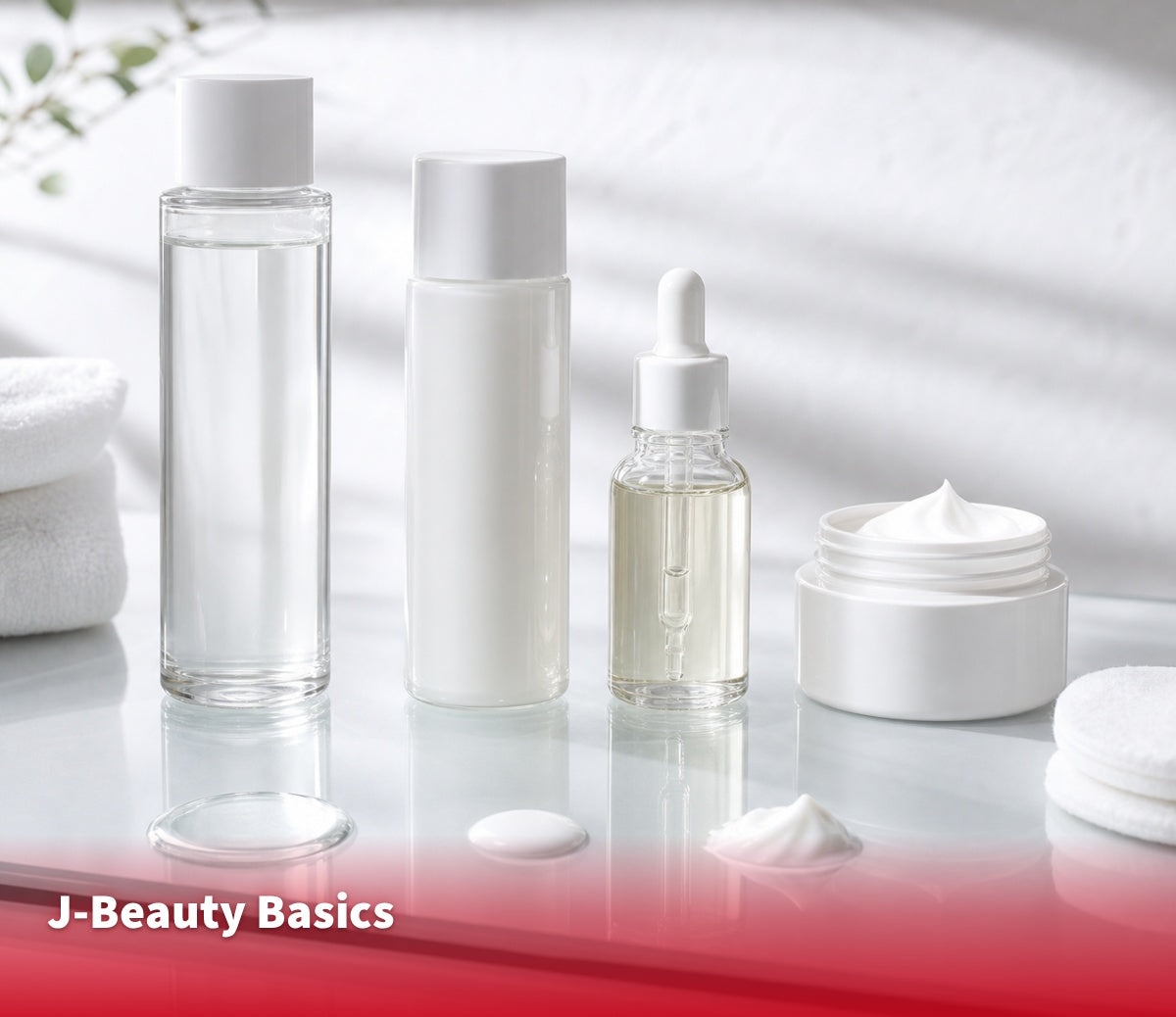
Japanese skincare is organized into product categories that map badly onto English. Here is the translation table worth memorizing.
| Japanese | Often labelled | What it actually is | Common misunderstanding |
|---|---|---|---|
| 化粧水 keshōsui | Lotion, skin lotion, toner | A light, water-based leave-on step used right after cleansing | "Lotion" suggests a creamy body moisturizer. It is usually not that. |
| 乳液 nyūeki | Emulsion, milk | A light oil-and-water moisturizer—richer than keshōsui, lighter than cream | It is not milk, and it is not a cleanser. |
| 美容液 biyōeki | Serum, essence | A concentrated leave-on product aimed at a particular cosmetic concern or skin feel | "Essence" and "serum" are not standardized globally; brands use them differently. |
| クリーム | Cream | Usually the richest, most occlusive step | Not automatically "stronger" than an emulsion—just a different texture and formula. |
| オールインワン | All-in-one gel | A product intended to combine several routine steps | It does not necessarily replace sunscreen; what it covers varies by product. |
If you take one thing from this article, make it the first row. A Japanese "lotion" is a watery hydrating step, not a moisturizing cream. "Hydrating toner" is often the clearest English rendering—though the safest approach of all is to work out where a product sits in the routine rather than trusting any single translated word.
2) The Light-to-Rich Routine
The routine most associated with Japanese skincare moves from the thinnest textures to the richest: cleanse, then keshōsui, then serum, then emulsion, then cream—with sunscreen last in the morning, before makeup.
Two honest caveats. This order is a common convention rather than a fixed law; individual products and personal preference change it, and product directions should lead. And the layering habit itself is best described as a routine preference that suits how Japanese products are formulated—in light, watery, and richer textures designed for sequential use—rather than as a scientifically superior method. More steps is not automatically better skincare.
What layering does offer is adjustability. You can run the full sequence in winter and drop to cleanser, keshōsui, and sunscreen in humid summer, using the same products. That flexibility, rather than any claim of superiority, is the practical case for it.
If you are starting out, three steps is a perfectly respectable routine: a cleanser, one hydrating step, and a sunscreen in the morning. Add layers only if you actually want them.
3) "Medicated," Quasi-Drugs, and What Bihaku Actually Means
This section matters more than the rest, because it is where translation causes real harm.
Japan's regulatory system has a category between cosmetics and medicines: "iyakubuhin-gai"—properly 医薬部外品 (iyakubugaihin), usually rendered in English as quasi-drug. Products in this category may carry specific approved efficacy wording tied to an approved product category and active ingredient. The word "yakuyō" (薬用), commonly translated as "medicated," typically signals such a product.
Two things follow, and both are important:
- A quasi-drug is not a prescription or over-the-counter medicine, and "medicated" does not mean "medicine" in the everyday English sense.
- Quasi-drug status is a Japanese classification only. It is not an international category, and it does not establish that the product, ingredient, or claim may be marketed the same way in your country. In the United States, for example, a cosmetic promoted to treat or prevent disease, or to affect the body's structure or function, can be regulated as a drug.
Now the term that most needs care. "Bihaku" (美白) is often translated literally as "whitening"—and that translation is misleading enough to be worth correcting directly.
In the Japanese quasi-drug context, the approved wording for this claim type is essentially: suppresses melanin production and prevents spots and freckles (メラニンの生成を抑え、しみ・そばかすを防ぐ). Read that carefully. It is preventive in scope. It does not mean bleaching skin. It does not mean lightening your natural complexion. It does not mean removing pigmentation you already have.
English-language materials often use "brightening" to convey the idea, which is less loaded than "whitening"—but the word alone does not make any product claim accurate or compliant in another market. The honest way to read a Japanese label carrying this wording is: this product belongs to a Japanese regulatory category concerned with preventing future spots and freckles. Nothing more should be inferred from the packaging.
You will encounter both "medicated whitening" and "medicated brightening" in the English product names of Japanese skincare, because that is how the manufacturers have chosen to translate their own labels. Now you know what the underlying Japanese claim actually says—and what it does not.
4) Reading an Ingredient List Without Overpromising
Japanese formulas often lead with a named ingredient, which makes them easy to shop but easy to over-read. Some context, stated the way it should be stated:
Hyaluronic acid is commonly formulated as a humectant—an ingredient selected for moisture-focused formulas and a hydrated skin feel. Ceramides are lipids associated with the skin's outermost layer, commonly included in products positioned around moisturization and comfort. Vitamin C derivatives appear frequently, often because a derivative can be more stable in a given formulation than pure ascorbic acid; which derivative, and in what product, matters. Tranexamic acid and arbutin may appear in Japanese cosmetics and quasi-drugs, including products carrying bihaku messaging.
The critical caveat: an ingredient name on a package is not evidence of a result. A cosmetic ingredient list does not by itself prove a finished product's performance, suitability, or legal claim status. Formula, concentration, product classification, directions for use, and local regulation all matter, and none of them are visible from the front of a bottle.
So read ingredient lists for what they are genuinely good for—checking for something you know you react to, and understanding roughly what a product is designed to do—rather than as a promise.
5) SPF, PA, and Everyday Sun Habits
Daily sunscreen is a visible feature of contemporary Japanese beauty culture—part of a morning routine rather than something reserved for beaches and holidays. (Visible as a cultural pattern, that is; it would be wrong to describe it as universal behaviour among everyone in Japan.)
Japanese labels carry two numbers, and they measure different things. SPF principally indicates protection against UVB, the range associated with sunburn. PA indicates the degree of UVA protection, graded from PA+ to PA++++, with more plus signs meaning a higher grade.
Two things people routinely get wrong. SPF is not a simple measure of how many hours you are protected—treat it as a tested protection grade and follow the product's directions on application and reapplication. And SPF values do not add up: an SPF 15 makeup over an SPF 25 base is not SPF 40.
One note for anyone importing: sunscreens with SPF claims can carry drug-related regulatory implications in some countries, including the United States. A Japanese sunscreen label should not be assumed to be export-ready or equivalent to a locally regulated product.
Conclusion: Read the Label, Then Ask a Professional
Practical closing advice. Introduce new products gradually rather than starting five at once—if something disagrees with you, you will want to know which thing it was. Patch testing can be a sensible precaution, but it is worth being honest that it cannot rule out every reaction under normal use. Follow the brand's directions, and avoid applying products to broken or actively irritated skin unless a clinician has advised otherwise.
Keep products clean and stored per the label, note when you opened them, and stop using anything whose smell, colour, or texture has changed. If a product causes irritation, stop.
And the referral that belongs in any article of this kind: anyone with sensitive skin, allergies, persistent irritation, or concerns about acne or pigmentation should consult a dermatologist or another qualified healthcare professional. An article about label vocabulary cannot diagnose anything, and Japanese skincare is not a substitute for care.
What it is, at its best, is a well-organized set of textures with unusually clear instructions—once you know that "lotion" means water.
Ready to explore? Browse Rohto skincare or Shiseido products at Tokyo Stash.
Keep reading:
Explore more Japanese culture stories on Tokyo Stash.