
In much of the world, canned tuna is one thing. You buy the tin, you drain it, you mix it with mayonnaise. Decisions: none.
Japanese supermarkets treat it as a much longer conversation. A single shelf will offer you a choice of fish species, three different textures, and at least four kinds of liquid to pack it in—oil, reduced-oil, water, or a seasoned vegetable broth. Some cans are designed to be flaked into rice; others hold together well enough to serve as the protein on a plate.
That variety exists because Japanese tuna is treated as a cooking ingredient rather than a finished sandwich filling. It goes into rice balls, okonomiyaki batter, simmered daikon, pasta, and salads. Once you can read the label, choosing the right can stops being guesswork—so let's read the label.
Want to stock your pantry? Explore Inaba canned tuna—oil-packed, water-packed, and no-oil—at Tokyo Stash.
What You'll Learn
- 1) "Light" and "white": similar words, different languages
- 2) Solid, chunk, flake—and what each is for
- 3) The liquid in the can is part of the recipe
- 4) Tuna mayo and the Japanese table
- 5) The wider canned-food pantry
1) "Light" and "White": Similar Words, Different Languages
The first thing to understand is that Japanese cans are usually organized by which fish as well as which texture—and that the vocabulary does not map cleanly onto English-language shelves.
Major Japanese makers commonly describe "binnaga maguro" (びんながまぐろ, albacore) as white tuna or white meat, while "kihada" (きはだ, yellowfin), "mebachi" (めばち, bigeye), and "katsuo" (かつお, skipjack bonito) are described as light tuna or light meat.
Now compare U.S. consumer guidance, where "white tuna" means albacore and "canned light tuna" is most often skipjack, with canned yellowfin treated separately. The categories overlap but are not identical. A Japanese can labeled light tuna may contain yellowfin, bigeye, or katsuo depending on the product—so it should not be assumed to match a U.S. "light tuna" species mix.
The practical takeaway is simple: read light and white as useful Japanese shopping clues that narrow things down, then read the ingredient list to learn what is actually in the can. These appear to be widely used commercial categories rather than one legally identical species-by-species definition applied to every brand, which makes the ingredient statement the final authority.
In flavor terms: albacore is paler and milder with a firmer, more "meaty" quality, which is why it often shows up in premium solid packs. Katsuo has more pronounced savory depth. Yellowfin sits comfortably in between and does most of the everyday work.
2) Solid, Chunk, Flake—and What Each Is For
Japanese makers sort tuna into three textures, and this is the distinction that most changes your cooking.
Solid (ソリッド) is an intact piece of muscle—a block of fish that keeps its shape. Use it where the tuna should behave like a piece of cooked fish rather than a spread: a composed salad, a rice bowl, anything where it will be visible on the plate.
Chunk (チャンク) is large flakes and pieces: recognizable bites without needing to be cut. Hagoromo suggests chunk for okonomiyaki, curry, and hot pots—dishes where you want the tuna to hold its own among other ingredients but not sit in one solid lump.
Flake (フレーク) is finely loosened fish, and it is the workhorse. It distributes evenly through mayonnaise, rice, pasta, cabbage, or batter. If you are making onigiri filling, sandwiches, dressed salads, or anything mixed, flake is what you want.
The mistake most people make is buying flake for everything, then wondering why the tuna disappears into a salad. Buy by what the dish needs to look like when it is finished.
3) The Liquid in the Can Is Part of the Recipe
Japanese tuna comes in oil-packed cans (often soybean or cottonseed oil), reduced-oil packs, water-packed cans, and a category labeled oil-free or no-oil-added. Inaba draws the lines specifically: an oil-packed product has roughly half or more of its packing liquid as oil; its "oil-in-water" category contains less than half oil; and its water-packed or no-oil products may be finished with water or a vegetable soup.
That last detail is the one worth pausing on. "No oil" does not mean "unseasoned." One Inaba no-oil katsuo product lists skipjack, water, salt, "shio-kōji" (塩麹, salted rice malt), vegetable extract, and seasoning. A Hagoromo oil-free yellowfin product is explicitly seasoned with vegetable soup. These cans are not simply fish in water—they carry a deliberately designed savory liquid.
You may see it claimed that Japanese tuna cans contain bonito dashi, and that this is what makes them taste different. Be careful there: the documented examples use vegetable-based seasoning, and a bonito-dashi claim would need checking against the specific can's ingredient list. What is fair to say is that some Japanese products treat the packing liquid as a flavor decision rather than a storage medium.
How to choose: use oil-packed when the oil will become part of the dish—tossed through pasta, stirred into a dressing, mixed into rice. Use water-packed or no-oil when the seasoning is coming from somewhere else and you want to control the fat yourself, as with mayonnaise, ponzu, or sesame dressing. One caution: oil-free does not automatically mean low-salt, so check the sodium if that matters to you.
4) Tuna Mayo and the Japanese Table
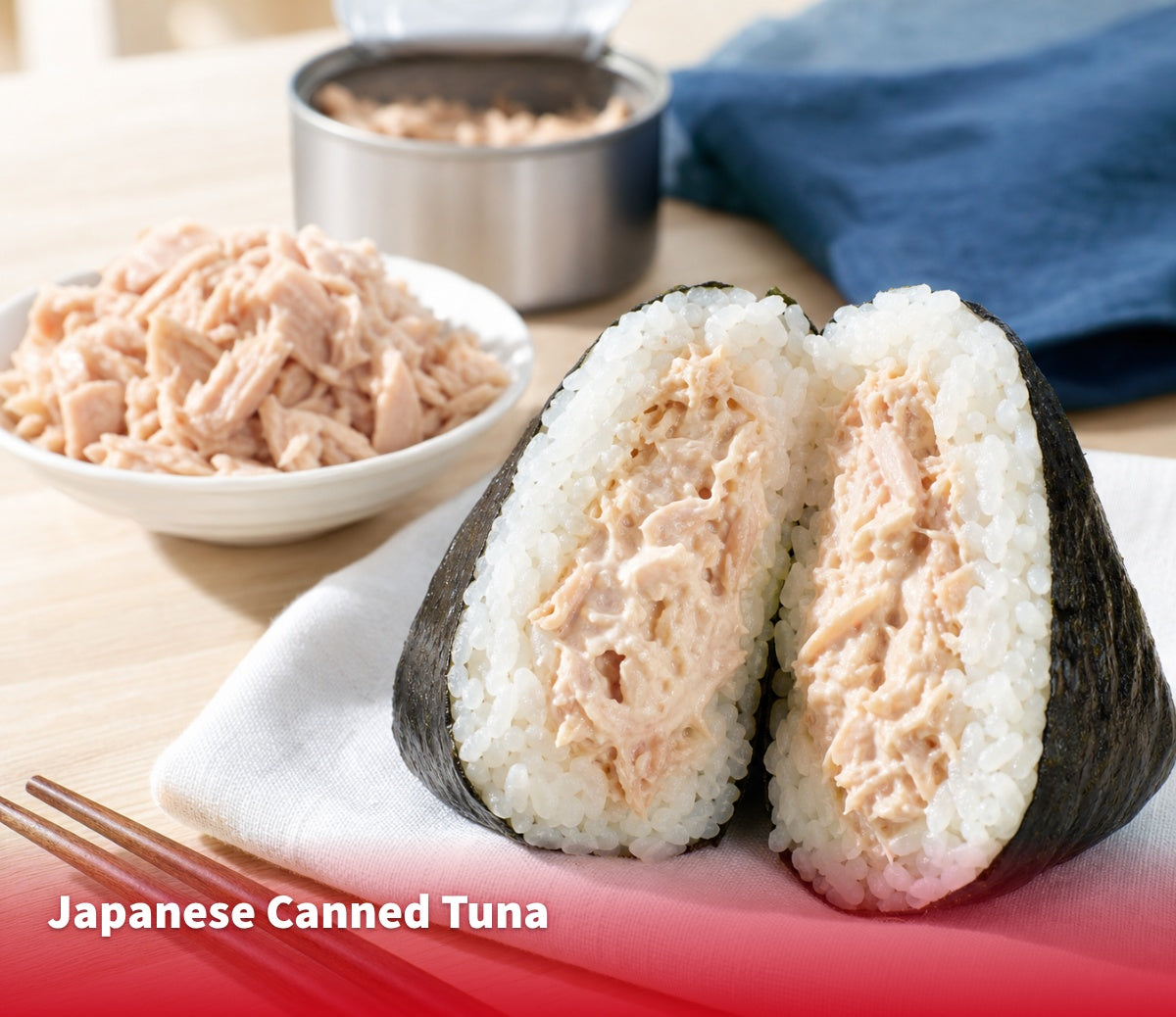
If one dish explains canned tuna's place in Japan, it is "tsuna mayo" (ツナマヨ)—tuna mixed with mayonnaise, used above all as a filling for "onigiri" (おにぎり, rice balls). It is a fixture of convenience-store rice balls and has been for decades; Lawson has described tuna-mayonnaise as a popular filling sold in onigiri format for many years.
Japanese mayonnaise matters to the result. It is typically made with egg yolks alone and seasoned with rice vinegar, giving it a richer, tangier character than many Western versions—which is why tsuna mayo tastes more savory than a plain tuna salad.
From there the applications spread out. Tuna is simmered gently with daikon radish or napa cabbage, folded into okonomiyaki batter, tossed with soy and sesame in a salad, or stirred through pasta. The common thread is a mild, shelf-stable fish that takes Japanese seasoning readily and does not fight what it is mixed with.
Three easy places to start:
Tuna-mayo onigiri. Drain a flake-style can lightly, mix with mayonnaise and a little black pepper, and tuck it into warm salted rice shaped into a triangle. Add the nori only when you serve, so it stays crisp.
Tuna and napa cabbage. Simmer chopped napa cabbage with a little water or dashi, soy sauce, and mirin, then fold in drained tuna near the end. Oil-packed gives a fuller broth; use no-oil if you plan to finish with sesame oil at the table.
Soy-butter tuna pasta. Toss spaghetti with tuna and a spoonful of its own oil, soy sauce, butter, and sliced scallion, then finish with shredded nori. A no-oil can works fine here—just add olive oil or butter deliberately.
5) The Wider Canned-Food Pantry
Tuna is one item in a larger shelf. Japanese shoppers also reach for canned mackerel—plain water-packed "mizuni" (水煮) or miso-simmered "misoni" (味噌煮)—as well as sardines, saury, and jarred salmon flakes. These are not interchangeable. Mackerel is richer and often anchors a meal outright, while salmon flakes are a salty rice topping rather than a protein you build a dish around.
Inaba itself illustrates how broad this category runs. The company was established in 1948, with its headquarters and a factory in Shimizu Ward, Shizuoka City, and it also lists factories in China and Thailand. Its Thailand factory's main products include tuna cans, and current no-oil SKUs may identify Thailand as their country of origin. That is a useful corrective: brand, processing location, and fish origin are three separate questions, and a Japanese brand does not automatically mean a can packed in Japan. Inaba's Thai Curry cans point the same way—Japanese canned-food culture happily includes globally inspired prepared meals.
There is also a practical dimension. Japan's Ministry of Agriculture, Forestry and Fisheries recommends fish cans—tuna, mackerel, sardines, saury—as household emergency stockpile items, used through a "rolling stock" approach where you eat and replace them continuously rather than letting a sealed emergency box expire. It is a quietly sensible idea: your disaster supplies are just groceries you happen to be ahead on.
Conclusion: Read the Can, Then Cook With It
The short version of everything above: decide the fish, the texture, and the liquid, in that order. Flake in no-oil for tsuna mayo. Chunk in oil for okonomiyaki or a hot pot. Solid albacore when the tuna is meant to be the centerpiece. After opening, move any unused fish out of the can into a clean covered container and refrigerate it promptly.
Two notes worth stating plainly. Read both the ingredients and the allergen statement, because seasonings can introduce soy, wheat, or sesame even when the fish itself is simple. And on mercury: guidance depends on the species and on who is eating—if you are pregnant, breastfeeding, feeding young children, or eating tuna very frequently, check your own country's public-health advice rather than relying on a general rule.
Beyond that, treat a Japanese tuna can the way a Japanese cook does: not as a finished salad waiting for bread, but as a shelf-stable ingredient that turns rice into dinner on a night when you have nothing else planned.
Ready to stock up? Explore Inaba canned tuna—flake, chunk, oil-packed, and no-oil—at Tokyo Stash.
Explore more Japanese snacks and culture stories on Tokyo Stash.