
Most confectionery companies begin with someone who wanted to make something delicious. Glico began with someone who noticed oyster broth being thrown away.
In 1919, Ezaki Ri-ichi saw the cooking liquid from oyster processing being discarded near his home region in Saga. He had read about glycogen—the form in which animals store carbohydrate energy—and suspected the discarded broth was full of it. He had it analyzed, and Glico says the analysis at Kyushu Imperial University Hospital confirmed glycogen was present.
What he did next is the reason the company exists. Rather than pursuing a medicine or a supplement, he put it in a caramel—a sweet aimed at children, sold on the idea that a treat could also deliver nutrition. The company's name is simply a shortened form of the word glycogen. Everything that followed, from a neon sign in Osaka to a chocolate-coated biscuit stick sold worldwide, grew out of that decision.
Want to taste the range? Explore Glico products—Pocky, Pretz, Caplico and more—at Tokyo Stash.
From this story, shipped from Japan:
 Glico Pocky Chocolate
 Glico Pretz Roasted Salted Butter
 Caplico Giant Strawberry
 Glico Almond Peak
 Glico Bitte Milk Chocolate
What You'll Learn
- 1) From oyster broth to a caramel
- 2) The runner who promised 300 meters
- 3) How Glico made the little extra memorable
- 4) A package icon becomes an Osaka landmark
- 5) A family of brands beyond one famous stick
1) From Oyster Broth to a Caramel
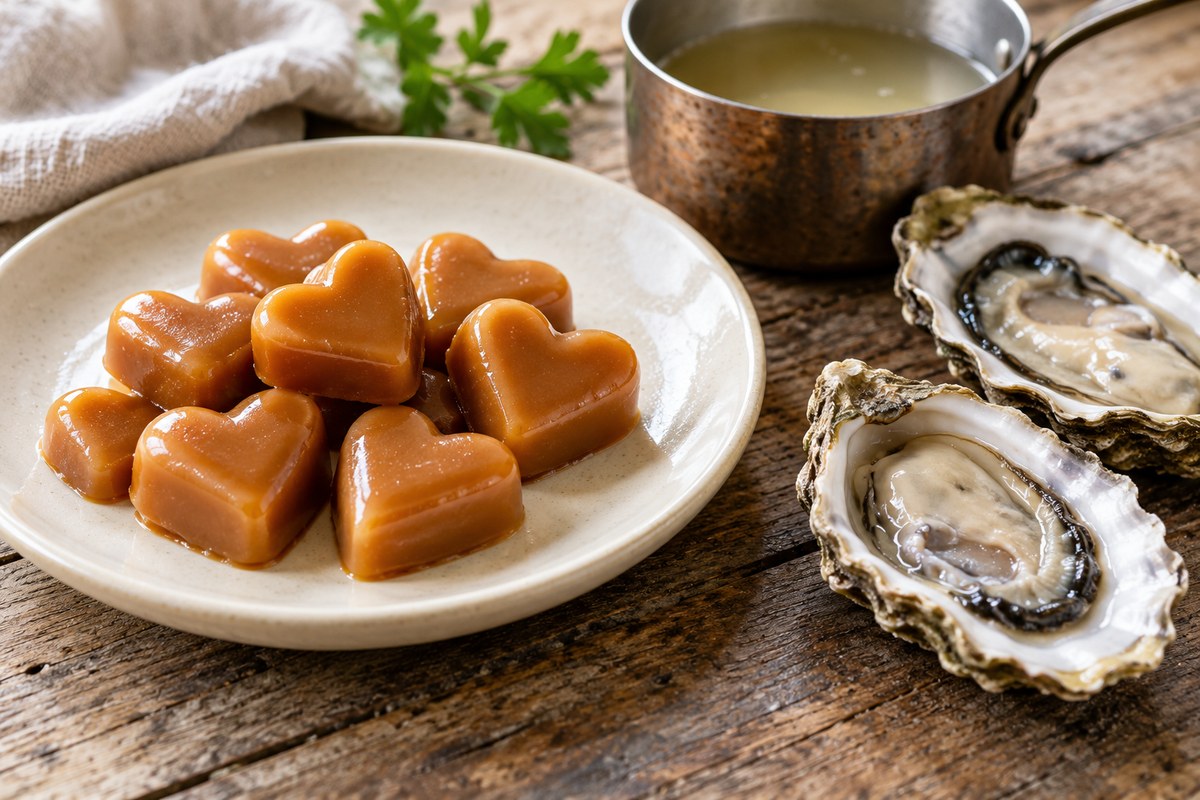
Glico treats 11 February 1922—the day its nutrition-fortified caramel went on sale at the Mitsukoshi department store in Osaka—as its founding day. That date is worth stating carefully, because the company's corporate data separately lists its legal establishment as February 1929. Both are true; they are simply different events, and conflating them is the most common error in retellings of this story.
The original product was Glico Nutritious Candy, a caramel positioned as a way to combine nourishment with enjoyment for children. In the early twentieth century, when nutrition science was still young, glycogen gave Ezaki a scientific-sounding foundation for an ordinary sweet—a way to argue that candy could do something for you.
Glico's corporate history also tells a more personal version: that Ezaki's ill son recovered after receiving glycogen extract. It is a compelling founding story and it belongs in any account of the company, but it should be presented as Glico's own account rather than as independently established medical evidence.
2) The Runner Who Promised 300 Meters
The figure on the Glico package—a runner crossing a finish line with both arms raised—has a formal name that few people outside Japan know. It is the Goal-in Mark (ゴールインマーク), not simply "the running man," and Glico says it has represented the product since launch.
The selection story is charming and well documented by the company: Ezaki's candidate designs were shown to children at a nearby elementary school, and the runner was chosen by their vote. The image was meant to evoke health, exercise, and the joy of achievement—a visual shorthand for the nutrition idea behind the caramel.
Who was the model? The honest answer is that no single real-life model is securely documented. A company spokesperson has said that later redesigns drew on several athletes, including the Filipino sprinter Fortunato Catalon, the Japanese runner Sasago Tani, and the marathoner Shisō Kanakuri. So the accurate formulation is "among the athletes said to have informed later versions"—not "the model was X." The mark itself has been redrawn over time, including a softening of the facial expression after feedback on early artwork, while always keeping the raised-arms finish.
Then there is the slogan: "A single piece gives you 300 meters." Glico says the figure was set by calculating the caramel's calories. It is a wonderful piece of advertising history and it fixed the health-and-movement idea in the public mind—but it should be read as era-specific marketing copy, not as current nutrition or exercise guidance.
3) How Glico Made the Little Extra Memorable
An "omake" (おまけ) is a small extra or bonus, and it is one of the defining pleasures of Japanese confectionery. Glico's role in that tradition is concrete and dated: the company says it enclosed picture cards in 1922, added small toys in 1927, and introduced a package with a dedicated space for a mini-toy in 1929.
That third step is the interesting one. Designing the box around the toy meant the extra was no longer an occasional promotion—it was part of what the product was. Glico's centenary history explicitly links those toys to children's knowledge, imagination, and enjoyment.
For overseas readers this is essential context for the whole Japanese snack aisle, which rewards collecting, surprise, seasonal packaging, and shared anticipation as much as flavor. Glico can fairly be described as an early and influential participant in that tradition. It would be an overreach to say it single-handedly invented toy-linked sweets in Japan; some sources make that broad claim, and it is safer to attribute it than to assert it.
4) A Package Icon Becomes an Osaka Landmark
In 1935, the runner left the box. The first Glico neon sign went up beside Ebisu Bridge in Osaka's Dōtonbori district, and it has been there in some form ever since.
"In some form" matters. The current sign is the sixth generation, installed in October 2014 with LEDs, and its upper Glico wordmark was updated in June 2022. So what visitors photograph is not a preserved 1935 original but a continuously renewed one—continuity of idea rather than of object.
Osaka City characterizes the sign as a symbol of the Minami and Dōtonbori area, and its role as a photo stop is easy to explain: a riverfront location, enormous scale, a history that goes back to 1935, and—crucially—a pose anyone can copy. Visitors stand in front of it and throw both arms up. An advertising mark became a piece of participatory tourism, which is a rare thing for a logo to achieve.
It is more accurate to call it an Osaka landmark and a famous photo spot than to imply it is an official civic monument.
5) A Family of Brands Beyond One Famous Stick
Pocky is Glico's best-known export, but it makes more sense as one branch of a larger tree—and the order of events surprises most people.
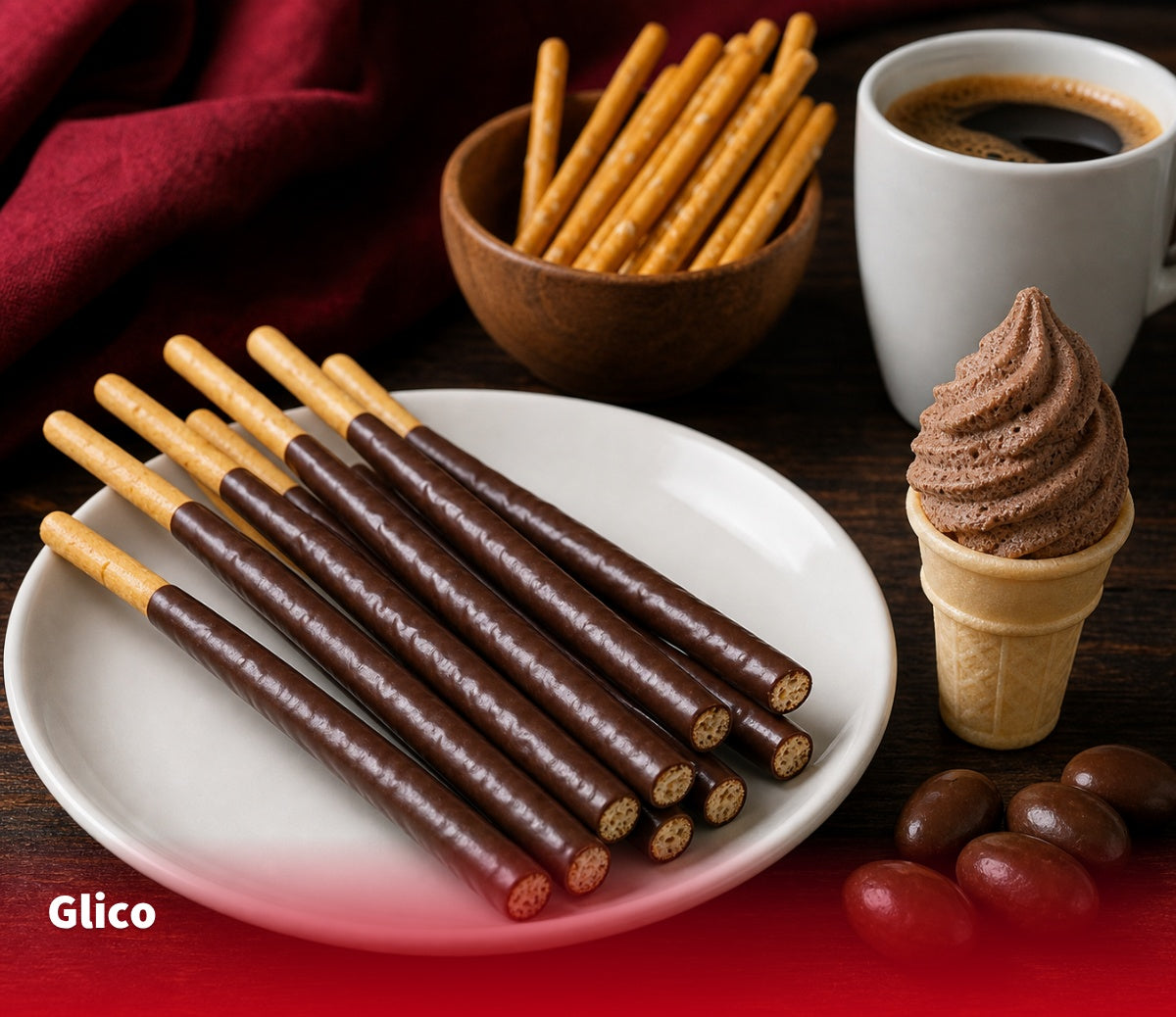
Pretz came first. Glico's sweet Butter Pretz was released in 1963, and Pocky Chocolate followed in 1966 by coating a Pretz-like stick with chocolate while leaving one end bare as a handle. That bare end is the whole design insight: it is what lets you eat chocolate with your fingers without wearing it. (A small precision note: Glico describes earlier salty Pretz test sales, and identifies 1963 specifically as the release of the successful sweet Butter Pretz—so "Pretz was invented in 1963" is a little too clean.)
| Brand | What it is | Launch |
|---|---|---|
| Pretz | Baked savory or sweet sticks; Pocky's predecessor concept | Butter Pretz, 1963 |
| Pocky | Chocolate-coated biscuit sticks with a bare handle | 1966 |
| Caplico | Airy chocolate in a wafer cone, shaped like soft-serve | 1970 |
| Almond Peak | Candy-roasted almonds covered in chocolate | 2011 |
| Bitte | Layered biscuit-and-cream bites in chocolate, framed as a coffee companion | September 2012 |
| Kobe Roast Chocolate | Bite-size chocolate using cacao roasted at Glico's Kobe facility | 2013 |
Caplico shows Glico's fondness for playful form—airy chocolate in a wafer cone, deliberately shaped to resemble a soft-serve ice cream that never melts. Bitte, Almond Peak, and Kobe Roast Chocolate point the other way, toward grown-up chocolate occasions: coffee pairings, roasted nuts, and single-origin roasting.
One of the genuine pleasures of Glico is its regional souvenir range. Glico sells area-exclusive Pocky and Pretz built on local associations and ingredients—Uji matcha Pocky and takoyaki-flavored Pretz in Kansai, mentaiko Pretz in Kyushu. A box of Pocky becomes a small piece of place.
Conclusion: A Hundred Years of a Simple Idea
Glico's whole history sits inside its first decision: that a sweet could carry an idea as well as a flavor. The idea was nutrition, the image was a runner, the extra was a toy, and the sign was a landmark—but the through-line is a company that has consistently sold a small experience rather than only a confection.
If you are buying for the first time, start with the classics: a box of Pretz next to a box of Pocky Chocolate lets you taste the 1963-to-1966 story for yourself. Regional flavors shift by area and season, so treat them as a bonus whenever you come across them. Keep chocolate products cool, dry, and out of direct sun, and follow the package for storage.
And check the label on the specific item you receive: Glico advises consumers to rely on the package itself for allergen information, because recipes and specifications change. Milk, wheat, soy, and nuts all appear across the range depending on the product—never generalize from one flavor to a whole brand.
Ready to explore? Explore Glico products—Pocky, Pretz, Caplico, Bitte and more—at Tokyo Stash.
Keep reading:
Explore more Japanese snacks and culture stories on Tokyo Stash.