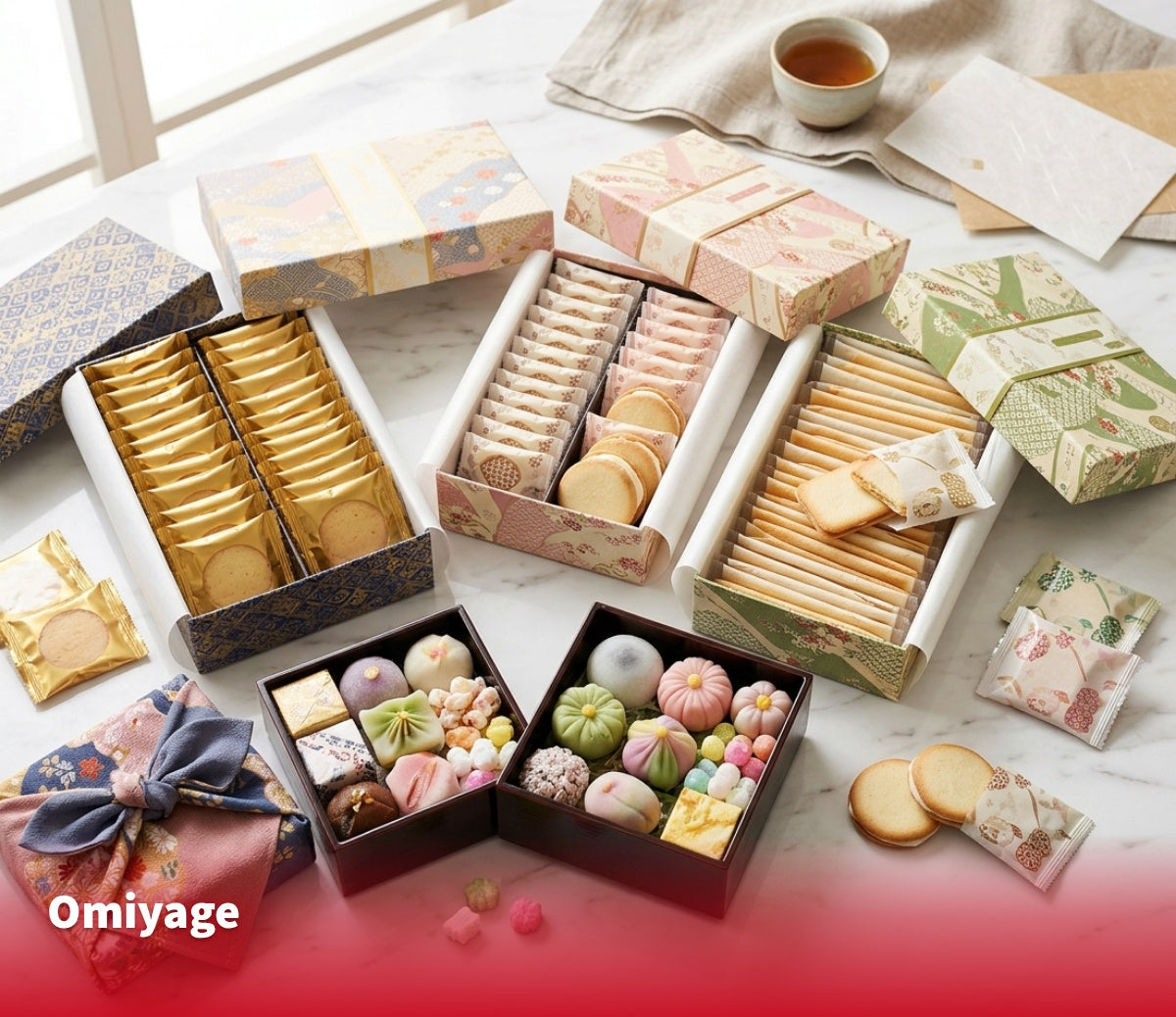

You return from a weekend trip to Kyoto. On Monday morning, before you even sit down, you place a neatly wrapped box of sweets on the shared table in your office. Twenty cookies for twenty people. Everyone takes one, says thank you, and the box is empty by noon.
This is "omiyage" (souvenir gifts)—one of Japan's most deeply embedded social rituals. It is not a nice gesture. It is an obligation. And it has quietly shaped an entire nation's confectionery industry, from how cookies are wrapped to how boxes are designed. If you have ever wondered why Japanese snacks come individually wrapped in beautiful boxes with exactly the right count, the answer is omiyage.
Understanding this tradition will change how you choose Japanese snacks as gifts—and help you select with the precision of a Japanese traveler.
Looking for gift-worthy Japanese snacks? Browse our full collection at Tokyo Stash.
What You'll Learn
- 1) The omiyage obligation: why it's not optional
- 2) The four rules of a perfect omiyage
- 3) How omiyage shaped Japan's snack industry
- 4) Choosing Japanese snack gifts like a local
1) The Omiyage Obligation: Buy One for Everyone, or Buy None at All
In most Western countries, bringing back souvenirs is a thoughtful bonus. You might grab a magnet, a postcard for a friend, maybe chocolates for your family. Nobody expects anything. Nobody notices if you don't.
In Japan, the calculation is entirely different.
When a Japanese person returns from a trip—a weekend getaway, a business conference, a vacation abroad—they are socially expected to bring back edible gifts for their workplace and their neighborhood circle. This is omiyage, and skipping it is not an option. It would be noticed. It would be talked about. It would be interpreted as a failure of social consideration.
The math is specific. If your department has 20 people, you buy a box with at least 20 individually wrapped pieces. If you belong to two groups—your team and a project group—you buy two separate boxes. A 2023 survey by the travel platform Jalan found that Japanese travelers spend an average of 4,000 to 6,000 yen (roughly $27 to $40) on omiyage per trip—specifically on gifts for others.
This concept of "ninzu-bun" (enough for every person) has no parallel in Western gift culture. You count heads, check the box for the exact number, and ensure nobody is left out. Leaving one person without a piece—even accidentally—would cause discomfort for everyone involved.
2) The Four Rules of a Perfect Omiyage
Not just any snack qualifies as omiyage. Japanese travelers evaluate potential gifts against a strict, unwritten set of criteria that has been refined over generations. A perfect omiyage must satisfy four conditions simultaneously.
Rule 1: It must be individually wrapped
This is non-negotiable. Each piece must come in its own sealed packet so it can be distributed hygienically. Nobody wants to reach into a shared bag with their fingers. Individual wrapping means each person receives a clean, untouched portion—an expression of "ki-kubari" (attentive consideration for others). What looks like excessive packaging to Western eyes is, in Japan, a fundamental act of respect.
Rule 2: The count must be sufficient
Japanese omiyage boxes are sold in precise quantities: 8 pieces, 12 pieces, 18 pieces, 24 pieces, 30 pieces. These numbers are not arbitrary—they correspond to common group sizes. A savvy buyer will choose a box with slightly more pieces than the number of people, because running short is far worse than having a few extra.
Rule 3: It must represent the destination
The best omiyage carries the identity of the place you visited. Hokkaido means Shiroi Koibito (White Lover butter cookies by Ishiya) or Royce chocolate. Kyoto means matcha sweets. Tokyo means Tokyo Banana. Hokkaido also boasts Rokkatei's Marusei Butter Sandwich—one of Japan's most beloved omiyage. Buying a generic snack defeats the purpose. The omiyage should say: "I went to this place, and I thought of you."
Rule 4: The presentation must be beautiful
The box matters almost as much as what's inside. Japanese omiyage packaging is designed to impress—elegant typography, seasonal colors, sometimes a window showing the contents. When you place the box on the office table, it should look like something worth pausing for, not something grabbed last-minute from a convenience store.
When all four conditions align, the omiyage becomes more than food. It becomes a gesture that says: "I traveled, I enjoyed myself, and I didn't forget about you."
3) How Omiyage Built Japan's Snack Industry
Here is the part that most people outside Japan never consider: the omiyage tradition didn't just influence how snacks are packaged. It fundamentally shaped how Japan's confectionery industry operates.
The souvenir economy is enormous
Walk through any major train station in Japan—Tokyo Station, Kyoto Station, Shin-Osaka—and you will encounter something with no equivalent in Europe or America: an entire floor dedicated to omiyage. At Tokyo Station alone, the underground "Gransta" complex houses over 80 confectionery shops. The retail space devoted to souvenir sweets at a single station exceeds the total floor area of most Western chocolate shops.
Japanese airports follow the same pattern. At Narita and Haneda, the omiyage sections are among the highest-grossing retail zones in the terminal. The combined market for omiyage and "temiyage" (gifts you bring when visiting someone's home) was estimated at over 500 billion yen ($3.3 billion) annually.
Manufacturers design for omiyage first
Because the omiyage market is so vast, manufacturers don't make good snacks and then figure out packaging. They design products from the ground up with omiyage in mind. Individual wrapping, precise counts, regional identity, beautiful packaging—these are engineering requirements, not afterthoughts.
Consider Shiroi Koibito by Ishiya, Hokkaido's most famous souvenir. Each butter cookie sandwich is individually sealed. The box comes in sizes of 9, 12, 18, 24, and 36 pieces—calibrated for different group sizes. The cookie was created in 1976 specifically as a Hokkaido souvenir, not as a supermarket product that happened to become popular with travelers.
The same logic applies to Tokyo Banana (launched in 1991 as a Tokyo-exclusive souvenir), Rokkatei's Marusei Butter Sandwich (Hokkaido's other legendary omiyage), and hundreds of regional specialties across Japan's 47 prefectures.
The "limited edition" obsession is an omiyage strategy
Japan's snack industry is famous for releasing an almost absurd number of limited-edition flavors. KitKat alone has produced over 400 varieties. This isn't random experimentation—it's driven by omiyage logic.
A limited regional flavor creates the perfect omiyage proposition: "You can only buy this here." The phrase "koko dake" (only here) is printed on countless omiyage boxes, and it is one of the most powerful selling propositions in Japanese retail. Exclusivity turns a snack into a story, and a story into social currency.
When you see individually wrapped Japanese snacks in beautifully designed boxes with region-specific flavors, you are not looking at a packaging trend. You are looking at the physical manifestation of a gift-giving culture that has been shaping product design for decades.
4) Choosing Japanese Snack Gifts Like a Local
Now that you understand the omiyage mindset, you can apply these principles when choosing Japanese snacks as gifts—whether sending a care package, bringing treats to an office party, or selecting a gift for someone who loves Japan.
Think in numbers, not in "a box"
Before choosing a product, count your recipients. Gifting to a team of 10? Look for a box with at least 12 pieces. Covering two groups? Buy two separate boxes. The Japanese approach treats each recipient as an individual who deserves their own piece—not a handful scooped from a communal container.
Prioritize individual wrapping
Check whether each piece is individually sealed. This isn't just about hygiene—it signals care. An individually wrapped cookie says: "This was prepared for you." A loose cookie from a shared tin says nothing. Most Japanese gift snacks—Shiroi Koibito, Tokyo Banana, Country Ma'am gift boxes, KitKat Mini assortments—come individually wrapped by default, because they were designed for giving.
Choose variety when possible
Japanese omiyage boxes often come in assorted flavors. This is deliberate—it gives each recipient a small surprise and creates conversation. "Which flavor did you get?" becomes a moment of shared experience. Assortment boxes carry more social energy than a box of identical items.
Let the packaging do the talking
In Japan, people rarely re-wrap omiyage. The original packaging is the presentation. The box design, the color scheme, and even the weight of the paper all contribute to the gifting experience. When you choose a Japanese snack as a gift, the packaging is the first thing your recipient sees, and it sets the tone for everything inside.
Match the gift to the occasion
A casual office share calls for crowd-pleasing flavors—chocolate, vanilla, matcha. A personal gift allows for adventurous choices—wasabi, sakura, seasonal specialties. Think about your audience the way a Japanese traveler would: not "What do I like?" but "What will make them feel considered?"
Conclusion: The Gift Is the Thought, Multiplied by Twenty
Omiyage is not about the snack. It is about the invisible thread connecting a traveler to the people back home. Every individually wrapped cookie, every precisely counted box, every beautifully designed package carries the same message: "I was away, but I was thinking of you."
This philosophy shaped Japan's confectionery industry in ways no other market can replicate. The individual wrapping, the exact counts, the regional exclusives, the stunning packaging—none of these are marketing gimmicks. They are responses to a culture where giving is an expectation, and your gift reflects the quality of your relationships.
Next time you choose a Japanese snack gift, think like a Japanese traveler. Count your people. Check the wrapping. Consider the presentation. In Japan, a box of cookies is never just a box of cookies. It is proof that someone was counting heads and thinking of every single one.
Ready to choose the perfect Japanese snack gift? Explore our full collection at Tokyo Stash.
Explore more Japanese snacks and culture stories on Tokyo Stash.