
Some of the world's best snacks were never supposed to exist. Chocolate chip cookies happened because Ruth Wakefield expected her chocolate chunks to melt into the dough. Potato chips were born when a chef sliced potatoes spitefully thin to annoy a complaining customer. And in a small rice cracker workshop in 1920s Japan, a woman accidentally stepped on a metal mold and created a snack that would become the country's most beloved drinking companion for the next hundred years.
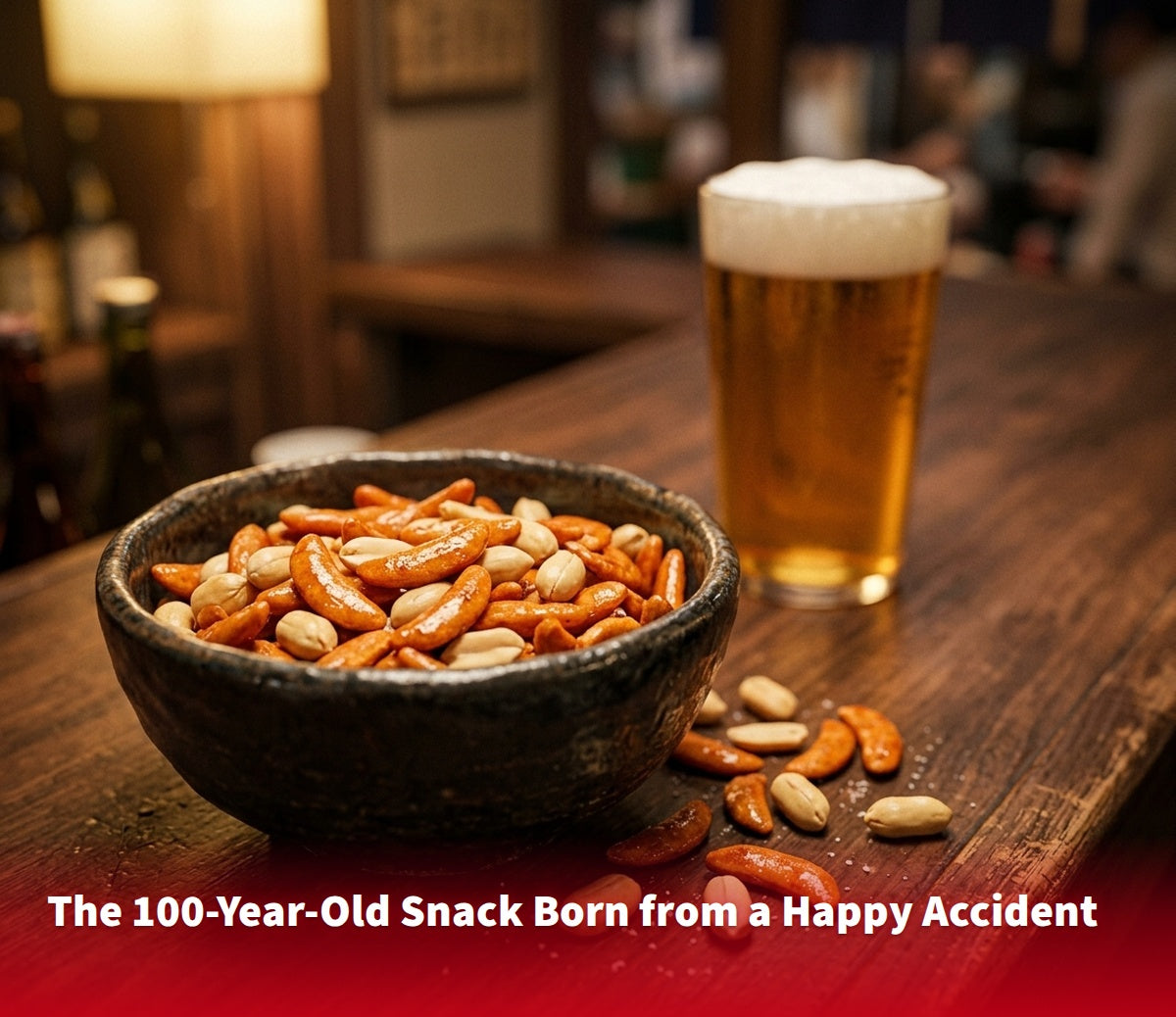
That snack is Kaki no Tane—tiny, crescent-shaped rice crackers dusted with soy sauce and chili, almost always paired with roasted peanuts. In Japan, the name is as familiar as "pretzel" is in the West, yet outside Japan it remains one of the great undiscovered snack treasures. Kaki no Tane is the snack you reach for when the beer is cold, the evening is long, and you want something that rewards you with every single bite—a sharp crack of spice, a bloom of soy-sauce umami, and then the quiet, creamy reprieve of a peanut before you reach for another.
This is the story of how a crescent-shaped accident became a national institution—and why, a century later, Japan still cannot stop debating the perfect ratio of crackers to peanuts.
Want to try Japan's favorite beer snack? Explore Kameda products available at Tokyo Stash.
What You'll Learn
- 1) The happy accident: how a broken mold created an icon
- 2) The great ratio debate: 7:3, 6:4, or all crackers?
- 3) Japan's ultimate beer snack
- 4) From classic to chocolate: the Kaki no Tane universe
1) The Happy Accident: How a Broken Mold Created an Icon
The origin of Kaki no Tane reads like a folk tale, but it is documented history. In the early 1920s, in Niigata Prefecture—Japan's rice country, the region that would later become the heartland of the nation's rice cracker industry—a small senbei maker was producing round, flat rice crackers using traditional metal molds. One day, the maker's wife accidentally stepped on one of the molds, warping it from a perfect circle into a flattened crescent. The damaged mold should have been discarded. Instead, the baker decided to use it anyway and see what happened.
What happened was a rice cracker shaped like nothing anyone had seen before. It was not round and flat like a proper senbei. It was narrow, curved, and tapered at both ends—a miniature crescent that bore an uncanny resemblance to the seed of a kaki (persimmon). Someone noticed the likeness, the name stuck, and Kaki no Tane—literally "persimmon seeds"—was born.
The early versions were simple: small pieces of glutinous rice dough, shaped by the dented mold, dried, and coated with soy sauce. There were no peanuts. There was no chili. Just the cracker itself—bite-sized, intensely savory, and with a satisfying crunch that was sharper and more aggressive than a traditional round senbei. The shape turned out to be more than cosmetic. Because each piece was small and slim rather than broad and flat, it fractured differently in the mouth—a quick, clean snap rather than a slow, crumbly break. That snap became the signature.
For decades, Kaki no Tane remained a regional product, one of many small rice cracker varieties sold across Niigata and neighboring prefectures. Its transformation into a national phenomenon began in 1957, when Kameda Seika was founded in Kameda, a town in Niigata that sits in the middle of Japan's most productive rice-growing plain. Kameda Seika did not invent Kaki no Tane, but they did something arguably more important: they industrialized it, standardized it, and turned a local curiosity into a mass-market product.
Kameda's innovation was twofold. First, they perfected the seasoning. The original soy sauce coating was refined into a proprietary blend of soy sauce and togarashi (red chili pepper) that gave each cracker a gentle heat—not enough to overwhelm, but enough to make your tongue tingle and your hand reach for another. Second, and more consequentially, they added peanuts. No one knows exactly when peanuts joined the mix—the best estimates place it in the 1960s—but the addition was transformative. The dry, spicy cracker suddenly had a partner: something mild, creamy, and slightly sweet to balance the salt and heat. The combination was so intuitive, so immediately satisfying, that within a few years it became impossible to imagine one without the other.
By the 1970s, Kameda Seika's Kaki no Tane had established itself as one of Japan's defining snack products. The iconic orange-red packaging—a color chosen to echo the soy-chili seasoning—became as recognizable in Japanese supermarkets as the Lay's yellow bag is in American ones. The name Kameda no Kaki no Tane entered everyday language, shortened by most people to simply "kakinotane"—said fast, as a single word, the way Americans say "Doritos" without thinking about it.
2) The Great Ratio Debate: 7:3, 6:4, or All Crackers?
In most countries, people argue about politics, sports, and whether pineapple belongs on pizza. In Japan, they argue about the ratio of Kaki no Tane crackers to peanuts. This is not a joke. It is a genuine cultural phenomenon that has persisted for decades and occasionally makes national news.
The issue is deceptively simple. Open a bag of Kameda's Kaki no Tane and you will find two things: the crescent-shaped rice crackers and roasted peanuts. They are mixed together in a specific proportion. But what should that proportion be? The answer, it turns out, depends on who you are and how you eat.
For most of its commercial history, the ratio was 6:4—six parts crackers to four parts peanuts, measured by weight. This was the original formula that Kameda established, and for decades it went unquestioned. The balance felt natural: roughly equal parts spicy and mild, crunchy and creamy. Plenty of peanuts to temper the heat. Enough crackers to keep the flavor assertive.
But a vocal faction always existed—people who felt there were too many peanuts. Their argument was simple: the crackers are the star. The soy-chili crunch is the reason you buy Kaki no Tane. Peanuts are fine as a supporting actor, but they should not be taking up 40 percent of the stage. These partisans wanted more cracker, less nut. Others pushed back: the peanuts are essential. Without enough of them, the heat becomes relentless. The creamy nuttiness is what makes the snack sustainable over a long drinking session. Remove peanuts and you just have a bag of small, spicy senbei.
In 2019, Kameda Seika did something remarkable. Rather than settling the debate internally, they put it to a national vote. The "Kaki no Tane National Ratio Poll" invited the Japanese public to choose their ideal proportion from several options. The campaign was covered by major media outlets. Social media erupted. Over 250,000 votes were cast—a quarter of a million people expressing a strong opinion about the relative volume of rice crackers and peanuts in a snack bag.
The result: 7:3 won decisively. Seven parts crackers, three parts peanuts. The cracker partisans had triumphed, but not by an extreme margin. The winning ratio acknowledged that peanuts matter—just not as much as they used to. Kameda officially changed the recipe in 2020, and 7:3 has been the standard ever since.
What makes the ratio debate fascinating is what it reveals about how Japanese consumers engage with food. This is not a product where you taste one element at a time. Eating Kaki no Tane is a process of self-directed mixing. You grab a handful, and within that handful, the ratio of crackers to peanuts determines the overall experience. Too many crackers and the heat builds without relief. Too many peanuts and the spice gets buried under mildness. The "right" ratio is personal, and the fact that 250,000 people voted on it tells you how seriously Japanese snack culture takes the question of balance.
The seasoning itself deserves attention. Each cracker is coated in a blend of soy sauce and togarashi (red chili pepper), with subtle variations in the exact formula that Kameda guards carefully. The soy sauce provides a deep, fermented saltiness—not just "salty" but umami-salty, with the complex depth that only soy sauce can deliver. The chili adds heat, but it is a gentle, back-of-the-throat warmth rather than the immediate burn of something like a habanero. Together, they create a flavor that is savory, slightly spicy, and almost addictively moreish—the kind of taste that makes you eat three more pieces while you are still deciding whether you want another.
Against this, the peanut plays a precise role. Roasted and unseasoned, it arrives in the mouth as a counterpoint: mild where the cracker is sharp, creamy where the cracker is crunchy, sweet where the cracker is salty. The combination is not random. It follows the same logic as Thai chili-peanut sauces, Mexican chili-lime peanuts, and Chinese spicy nut mixes—cultures around the world have independently discovered that spice and peanut together create something greater than the sum of their parts. Kameda's version is simply the most refined, the most obsessively calibrated iteration of that universal pairing.
3) Japan's Ultimate Beer Snack
In Japanese, there is a word that has no direct English translation: otsumami. It refers to food eaten specifically as an accompaniment to alcohol—not a meal, not a dessert, but a category of small, savory bites whose entire purpose is to make drinking more enjoyable. Every Japanese izakaya (pub) serves otsumami. Every convenience store devotes shelf space to it. And at the very top of the otsumami hierarchy—in polls, in sales figures, in cultural consciousness—sits Kaki no Tane.
The pairing of Kaki no Tane and beer is not just popular. It is iconic. Ask a Japanese person to name the single best snack to eat with beer, and Kaki no Tane will top the list more often than any other. The reasons are partly scientific and partly cultural, and understanding them explains why this particular snack has held its position for generations.
Start with the flavor chemistry. The soy-chili seasoning on each cracker is engineered—whether intentionally or through decades of evolutionary refinement—to trigger thirst. Salt makes you want liquid. Chili heat, even mild heat, creates a desire for something cold and carbonated to extinguish it. Beer answers both calls simultaneously. The cold temperature soothes the heat. The carbonation lifts the salt from your palate. The mild bitterness of hops complements the soy sauce's umami. It is a closed loop: the cracker makes you want the beer, and the beer makes you want the cracker.
Then there is the textural contrast. Beer is liquid, smooth, and effervescent. Kaki no Tane is dry, hard, and brittle. The crunch of the cracker against the backdrop of a cold sip creates a sensory oscillation—solid to liquid, dry to wet, silence to snap—that keeps both elements feeling fresh no matter how long the session lasts. This is the same principle that makes pretzels work with beer in Germany or peanuts work with beer in American bars, but Kaki no Tane adds the spice dimension that pretzels and plain peanuts lack.
The size and format matter too. Each cracker is tiny—roughly the size of a sunflower seed. You do not need to bite, tear, or break anything. You simply toss a few into your mouth and crunch. This makes Kaki no Tane the ultimate mindless nibbling snack, designed for situations where your hands are busy with a glass and your attention is on conversation, a baseball game, or the evening news. The individual pieces are small enough that eating feels continuous rather than episodic. There is no moment of commitment—no unwrapping, no breaking a piece off, no getting crumbs everywhere. Just a steady stream of crunch and spice.
Kameda understands the drinking occasion so well that they package Kaki no Tane accordingly. The most popular format is a long bag divided into six individual pouches, each containing a single-serving portion. This is not about freshness alone—it is about pacing. One pouch accompanies one beer. Open a pouch, pour a glass, and the two are calibrated to run out at roughly the same time. It is portion design as ritual design.
The cultural context runs deeper still. Japan's drinking culture is built around the concept of nomi-kai—gatherings centered on drinking, whether at an izakaya with coworkers or at home with family. At a nomi-kai, the food is secondary to the social function; it exists to sustain the drinking and the conversation, not to be the focus itself. Kaki no Tane is the perfect nomi-kai snack because it demands nothing. It sits in a bowl at the center of the table. People reach for it absently, without interrupting the flow of talk. It does not require plates, chopsticks, or attention. It is the social lubricant's lubricant.
Consider the home version of this ritual, repeated in millions of Japanese households every evening: a person settles onto the sofa after work, opens a can of beer, tears open a pouch of Kaki no Tane, and turns on the television. Baseball in summer. Soccer in winter. News anytime. The crunching becomes ambient, almost unconscious. The pattern—sip, crunch, sip, crunch—is meditative in its repetition. It is not dramatic. It is not Instagram-worthy. It is simply one of the most deeply embedded food rituals in Japanese daily life.
Western bar snacks serve a similar function, but none achieve the same specificity. Pretzels are salty but one-dimensional. Beer nuts are rich but lack crunch variation. Popcorn absorbs moisture and goes limp. Kaki no Tane, with its soy-chili seasoning and peanut counterpoint, its unbreakable crunch and its built-in portion control, occupies a niche that no Western snack quite fills. It is the snack that was shaped—literally, by a dented mold—for this exact purpose.
4) From Classic to Chocolate: The Kaki no Tane Universe
For decades, Kaki no Tane meant one thing: soy-chili crackers with peanuts. The formula was untouchable, the kind of product so perfectly calibrated that variation seemed unnecessary. But Japan's relentless snack innovation culture eventually came for Kaki no Tane too, and what emerged is a product universe far wider than the original's simplicity would suggest.
The original flavor remains the foundation and the bestseller. The soy sauce-and-chili seasoning that Kameda perfected decades ago has been subtly adjusted over the years—the company admits to periodic formula tweaks—but the core experience is unchanged: a sharp, savory crack followed by gentle heat, tempered by the creamy peanut. This is the version that Japan collectively decided should be mixed at a 7:3 ratio. It is the default, the benchmark, the one that stocks every convenience store in the country 365 days a year.
The first major variant, and the one that comes closest to rivaling the original in popularity, is wasabi. Kameda coats the crackers in a wasabi-soy seasoning that replaces the chili heat with wasabi's distinctive nasal burn—that sharp, clearing sensation that rises through the sinuses rather than sitting on the tongue. The effect with peanuts is different from the original: where chili-soy and peanut create a warm, simmering cycle, wasabi-soy and peanut create a sharper oscillation between intensity and relief. Wasabi Kaki no Tane has become the go-to variant for people who find the original's heat too mild and want something that wakes the senses up more aggressively. It is also, not coincidentally, a superb match for Japanese beer—the nasal heat of wasabi and the cold effervescence of lager create an almost electric contrast.
Beyond wasabi, Kameda has released a steady stream of seasonal and limited-edition flavors. Ume (pickled plum) brings a tart, salty sourness that is unmistakably Japanese—the same flavor profile that Japanese people crave in their rice balls and lunch boxes. Curry coats the crackers in a Japanese-style curry powder that is warmer and sweeter than Indian curry, with notes of turmeric and fruit chutney. Both are widely available and have earned permanent spots in the rotation, though neither commands the market share of original or wasabi.
The truly surprising evolution came when Kameda crossed into chocolate territory. Choco Kaki no Tane coats the rice crackers in chocolate—milk, dark, or white—creating a snack that blurs the line between savory and sweet. The concept sounds dissonant until you taste it. The soy sauce seasoning on the cracker bleeds through the chocolate coating, producing a salt-sweet-umami combination that echoes the logic of salted caramel or chocolate-covered pretzels, but with a distinctly Japanese accent. The crunch of the rice cracker beneath the smooth chocolate shell adds a textural contrast that a plain chocolate bar cannot offer. Milk chocolate versions lean sweet and accessible. White chocolate versions let the soy-sauce-salty cracker assert itself more prominently. Both have developed cult followings, particularly as gifts—a box of Choco Kaki no Tane is one of those presents that looks whimsical but tastes genuinely impressive.
Kameda has also produced premium and limited-edition boxes aimed at the gift market. These feature higher-quality ingredients, more elegant packaging, and flavors that push further into gourmet territory. Regional editions surface occasionally, tying flavors to specific prefectures in the same gotochi tradition that drives KitKat and Pocky regional variants. The premium boxes have helped reposition Kaki no Tane from a humble beer snack to something that can sit respectably on a gift shelf alongside high-end senbei and wagashi.
Perhaps the most unexpected chapter in the Kaki no Tane story is its journey beyond Earth. In 2014, JAXA (the Japan Aerospace Exploration Agency) certified a specially formulated version of Kaki no Tane as a space-approved snack for astronauts aboard the International Space Station. The space version was adapted for zero-gravity conditions—no loose crumbs that could float into equipment, no peanuts that could cause allergic reactions in a confined environment. Japanese astronaut Soichi Noguchi carried Kaki no Tane into orbit, and the image of a Japanese snack floating weightlessly in the ISS galley became a point of quiet national pride. It was a fitting milestone for a product born from an accident: a snack that was never supposed to exist, eaten in a place humans were never supposed to reach.
The most recent trend in Kaki no Tane culture is the emergence of pairing menus at craft beer bars across Japan. Just as sommeliers pair wine with cheese, a growing number of Japanese beer bars have begun pairing specific Kaki no Tane flavors with specific beer styles. Original with a crisp pilsner. Wasabi with a hop-forward IPA. Curry with a malty amber ale. Chocolate-coated with a rich stout. These pairings treat Kaki no Tane not as a casual bar snack but as a tasting ingredient—a recognition that the flavor range Kameda has built over the decades is sophisticated enough to warrant the same attention that craft beer enthusiasts give to their hops and malts.
From a dented mold in 1920s Niigata to the galley of the International Space Station, from a six-pack of pouches on a living room table to a curated tasting flight at a Tokyo craft beer bar—the Kaki no Tane universe keeps expanding. But it expands from a center that has never moved. The original cracker, shaped like a persimmon seed, seasoned with soy and chili, partnered with a peanut, remains. Everything else is variation on a theme that was perfect from the start.
Conclusion: The Snack That Was Never Supposed to Exist
A hundred years is a long time for any product to survive, let alone a snack born from a workshop accident. Kaki no Tane has endured not because of brilliant marketing or aggressive expansion, but because of something simpler: it is exactly right. The crunch is right. The seasoning is right. The size—small enough to eat without thinking, large enough to deliver a satisfying snap—is right. And the partnership with peanuts, arrived at through trial and intuition rather than consumer research, turned a good rice cracker into one of the most complete snacking experiences ever devised.
The ratio debate, the wasabi variant, the chocolate crossover, the space station certification—these are all chapters in a story that keeps generating new ones. But the core of Kaki no Tane remains what it has always been: a small, crescent-shaped cracker that delivers soy sauce, chili, and crunch in a single bite, then asks you—politely, insistently—to take another.
Pour a cold beer. Tear open a pouch. Listen to the crunch. A hundred years after a bent mold created something no one planned, the accident has become the ritual, and the ritual shows no sign of ending.
Ready to discover Japan's favorite beer snack? Explore Kameda's Kaki no Tane collection at Tokyo Stash.
Explore more Japanese snacks and culture stories on Tokyo Stash.