
There is a phrase in Japan that nearly everyone knows. It does not come from a poem, a song, or a politician. It comes from a bag of shrimp chips: "Yamerarenai, tomaranai" — can't stop, won't stop. Say those words in any Japanese household, and the response is automatic: Kappa Ebisen.
Since 1964, Calbee's shrimp-flavored snack has held a position in Japanese food culture that has no real Western equivalent. It is not a luxury item. It is not a health food. It is a simple, curved chip made from real shrimp — shells and all — that has somehow remained one of the best-selling snacks in Japan for over sixty years. In a market that rotates limited-edition flavors every few weeks, Kappa Ebisen endures because it does one thing so well that nothing else comes close.
This is the story of why Japan's most addictive snack earned that slogan, what makes it fundamentally different from every other shrimp chip on the planet, and how a single product became a multi-generational institution — from toddlers to grandparents.
Want to try the original? Explore Calbee products available at Tokyo Stash.
What You'll Learn
- 1) "Yamerarenai, Tomaranai" — the most famous snack slogan in Japan
- 2) Real shrimp, not flavoring — the key differentiator
- 3) How a shrimp becomes a chip
- 4) The Kappa Ebisen family — from toddlers to connoisseurs
1) "Yamerarenai, Tomaranai" — The Most Famous Snack Slogan in Japan
In 1969, five years after Kappa Ebisen first hit shelves, Calbee launched a television commercial that would alter the trajectory of Japanese advertising. The jingle was built around a single phrase: "Yamerarenai, tomaranai, Kappa Ebisen" — roughly, "Can't stop, won't stop, Kappa Ebisen." It was catchy. It was rhythmic. And it described, with surgical accuracy, what actually happens when you open a bag.
The slogan did not just sell chips. It entered the Japanese language. Today, more than fifty years later, yamerarenai, tomaranai is used in everyday conversation to describe anything compulsively enjoyable — a TV drama you binge-watch, a puzzle game on your phone, a stretch of perfect weather that keeps you walking. Japanese people use it without even thinking about snack food. But everyone knows where it came from. Surveys by advertising research firms have consistently ranked it among the most recognized slogans in Japanese history, alongside the jingles of Suntory, Shiseido, and Toyota.
The commercials themselves became cultural artifacts. Early Kappa Ebisen CMs featured the Kappa — a mythological water creature from Japanese folklore — dancing and eating chips in a riverbed. The kappa, a cucumber-loving, mischief-making spirit that inhabits rivers and ponds, was the snack's mascot from the beginning. The name "Kappa Ebisen" literally combines the creature's name with ebi (shrimp) and sen (from senbei, rice cracker). Over the decades, the commercial style evolved — from animated kappa to celebrity endorsements to modern CGI — but the slogan never changed. It did not need to. When something works at that level, you do not touch it.
What made the slogan so effective was its honesty. This was not aspirational marketing or lifestyle branding. It was a plain statement of physical reality: once you start eating Kappa Ebisen, the interplay of salt, shrimp umami, and satisfying crunch creates a feedback loop that your hand simply will not stop responding to. The bag empties before you realize what happened. Calbee did not need to exaggerate. They just described the experience.
Kappa Ebisen was one of Calbee's earliest products, launching alongside Kappa Arare — a shrimp-flavored rice cracker that predated it. Founded in 1949 in Hiroshima by Takashi Matsuo, Calbee was still a small, regional company when Kappa Ebisen debuted. The product's success was transformative. It gave Calbee its first national hit, funded the company's expansion across Japan, and established the identity that would eventually make Calbee the largest snack food company in the country. Without Kappa Ebisen, there is no Jagariko, no Potato Chips Consomme, no Calbee as we know it today. The shrimp chip built the house.
2) Real Shrimp, Not Flavoring — The Key Differentiator
Here is the fact that surprises most people outside Japan: Kappa Ebisen contains real shrimp. Not shrimp extract. Not shrimp flavoring. Not a chemical approximation of what shrimp might taste like if you squinted hard enough. The dough from which every single chip is made includes whole shrimp ground directly into the mixture — shells, tails, and all.
This is the fundamental difference between Kappa Ebisen and virtually every other shrimp chip or prawn cracker sold anywhere in the world. Most "shrimp chips" — including popular Southeast Asian varieties and the prawn crackers served at Chinese restaurants — rely on shrimp paste, shrimp extract, or artificial shrimp flavoring to deliver their taste. The base is typically starch or flour with seafood seasoning added to it. The shrimp is a guest. In Kappa Ebisen, the shrimp is a structural component.
Calbee uses several species of shrimp, sourced primarily from the waters around Japan and Southeast Asia. The shrimp are dried and ground into a fine powder that is blended directly into the wheat flour and starch dough. The shells are not removed because they serve a dual purpose: they contribute calcium — Calbee highlights this nutritional benefit on the packaging — and they deliver a deeper, more complex flavor than shrimp meat alone. Crustacean shells are rich in chitin and minerals that produce subtle roasted and savory notes when heated. It is the same reason a good shrimp stock uses the shells: the flavor lives as much in the armor as in the flesh.
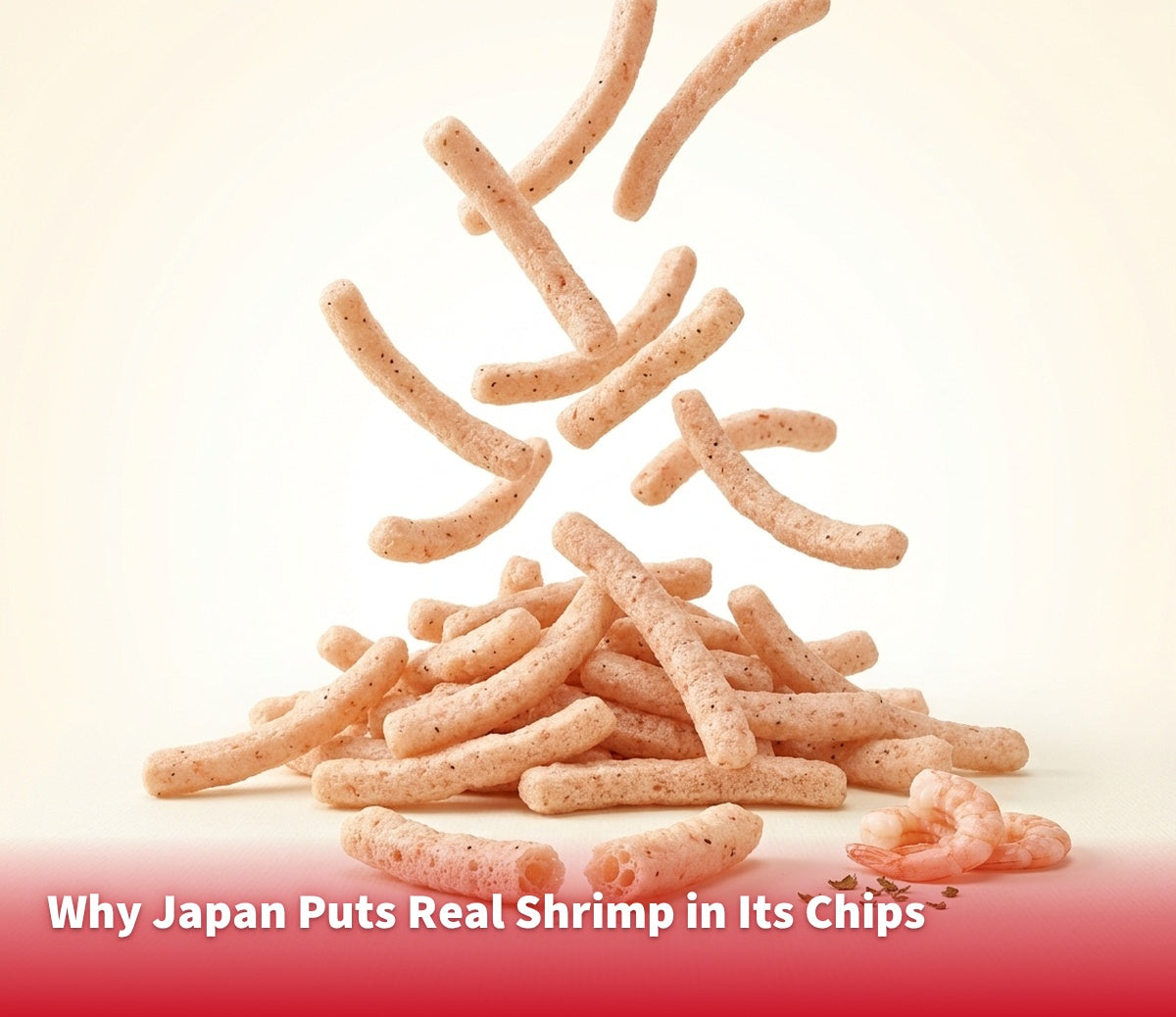
If you hold a Kappa Ebisen chip up to the light — or simply look closely at one in your hand — you can see tiny flecks and specks of shell embedded in the surface. These are not imperfections. They are proof. Each visible fragment is a piece of real shrimp that made it through the mixing and shaping process intact enough to remain visible. It is a transparency you rarely see in mass-market snack foods, and Japanese consumers appreciate it precisely because it confirms what the ingredient list promises.
The flavor this produces is qualitatively different from any artificially flavored product. Where shrimp-flavored chips hit your palate with a single, loud, synthetic note — usually heavy on MSG and garlic powder — Kappa Ebisen delivers a layered experience. The initial taste is gently salty and wheaty. Then the shrimp umami builds, not as an assault but as a slow crescendo — that deep, savory richness that the Japanese call umai. There is a faint sweetness underneath, the natural sweetness of crustacean protein breaking down during cooking. And there is a mineral quality, almost oceanic, that lingers on the palate after the chip dissolves. It tastes, in the most literal sense, like the sea.
This approach connects directly to Japan's identity as a seafood nation. Japan is an archipelago surrounded by some of the richest fishing waters on earth, and shrimp — ebi — occupies a position of honor in Japanese cuisine. From the sweet amaebi (sweet shrimp) served raw at sushi counters to the battered ebi furai (fried shrimp) that appears in every home-style restaurant, shrimp is not an exotic ingredient in Japan. It is elemental. Kappa Ebisen's use of whole, real shrimp is not a marketing gimmick in this context. It is a reflection of a food culture where putting real ingredients in food is not remarkable — it is expected.
3) How a Shrimp Becomes a Chip
The production process behind Kappa Ebisen is deceptively simple in concept and demanding in execution. It begins with the raw ingredients: wheat flour, starch, and dried ground shrimp are combined with water and seasoning to form a dough. The proportions matter enormously — too much shrimp and the dough becomes brittle and difficult to shape; too little and the flavor recedes behind the wheat. Calbee has spent decades calibrating this ratio, and the exact formula is proprietary.
The dough is extruded through a die that gives each chip its distinctive curved, elongated shape — somewhere between a comma and a crescent. This shape is not arbitrary. The curve creates structural integrity that prevents the chip from snapping under its own weight during processing, and it produces a satisfying feel in the mouth — the chip fits naturally against the palate as you bite down, distributing the crunch evenly rather than concentrating force at a single point.
Here is where Kappa Ebisen diverges from most of the snack world: the chips are baked, not fried. This is a critical distinction that defines the entire eating experience. Fried chips — whether potato, corn, or shrimp-based — absorb oil during cooking, which gives them a rich, heavy mouthfeel and a particular kind of greasy crunch. Kappa Ebisen's baking process produces something fundamentally different: a light, airy texture that is closer to a cracker than a chip. The crunch is delicate, almost brittle, with a clean snap that does not leave oil on your fingers or a heavy coating on your tongue.
The baking also transforms the shrimp in ways that frying cannot replicate. As the dough heats in the oven, the proteins in the ground shrimp undergo Maillard reactions — the same chemical process that gives grilled seafood its complex, toasty aroma. Because the chips are not submerged in oil, these delicate Maillard flavors are not muted or overwhelmed. They reach your nose directly. Open a fresh bag of Kappa Ebisen in a quiet room and the aroma is immediately, unmistakably shrimp — not artificial shrimp, but the genuine scent of roasted crustacean, like walking past a fish market grill or standing downwind of a teppanyaki counter cooking ebi.
The texture deserves its own attention. A potato chip is dense and satisfying — you feel it between your teeth. A rice cracker is hard and brittle — it shatters. Kappa Ebisen occupies a middle ground that is distinctly its own. The initial bite produces a clean, light snap, followed by a crumble that dissolves on the tongue with surprising speed. There is no prolonged chewing required. The chip seems to evaporate, leaving behind the shrimp flavor and a faint saltiness that immediately makes you reach for the next one. This dissolving quality is central to why the slogan works: the speed at which each chip disappears creates a rhythm — bite, crunch, dissolve, reach — that becomes genuinely difficult to interrupt.
Comparisons to krupuk — the Southeast Asian prawn crackers ubiquitous in Indonesian, Malaysian, and Vietnamese cuisine — are inevitable but instructive. Krupuk are made from tapioca starch and shrimp paste, then deep-fried until they puff into large, airy, almost styrofoam-like wafers. The texture is cloud-light and the shrimp flavor is mild, carried more by the paste than by whole shellfish. They serve a different culinary purpose: krupuk is a textural accent to a rice-based meal, a scooping tool, a palate cleanser. Kappa Ebisen is a standalone snack designed for direct, focused consumption. The shrimp content is denser, the flavor more concentrated, the texture more refined. Both are shrimp crackers in name. In practice, they are entirely different foods, born from different traditions and consumed in different ways.
4) The Kappa Ebisen Family — From Toddlers to Connoisseurs
The original Kappa Ebisen — the one in the iconic red bag — has been in continuous production since 1964. Its recipe has been refined but never fundamentally altered. It remains, sixty years later, the core product and the highest seller. But Calbee has built an entire family around it, and the range of that family reveals something remarkable about the snack's place in Japanese life.
The most striking member of the lineup is Kappa Ebisen 1-sai kara — literally, "Kappa Ebisen from age 1." This is a version specifically formulated for toddlers, and its existence would astonish most Western consumers. The 1-sai kara edition uses reduced salt (roughly one-third the sodium of the standard product), contains no artificial flavors, colors, or preservatives, and is enriched with calcium from the shrimp shells to support early childhood bone development. Each chip is slightly smaller and softer than the adult version, making it safe for young children who are still developing their chewing skills.
What this product represents culturally is profound. Japanese parents trust Calbee — and specifically trust the real-shrimp formulation of Kappa Ebisen — enough to feed it to their one-year-old children. In a market where parents scrutinize every ingredient on every label, the 1-sai kara edition has become one of the most popular toddler snacks in Japan. It is sold in every supermarket, every drugstore baby section, and every convenience store with a family aisle. Pediatricians do not object. Parenting magazines recommend it. The product is so normalized that it has become part of the standard toolkit of Japanese child-rearing alongside baby rice crackers and fruit pouches.
This creates a remarkable lifecycle. A Japanese child might eat Kappa Ebisen 1-sai kara at age one, graduate to the standard red bag as a schoolchild, snack on it through university, buy it for their own children, and continue eating it into old age. Few snack products anywhere in the world achieve this kind of multi-generational continuity. It is not just that parents and children eat the same brand — they eat the same product, in age-appropriate versions, across an entire lifespan.
At the opposite end of the spectrum sits Kappa Ebisen Zeppin — the premium line. Zeppin translates roughly to "exquisite" or "superb," and the product lives up to the name. Zeppin uses a higher ratio of shrimp to dough, selects premium shrimp varieties, and applies a more delicate seasoning that lets the natural shrimp flavor dominate without distraction. The texture is slightly more refined — thinner, crispier, with an even more pronounced shrimp aroma. It is priced higher than the standard edition and positioned for adult consumers who want something elevated for evening snacking, often alongside beer or sake. The pairing of Kappa Ebisen Zeppin with a cold Japanese beer is, in the opinion of many Japanese adults, one of the simplest and most perfect otsumami — drinking snack — combinations in existence.
Beyond the permanent lineup, Calbee releases seasonal and regional editions of Kappa Ebisen that rotate through the year. These have included collaborations with regional cuisines — mentaiko (spicy cod roe) from Hakata, wasabi from Shizuoka, nori-shio (seaweed salt) variants, and even tartar sauce editions that reference the classic Japanese combination of fried shrimp with tartar. Each edition keeps the core shrimp-dough foundation but layers a new flavor dimension on top, demonstrating the versatility of a base product that is savory and oceanic enough to anchor almost any Japanese seasoning profile.
The numbers speak to the product's endurance. Kappa Ebisen has been one of Calbee's top-selling products every single year since its launch. In a Japanese snack market worth over 3 trillion yen annually, where competition is fierce and consumer attention spans are famously short, sustaining a single product for six decades without a fundamental reformulation is an achievement that borders on the extraordinary. Many of Japan's other snack institutions — Pocky, KitKat, Koala's March — have survived through constant reinvention, new flavors, and aggressive limited-edition cycles. Kappa Ebisen survives because the original is so good that reinvention is optional, not mandatory.
There is a Japanese concept called teiban — the standard, the default, the thing you always come back to. Every category has its teiban: the restaurant dish you always order, the train route you always take, the song everyone knows the words to. In the world of Japanese snack food, Kappa Ebisen is teiban. It is not the newest. It is not the flashiest. It is the one that has been there since before most people alive today were born, and it will still be there long after the latest limited edition has been forgotten.
Conclusion: The Simplest Snack, the Deepest Roots
Kappa Ebisen does not have a complicated story. There is no linguistic accident, no celebrity origin myth, no viral moment that catapulted it to fame. It is a snack made from real shrimp, baked into a light, curved chip, and seasoned with nothing more than salt and the sea's own umami. It earned its slogan — "Yamerarenai, tomaranai" — not through advertising brilliance but through the simple, mechanical truth that eating one makes you want another, and another, and another, until the bag is empty and your fingers smell like a fishing dock.
What makes Kappa Ebisen extraordinary is its persistence. Sixty years of unchanged excellence in a market that worships novelty. A product trusted enough to feed to one-year-olds and sophisticated enough to pair with premium sake. A slogan so perfectly descriptive that it escaped its own product and entered the language itself. And at the center of it all, the simplest possible promise: this chip contains real shrimp, and you can taste it.
The next time you open a bag, hold one chip up to the light. Look for the flecks of shell. Smell the roasted shrimp aroma before you bite. Then try to stop at one. You already know you cannot.
Ready to taste the real shrimp difference? Explore Kappa Ebisen and other Calbee products at Tokyo Stash.
Explore more Japanese snacks and culture stories on Tokyo Stash.