
In 1958, a 48-year-old bankrupt businessman stood in a small wooden shed behind his house in Ikeda, Osaka, stirring a wok full of noodles and oil. He had no factory, no investors, and no staff. What he had was a single observation that would not leave him alone: every night, long lines of hungry people waited in the cold for a bowl of ramen from street stalls in post-war Japan. The country needed a way to eat well, quickly and cheaply. His name was Momofuku Ando, and the product he pulled out of that shed would become one of the most consumed foods in human history.
Today, Nissin Foods is a global corporation with operations in over 20 countries and annual sales exceeding 700 billion yen. It makes Cup Noodles, Chicken Ramen, Donbei, Raoh, U.F.O., and dozens of other brands that fill pantries from Tokyo to Sao Paulo. But what makes Nissin remarkable is not just that it invented a category. It is that the company has reinvented that category over and over again for nearly seven decades, segmenting instant noodles into an entire ecosystem of textures, formats, and eating occasions.
This is the story of how one man's backyard experiment became a global food revolution—and why the Japanese-domestic versions of Nissin's products taste noticeably different from what the rest of the world gets.
Ready to explore the full Nissin lineup? Browse Nissin products at Tokyo Stash.
What You'll Learn
- 1) Momofuku Ando's backyard invention (1958)
- 2) Cup Noodles: the container revolution (1971)
- 3) The domestic arsenal: Donbei, Raoh, U.F.O., and the Japanese pantry
- 4) Why Nissin's Japanese products taste different
1) Momofuku Ando's Backyard Invention (1958)
Momofuku Ando was born in 1910 in what is now Taiwan, then under Japanese rule. He moved to Osaka as a young man and built a modest business career that collapsed entirely in 1957 when he went bankrupt after a series of failed ventures. At 47, he was broke, discredited, and starting from zero. Most people in his position would have retreated. Ando built a shed.
The shed was roughly 10 square meters, barely large enough for a stove, a workbench, and the man himself. His goal was deceptively simple: create a ramen that anyone could prepare at home by just adding hot water. It had to be tasty, inexpensive, safe to store at room temperature, and ready in minutes. For a full year—from the spring of 1957 through the summer of 1958—Ando worked alone in that shed, experimenting with dough recipes, seasoning combinations, and drying methods. He slept four hours a night. He tested and discarded hundreds of approaches.
The breakthrough came when he observed his wife making tempura. She dipped food into hot oil, and the moisture inside flash-evaporated, leaving behind a porous, crispy structure. Ando realized the same principle could dehydrate noodles. By flash-frying cooked noodles in oil at approximately 160 degrees Celsius, he could drive out nearly all the moisture in seconds, creating a dry, shelf-stable block riddled with tiny air pockets. When hot water was poured over it, those pockets would rapidly reabsorb liquid, rehydrating the noodles to something close to their original texture in just two to three minutes.
He called it "flash-frying dehydration" (shunkan yuki kanso ho), and it remains the foundational technology behind most instant noodles produced worldwide today. On August 25, 1958, Nissin launched Chicken Ramen—a single block of flash-fried noodles pre-seasoned with chicken-flavored broth. No separate seasoning packet. No complicated instructions. Just add boiling water, wait three minutes, and eat.
The initial price was 35 yen—roughly six times the cost of fresh ramen from a street stall. Grocery store buyers were skeptical. A luxury-priced instant noodle from an unknown bankrupt? But once consumers tasted it, demand exploded. Within a year, Nissin was struggling to keep up with orders. August 25 is now officially celebrated in Japan as "Instant Ramen Day" (Insutanto Ramen no Hi), a recognition of the date that changed how the world eats.
Chicken Ramen is still in production today, essentially unchanged. The flat block of noodles, the faint golden color from flash-frying, the salty chicken broth that emerges when hot water hits the seasoned surface—it all tastes like 1958. In Japan, it holds a nostalgic status that no other instant noodle can touch. Nissin even added a small indentation on top of the noodle block in 1991, called the "tamago pocket", designed to cradle a raw egg so it cooks gently as the noodles rehydrate. It is a tiny, thoughtful detail—and it is pure Nissin.
2) Cup Noodles: The Container Revolution (1971)
Chicken Ramen was a hit in Japan, but Ando saw a problem when he tried to take the product international. During a trip to the United States in 1966, he watched American supermarket buyers break apart his noodle block, drop the pieces into paper coffee cups, pour hot water over them, and eat with forks. They had no bowls. They had no chopsticks. And they found the portion size strange for a standalone meal.
Most food executives would have adapted the seasoning for Western palates and moved on. Ando reimagined the entire format. If the world did not have bowls, he would build the bowl into the product.
It took five years of development. The challenges were formidable. The container had to be waterproof, heat-resistant, lightweight, and cheap to manufacture. It had to keep the noodles fresh during storage but allow boiling water to be poured directly inside. And it had to feel natural to hold in one hand while eating with the other—a fork in the West, chopsticks in Asia.
Nissin settled on an expanded polystyrene foam cup (later replaced with paper in many markets for environmental reasons). But the real engineering lay inside. The noodles do not sit at the bottom of the cup. They are suspended in the middle, held in place by the tapered shape of the container and the friction of the noodle block against the cup walls. This is the "mid-air" placement technique (chuukan hoji ho), and it solves a critical problem: when boiling water is poured in, it flows both above and below the noodles simultaneously, rehydrating them evenly from all sides. If the noodles sat flat on the bottom, the underside would stay hard while the top turned to mush.
Beneath the noodles, dehydrated ingredients—shrimp, egg, scallions, and small cubes of seasoned meat—are layered so they float upward as the water fills the cup, distributing themselves across the surface. When you open the lid after three minutes, the toppings are visible and evenly arranged, as if placed there by hand. None of this is accidental. Every detail was engineered to create the impression of a freshly assembled bowl of ramen.
Cup Noodle (note: in Japan, the product has always been singular—"Cup Noodle," not "Cup Noodles") launched on September 18, 1971, priced at 100 yen. The initial response was lukewarm. It was expensive and unfamiliar. Then, on February 19, 1972, the Asama-Sanso hostage crisis—a televised police siege that gripped Japan for ten days—inadvertently changed everything. Television cameras captured police officers and journalists eating Cup Noodle during the freezing standoff in the mountains of Nagano. Millions of viewers watched people warming their hands on the steaming cups. Within weeks, Cup Noodle became a household name. It was the first viral food moment in Japanese television history.
Internationally, the product was renamed "Cup Noodles" (plural) for English-speaking markets. It launched in the United States in 1973 and expanded rapidly across Asia, Europe, and Latin America. Today, Nissin sells over 50 billion units of Cup Noodles globally per year. It is the single best-selling instant noodle format in the world.
3) The Domestic Arsenal: Donbei, Raoh, U.F.O., and the Japanese Pantry
Outside Japan, Nissin is synonymous with Cup Noodles. Inside Japan, the picture is far more complex. Nissin has built an entire portfolio of brands, each engineered for a different eating occasion, a different craving, and a different level of commitment from the eater. Understanding this portfolio is like understanding the Japanese approach to convenience food itself.
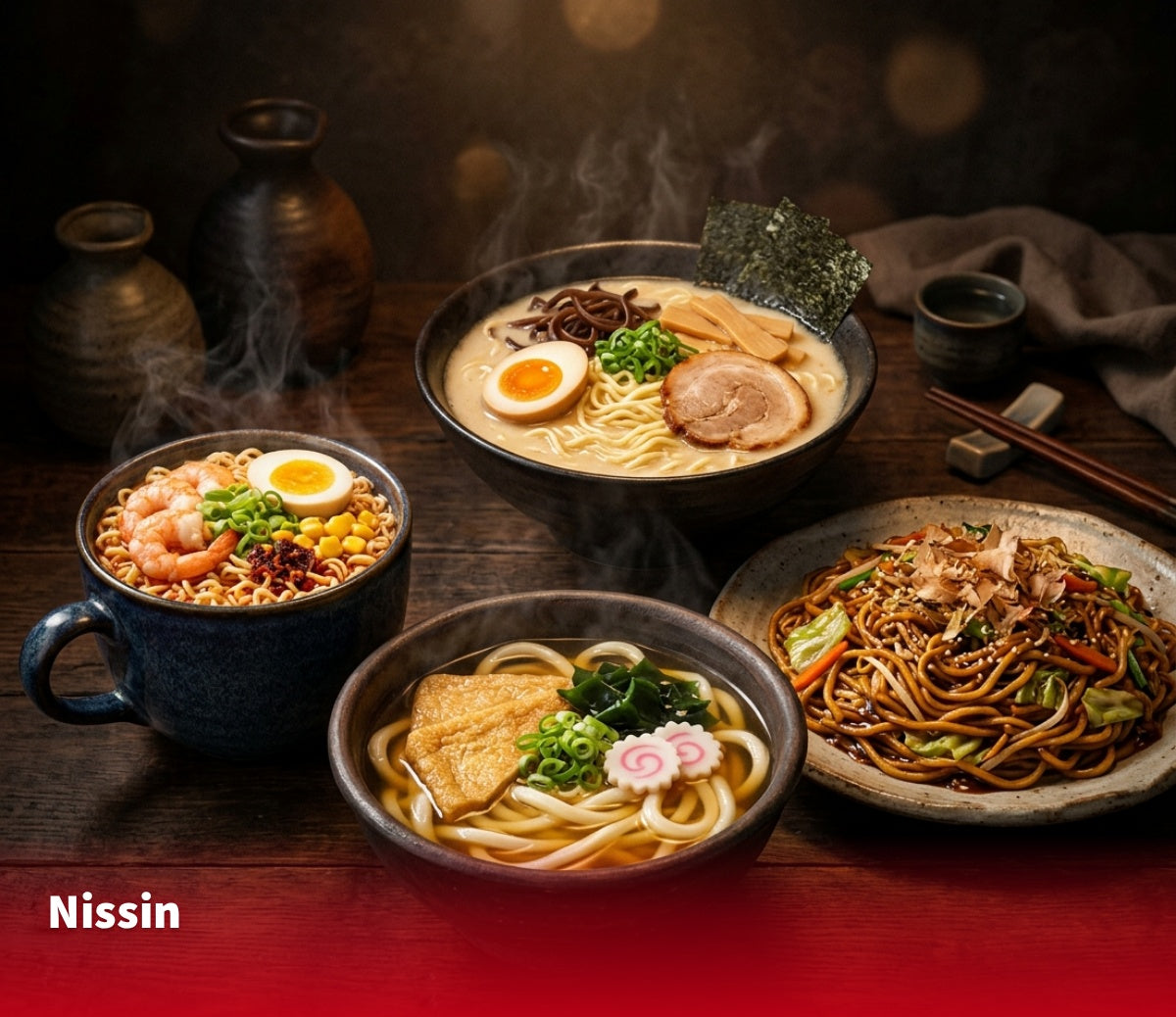
Donbei launched in 1976 and occupies a unique emotional space: it is Japan's instant comfort food. Where Cup Noodle is modern and global, Donbei is traditional and deeply Japanese. The product comes in a wide, bowl-shaped cup and offers udon (thick wheat noodles) and soba (buckwheat noodles) in a clear, golden dashi broth—the kelp-and-bonito stock that forms the backbone of Japanese cuisine. The signature topping is a sheet of kitsune aburaage—sweet, soy-simmered fried tofu—that arrives dehydrated and plumps back to life in the hot broth. Donbei tastes like something your grandmother might serve on a cold evening, except it takes three minutes and fits in your desk drawer. In 2024, Nissin sold its 15 billionth unit of Donbei. There is a fascinating regional detail: the broth recipe differs between eastern Japan (darker, soy-heavy) and western Japan (lighter, dashi-forward), reflecting a culinary divide that has existed for centuries. Nissin is one of the few companies that maintains separate production lines to honor this distinction.
Nissin Raoh (literally "Ramen King") debuted in 1992 and represented a deliberate move upmarket. While Chicken Ramen and Cup Noodle relied on flash-fried noodles, Raoh introduced non-fried, air-dried noodles produced using Nissin's proprietary "triple-layer method" (sansoka seimen). Three layers of dough with different moisture and gluten levels are pressed together and slowly dried, producing a noodle that rehydrates to a texture remarkably close to fresh ramen from a specialty shop—springy, chewy, with a slight resistance when you bite through. The broth packets are richer and more complex than standard instant ramen, often containing pork-bone concentrate, soy tare, and aromatic oil in separate sachets. Raoh is not trying to be cheap or fast. It is trying to make you forget you are eating instant noodles. When it launched, the price point was nearly double that of regular instant ramen—a bold gamble that paid off. The premium instant noodle segment that Raoh created now accounts for a significant portion of Japan's domestic market.
Nissin U.F.O. (standing for "Umai, Futoi, Okii"—delicious, thick, big) launched in 1976 as Japan's definitive instant yakisoba. The format is clever: you pour boiling water in, wait three minutes, then drain the water through a built-in strainer in the lid before adding the thick, sweet-savory yakisoba sauce. The result is stir-fried-style noodles without a drop of broth—chewy, saucy, and substantial. U.F.O. occupies the "I want something heavier than soup noodles" niche, and it does so with a boldness that matches its name. The original U.F.O. sauce is a concentrated blend of Worcestershire, oyster sauce, and soy that clings to the thick noodles with an almost aggressive intensity. Limited editions regularly push the boundaries—extra-large sizes, ultra-spicy variants, collaborations with regional sauce makers. In Japan, U.F.O. is less a product than a personality.
Men Shokunin ("Noodle Craftsman") sits alongside Raoh in the premium tier but takes a different approach. Where Raoh emphasizes rich, heavy broths reminiscent of ramen shops, Men Shokunin focuses on clarity and balance. Its dashi-based soups and refined seasoning packets aim for the elegance of a well-run Japanese noodle house rather than the intensity of a late-night ramen counter. The noodles are thinner and silkier. It is the thinking person's instant ramen—subtle, precise, and easy to underestimate until you taste it side by side with anything else in the category.
This segmentation is deliberate and deeply Japanese. Rather than making one product and extending it into a hundred flavors, Nissin builds distinct brands for distinct moments: Cup Noodle for speed and portability, Donbei for warmth and nostalgia, Raoh for Saturday-night indulgence, U.F.O. for bold satisfaction, Men Shokunin for quiet refinement. A Japanese pantry stocked with all five is not redundant. It is a complete instant noodle toolkit.
4) Why Nissin's Japanese Products Taste Different
If you have ever eaten a Cup Noodle bought in Japan and compared it to one purchased in the United States, the UK, or Southeast Asia, you already know: they are not the same product. The packaging looks similar. The brand name is identical. But the flavor, the noodle texture, and the overall eating experience are noticeably different. This is not your imagination, and it is not an accident.
Nissin maintains separate formulations for virtually every major market. The Japan-domestic versions are developed at the company's research headquarters in Osaka and are optimized for Japanese palates that have been trained on decades of real ramen, real dashi, and real soy sauce. The seasoning profiles are more complex, layering multiple umami sources—bonito, kelp, shiitake, dried sardine—rather than relying on a single dominant flavor. The salt levels are calibrated for Japanese preferences, which tend to run slightly lower than export versions designed for markets accustomed to bolder seasoning. The noodles themselves are often thinner and have a firmer bite, reflecting the Japanese expectation that ramen noodles should have koshi—an elastic, springy resistance that is central to noodle quality in Japan.
Portion sizes tell the same story. A standard Cup Noodle in Japan contains 77 grams of product. Many export versions are 10 to 20 percent larger, adjusted for markets where consumers expect a bigger serving. The Japanese version is designed as a light meal or a supplement—something to eat at your desk at 3 PM or to warm up with after coming home late. It is not trying to replace dinner. This difference in intended occasion shapes everything from calorie count to seasoning intensity.
Then there are the flavors that simply do not exist outside Japan. Seafood Cup Noodle—the second-best-selling flavor in Japan after the original—features a broth built on squid, shrimp, and crab extracts that tastes distinctly oceanic in a way that no export version replicates. Curry Cup Noodle, the third pillar of the domestic lineup, uses a Japanese-style curry seasoning that is sweeter and more aromatic than the Indian- or Thai-influenced curry flavors sold in other markets. Donbei's regional broth variants, Raoh's pork-bone tonkotsu, U.F.O.'s original sauce—none of these have direct equivalents in export lines.
The reason for all of this is straightforward: Nissin invests heavily in R&D, spending approximately 2 to 3 percent of revenue on product development—a figure that translates to billions of yen annually. The company operates multiple research facilities, including a dedicated noodle research center in Osaka and flavor development laboratories that employ food scientists, chemists, and professional tasters. This infrastructure exists primarily to serve the Japanese domestic market, which remains the most competitive instant noodle market in the world. Over 50 brands compete for shelf space in Japanese convenience stores and supermarkets, and consumer expectations are extraordinarily high. A new Cup Noodle flavor that fails a blind taste test against its competitors will never reach store shelves.
For anyone curious about this world, the Cup Noodles Museum (formally the "Momofuku Ando Instant Ramen Museum") offers a tangible way in. There are two locations: the original in Ikeda, Osaka—just minutes from the site of Ando's backyard shed—and a larger facility in Yokohama. The Osaka museum preserves a recreation of the 10-square-meter shed where Chicken Ramen was born, complete with the original tools and equipment. The Yokohama location features a "My Cup Noodles Factory" where visitors design their own cup, choose from dozens of toppings and soup bases, and watch their custom creation get sealed and shrink-wrapped. Both museums attract over a million visitors per year—remarkable attendance for a museum dedicated to instant noodles, and a testament to the cultural weight the product carries in Japan.
The practical takeaway for anyone shopping at Tokyo Stash is simple: the Nissin products we carry are the Japan-domestic formulations. They are the versions developed by Nissin's best food scientists for the world's most demanding instant noodle consumers. If you have only ever had the export version of Cup Noodle, the Japanese original will feel like a different product—more nuanced, lighter, more carefully balanced. If you have never tried Donbei, Raoh, or U.F.O. at all, you are entering territory that most of the world's instant noodle eaters have never experienced. These are not just noodles. They are the products of a company that has spent 67 years perfecting a food it invented.
Conclusion: The Shed That Fed the World
Momofuku Ando died on January 5, 2007, at the age of 96. He had lived to see his backyard invention become one of the most consumed foods on Earth—over 120 billion servings of instant noodles are eaten worldwide every year. He was named one of the greatest Japanese inventors of the 20th century, and the shed in Ikeda where he spent that solitary year of experiments has become something close to a national monument.
But Ando's real legacy is not a single product. It is a way of thinking about food: that convenience and quality are not opposites, that a three-minute meal can be engineered with the same precision as a three-hour one, and that the best innovations come not from laboratories but from paying attention to what ordinary people actually need.
Nissin has never stopped applying that philosophy. From Chicken Ramen's flash-fried simplicity to Raoh's triple-layer noodle architecture, from Donbei's regionally calibrated dashi to the mid-air noodle suspension inside every Cup Noodle, the company treats instant food as a field worthy of real engineering, real science, and real craft. The result is a product line that does not feel like a compromise. It feels like someone cared.
That is what you get when a company spends nearly seven decades trying to make a perfect bowl of noodles in three minutes.
Ready to taste Nissin's innovation? Shop Nissin products at Tokyo Stash.
Explore more Japanese snacks and culture stories on Tokyo Stash.