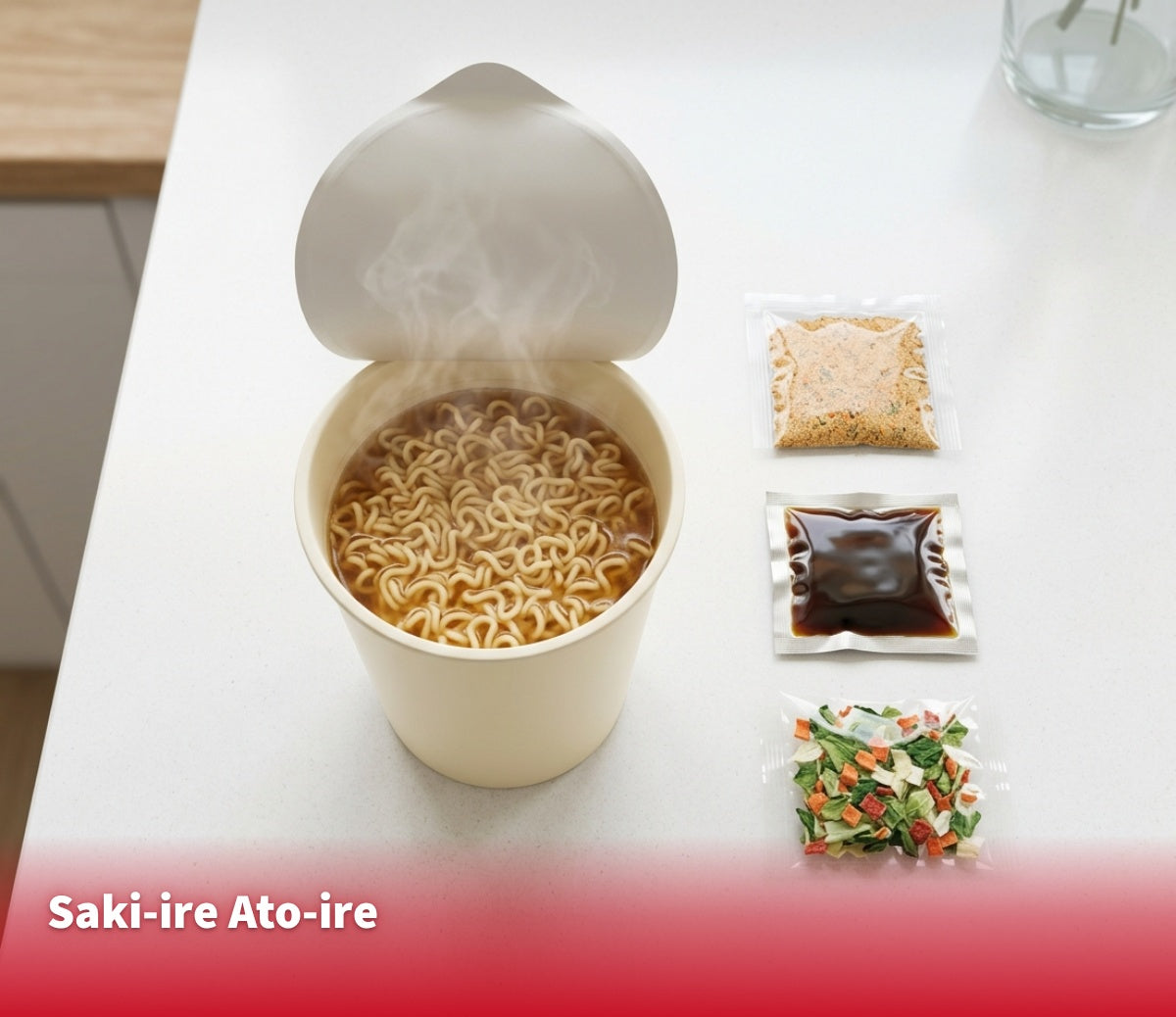

You tear the lid off a Japanese cup noodle, and three small packets tumble out. One is a foil pouch of powder. One is a slippery sachet of dark liquid. The third is a flat bag of dried flakes. Every packet is labeled entirely in Japanese. There are no numbers, no arrows, no English instructions. You stare at them, shrug, rip everything open, dump it all in, and pour the hot water.
You have just made a mistake that changes the flavor of the entire bowl. In Japan, seasoning order is not a suggestion -- it is an engineering decision built into the product. Japanese cup noodles are designed around a two-phase system: some packets go in before the hot water, others go in after. The two Japanese terms printed on those packets -- "saki-ire" (先入れ) and "ato-ire" (後入れ) -- are the most important words on the entire cup, and most non-Japanese speakers have no idea they exist.
This article will teach you what those words mean, why the order matters, how to identify which packet is which even if you cannot read a single character of Japanese, and a universal step-by-step method that works for any Japanese cup noodle you will ever open.
Ready to try the proper technique? Browse Japanese noodles at Tokyo Stash.
What You'll Learn
- 1) The problem: three packets, no English
- 2) Why it matters: the science of seasoning order
- 3) How to read the packets without Japanese
- 4) A step-by-step guide for any Japanese cup noodle
1) The Problem: Three Packets, No English
If you have ever bought an imported Japanese cup noodle -- whether from an Asian grocery store, an online shop, or a friend's suitcase -- you know the moment. You peel back the lid and find two or three small packets sitting on top of the dried noodle block. Each one is sealed, labeled in Japanese, and offers zero indication of what to do with it.
The instinct is reasonable: open everything and pour it all in at once. That is how most Western instant noodles work. You get one seasoning packet, you add it, you add water, you eat. Simple. But Japanese cup noodles are not built that way. They are built around a principle that has two names you need to learn right now.
"Saki-ire" (先入れ) means "add first" -- before the hot water. The characters break down as "saki" (先, before/ahead) and "ire" (入れ, to put in). When you see this on a packet, it goes into the cup before you pour the water.
"Ato-ire" (後入れ) means "add later" -- after the hot water, after the wait time. The characters break down as "ato" (後, after/later) and "ire" (入れ, to put in). When you see this on a packet, it stays outside the cup until the noodles are done cooking.
These two terms appear on almost every Japanese cup noodle. They are printed directly on the seasoning packets, usually in large text, sometimes with additional markings like "お湯を注いでから入れてください" (please add after pouring hot water). But if you cannot read Japanese, they are just more characters on a packet full of characters.
What happens when you ignore the distinction and add everything at once? Three things go wrong. First, liquid seasonings and flavored oils that were designed to float on the surface get buried under three minutes of hot water agitation, losing their aromatic punch. Second, powder seasonings that need time to dissolve in hot water may clump around toppings instead of distributing evenly. Third, certain dried toppings that were meant to stay crispy -- tempura flakes, fried garlic chips, crispy onions -- turn into soggy mush during the wait time when they were supposed to be added at the very end.
The result is not inedible. It is just noticeably worse than what the product was designed to deliver. And once you learn the system, you will taste the difference every time.
2) Why It Matters: The Science of Seasoning Order
Japanese food manufacturers do not separate seasoning packets to annoy you. The separation exists because different ingredients behave differently in hot water, and the engineers who design these products have optimized for a specific sequence. Here is what happens at each stage.
Powder Packets: Why They Go First (Saki-ire)
Powdered seasoning -- the most common saki-ire packet -- is typically a blend of salt, dried soy sauce, MSG, dehydrated vegetable extracts, and spices. These ingredients need hot water and time to dissolve completely. When you add the powder before the water, the boiling water hits it directly and creates a turbulent mixing action as you pour. The three-minute wait time then allows every granule to fully dissolve and distribute evenly through the broth.
If you add the powder after the noodles are done, you get uneven distribution. Some of the powder clings to the softened noodles. Some sinks to the bottom and never fully dissolves. You end up with a broth that tastes strong in one sip and weak in the next. The engineers tested this. The powder goes first.
Liquid and Oil Packets: Why They Go Last (Ato-ire)
Liquid seasoning packets and flavored oils are almost always ato-ire. These typically contain concentrated "tare" (sauce base), sesame oil, chili oil, lard, or aromatic finishing oils. They are designed to sit on the surface of the broth, creating an aromatic layer that hits your nose before each sip.
This is not marketing poetry. It is physics. Oil floats on water. When you add a finishing oil after the noodles are cooked, it forms a thin, fragrant film across the top of the broth. Every time you bring the cup to your lips, that oil layer delivers a burst of aroma through retronasal olfaction -- the same mechanism that makes wine tasting work. The aroma is half the flavor.
If you add the oil before the hot water, three minutes of convection currents break the oil into tiny droplets that disperse throughout the broth. The aromatic layer is destroyed. The oil is still there, but it is emulsified into the liquid instead of concentrated on the surface. The broth will taste slightly flatter, slightly less fragrant, and you will not understand why.
Dried Toppings: It Depends on the Topping
This is where it gets interesting. Dried toppings can be either saki-ire or ato-ire, depending on what they are.
Saki-ire toppings are ingredients that need time to rehydrate: dried vegetables (green onion, corn, carrots), dried meat pieces, and dried egg. These go in before the water because they need the full three-minute soak to soften and release flavor. Without that time, you get crunchy carrot chips in your soup.
Ato-ire toppings are ingredients that are meant to stay crispy: "tenkasu" (tempura crumbs), fried garlic, crispy nori flakes, or "agedama" (deep-fried batter bits). Nissin's Donbei Kitsune Udon is a famous example -- the large fried tofu sheet goes in before the water to absorb broth, but a separate packet of "tenkasu" goes in after to provide textural contrast. If you add the tempura crumbs before, they dissolve into a greasy sludge during the wait time. The entire point of their existence -- that crispy crunch against soft noodles -- is lost.
The Difference Is Real
Japanese food media has tested this repeatedly. Nissin's own product development team has published explanations of why the separation matters. The consensus is consistent: following the saki-ire / ato-ire instructions produces a measurably better result in aroma, texture, and flavor balance. It is not a dramatic difference -- you will not spit out a wrongly-prepared cup noodle -- but it is the difference between "fine" and "this is actually good." Once you taste a properly prepared bowl next to an improperly prepared one, you cannot un-notice it.
3) How to Read the Packets Without Japanese
Knowing the theory is useful. But when you are standing in your kitchen holding three unlabeled packets, you need a practical identification method. Here is how to figure out which packet is which, even with zero Japanese ability.
Look for the Characters
The single most reliable method: look for the words 先入れ and 後入れ printed on each packet. Even if you cannot read Japanese, you can learn to recognize these specific characters by shape.
先入れ (saki-ire / add before): The first character, 先, looks like a person walking forward -- two legs at the bottom with an upward stroke on top. Think of it as "ahead."
後入れ (ato-ire / add after): The first character, 後, is more complex -- it has a cluster of strokes on the left side with additional marks on the right. It is visibly busier and heavier than 先.
The simplest way to tell them apart: 先 (before) is simpler, 後 (after) is more complex. If the first character on the packet looks clean and minimal, it probably goes in first. If it looks dense and detailed, it probably goes in after.
Many products also include the timing instruction in different colors or with icons. Some print 先入れ in blue or green and 後入れ in red or orange. This is not universal, but it is common enough to be a useful secondary clue.
Use the Squeeze Test
When the visual clues fail, use your fingers. Pick up each packet and squeeze it gently.
- Powder packets feel granular and shift like sand inside the wrapper. They rustle. They are usually saki-ire (add before).
- Liquid or oil packets feel squishy and viscous, like a tiny ketchup packet. They do not rustle -- they squish. They are almost always ato-ire (add after).
- Dried topping packets feel light and full of air, with hard irregular shapes inside (dried vegetables, freeze-dried pieces). Check if they have 先入れ or 後入れ markings. If you cannot tell, the safe default is saki-ire: most dried toppings need rehydration time.
Check the Packet Size and Shape
Manufacturers use consistent packaging patterns across product lines.
- Large, flat, rectangular packets with visible powder shifting inside are almost always the base seasoning (saki-ire).
- Small, pillow-shaped packets that feel oily or sticky are finishing oils or liquid tare (ato-ire).
- Flat packets with visible chunks pressed against the wrapper (you can feel the shapes of dried shrimp, corn kernels, or green onion through the packaging) are dried toppings -- usually saki-ire, but check for markings.
Specific Products: A Cheat Sheet
Here are the packet configurations for some of the most common Japanese cup noodles you might encounter.
Nissin Cup Noodle (standard, seafood, curry): These iconic cups have no separate seasoning packets at all. The seasoning is pre-mixed into the cup. Just add hot water. This is one reason Cup Noodle is the easiest Japanese instant noodle for beginners.
Nissin Donbei (Kitsune Udon, Tempura Soba): Two packets. The powder seasoning is saki-ire. The liquid tare or finishing oil is ato-ire. Donbei also includes a large piece of fried tofu (kitsune udon) or a tempura disk (tempura soba) that goes in before the water.
Maruchan Seimen (various flavors): Typically two packets. The powder base is saki-ire. The liquid seasoning is ato-ire. Maruchan Seimen is known for its unusually good noodle texture, and getting the seasoning order right matters more here because the broth is the star.
Nissin Raoh (various flavors): Two to three packets. Powder is saki-ire. Liquid tare and finishing oil are ato-ire. Raoh is a premium instant noodle -- the broth complexity rewards proper preparation.
Toyo Suisan Maruchan Aka / Midori no Tanuki: The red and green duo of Japanese instant noodles. Typically powder is saki-ire and tenkasu (tempura bits) are ato-ire for the soba version. The udon version may differ -- always check the markings.
When in Doubt: The Universal Default
If you absolutely cannot figure out which packet is which, follow this rule: powder goes before the water, everything else goes after. This is correct about 90 percent of the time and will never produce a bad result. The worst case is that a dried topping that should have been rehydrated stays slightly crunchy -- which is far better than turning your finishing oil into invisible background fat.
4) A Step-by-Step Guide for Any Japanese Cup Noodle
Here is a universal six-step process that works for every Japanese cup noodle, regardless of brand or flavor. Print it out, bookmark it, or just memorize it. Once you have done it three times, it becomes automatic.
Step 1: Open the Lid and Remove All Packets
Peel back the lid to the marked line -- most Japanese cup noodles have a dotted line or a small arrow showing where to stop peeling. Do not rip the lid off completely. You will need it as a cover during the wait time. Take out every packet and lay them on the counter. Count them. Most products have two or three.
Step 2: Sort the Packets
Examine each packet. Look for 先入れ (simple first character = add before) or 後入れ (complex first character = add after). If you cannot read the characters, use the squeeze test: granular/powder goes before, squishy/liquid goes after. Make two piles on the counter -- one "before" pile, one "after" pile.
Step 3: Add the Saki-ire (Before) Packets
Open each saki-ire packet and pour its contents into the cup, on top of the dry noodles. This typically includes the powder seasoning and any dried toppings that need rehydration. Spread the powder as evenly as you can across the noodles -- do not dump it all in one corner.
Step 4: Add Hot Water to the Line
Boil your water and pour it into the cup up to the inner line. Every Japanese cup noodle has a fill line molded or printed on the inside of the cup. It looks like a subtle ridge or a printed arrow pointing to a specific height. Do not overfill. Too much water dilutes the broth. Too little water leaves the noodles partially dry. The line exists for a reason -- hit it.
Pour the water in a circular motion so it hits the powder seasoning from all angles. This helps dissolve it evenly.
Step 5: Seal and Wait
Fold the lid back down. Here is where a classic Japanese trick comes in: place one of the ato-ire packets on top of the lid as a weight to keep it sealed. The hot steam inside the cup will also warm the ato-ire packet, which makes the liquid or oil inside more fluid and easier to pour later. This is not folklore -- cold oil is viscous and pours unevenly, while warm oil flows smoothly and distributes better across the broth surface.
Wait the time specified on the packaging. For most products, this is three minutes. Some thicker noodles (udon-style) require four or five minutes. If you cannot read the number, three minutes is a safe universal default for standard cup noodles.
Step 6: Open, Add Ato-ire Packets, and Stir
Peel back the lid fully. Open each ato-ire packet and add it to the cup. For liquid seasonings and oils, drizzle them across the surface rather than pouring into one spot. You want an even layer on top of the broth, not a concentrated puddle in one corner.
Now stir. But stir with intention: dip your chopsticks or fork to the bottom of the cup and bring the noodles up and over, folding the broth through them three or four times. This distributes the base seasoning (which has been dissolving for three minutes) while leaving the fresh oil layer partially intact on the surface.
That is it. Six steps. The entire process adds maybe 30 seconds to your preparation time compared to dumping everything in at once. But the difference in the cup is unmistakable: a broth that tastes balanced from top to bottom, a fragrant oil layer that greets your nose with every sip, and toppings that have the texture they were designed to have.
A Note on Stirring
One common question: should you stir vigorously? No. A gentle fold is better than aggressive stirring. Aggressive stirring breaks the oil layer entirely and can also damage softer noodles. Think of it like folding egg whites into batter -- you want to integrate, not obliterate.
Conclusion: Thirty Seconds That Change the Bowl
The saki-ire / ato-ire system is one of those details that separates a good bowl from a great one. It costs you nothing but a moment of attention: sort the packets, add the powder before the water, add the liquid after. That is the entire secret.
What makes this worth knowing is not just the improved flavor of any single bowl. It is the realization that Japanese instant noodles are more carefully engineered than most people assume. Every packet, every instruction, every fill line exists because someone in a test kitchen tried it the other way and measured the difference. When you follow the system, you are tasting the product the way its creator intended -- and that version is always better than the version where you guessed.
The next time you open a Japanese cup noodle and find three mystery packets, you will not shrug and dump them all in. You will sort them into two piles, add the right ones at the right time, and taste the result. And you will notice the difference. Everyone does.
Ready to put your new knowledge to work? Explore Japanese instant noodles at Tokyo Stash.
Explore more Japanese snacks and culture stories on Tokyo Stash.