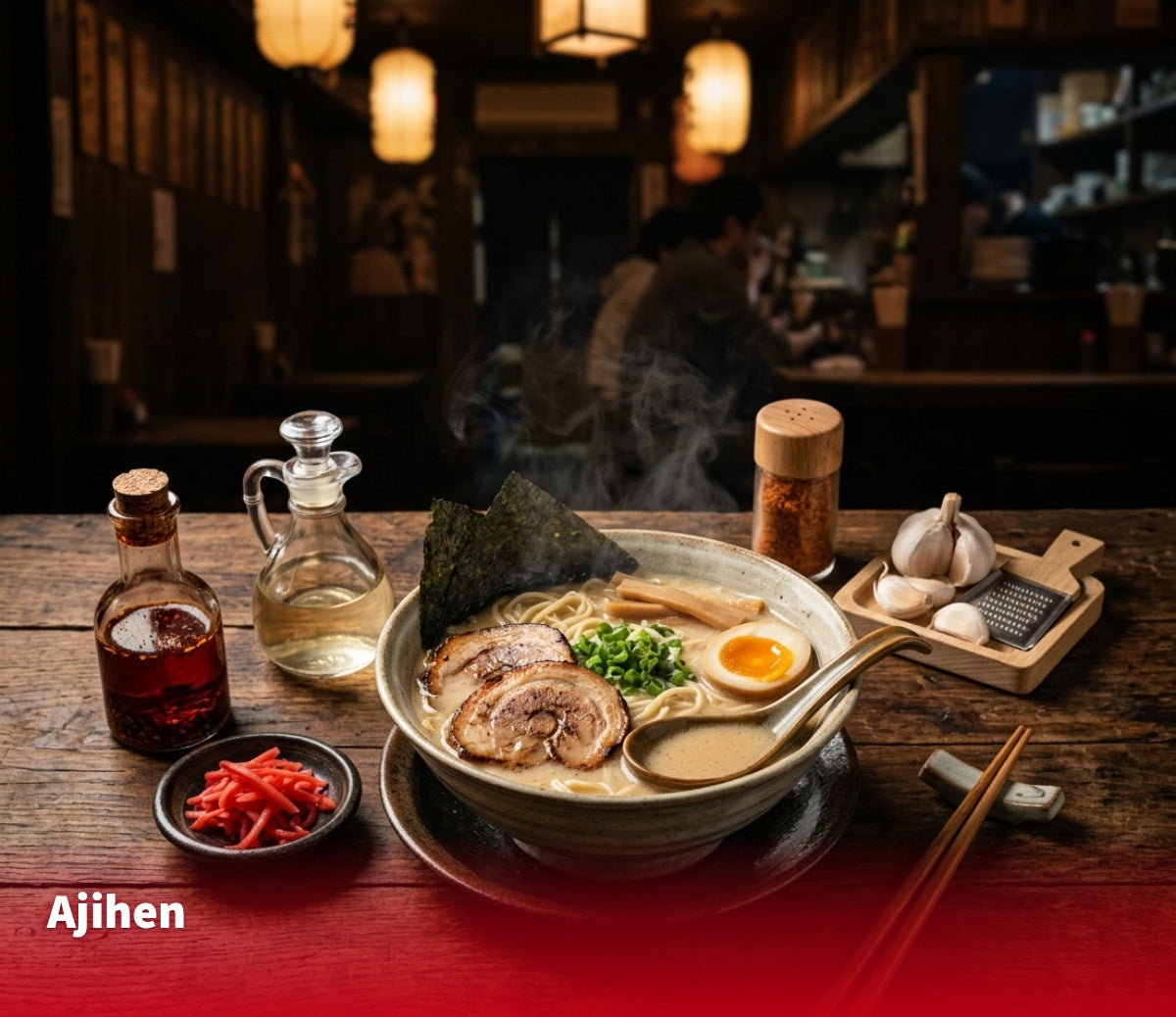

You sit down at a ramen shop in Tokyo. The bowl arrives: a deep, cloudy pork broth with noodles coiled beneath the surface. You take a sip and it is perfect -- rich, savory, exactly what you came for.
Then, halfway through, you reach for the small bottle of chili oil on the table. A few drops, a quick stir, and suddenly the bowl is different -- warmer, sharper, alive in a new way. A few minutes later, you splash in some vinegar. The heaviness lifts. The sourness cuts through the fat like a reset button. By the time you finish, you have eaten what feels like three different meals from the same bowl.
This is "ajihen" (味変) -- literally "flavor change" -- and it is one of the most practical, deeply ingrained eating habits in Japan. Once you understand it, you will never eat a bowl of noodles the same way again.
Ready to start experimenting? Browse Japanese ramen at Tokyo Stash.
What You'll Learn
- 1) What ajihen is and why Japan embraces it
- 2) The ramen shop condiment table: a practical walkthrough
- 3) Cup noodle ajihen: techniques you can try tonight
- 4) The philosophy behind the flavor change
1) What Is Ajihen -- and Why the West Doesn't Do It
In most Western dining traditions, a dish arrives as a finished composition. The chef has seasoned it. The sauce is calibrated. Adding condiments can feel almost rude, as though you are telling the kitchen their work was not good enough.
Japan operates on a fundamentally different logic. Here, the baseline dish is intentionally designed with room to move. A bowl of ramen, a plate of gyoza, a serving of "gyudon" (beef bowl) -- these are not sealed packages of flavor. They are starting points. The cook builds a strong foundation, and the eater is expected to change the direction partway through.
"Ajihen" (味変) is a compound of "aji" (味, flavor) and "hen" (変, change). The word is casual -- the kind of thing a friend says when they slide the bottle of chili oil across the table: "Try some ajihen."
The concept is so normalized that most Japanese people do not even think of it as a technique. Ramen shops place condiments on every table not as decoration, but as essential tools. Yoshinoya and Matsuya -- Japan's massive beef bowl chains -- line their counters with pickled ginger, shichimi pepper, and soy sauce, fully expecting customers to modify every bowl. At CoCo Ichibanya, the country's largest curry chain, tables carry "fukujinzuke" (sweet pickled relish) because the curry is designed to taste one way at the start and another way by the end.
Once you see ajihen as a deliberate part of the meal, the question flips: why would you eat the same flavor for twenty straight minutes?
2) The Ramen Shop Condiment Table: A Practical Walkthrough
If ajihen has a natural home, it is the ramen shop. Walk into any ramen-ya in Japan and you will find condiments arranged on the table or counter. These are not optional extras. They are part of the meal's design. Here is how to use them.
Phase 1: Taste it pure
Always start with the broth as-is. The chef has spent hours building this flavor. Slurp the noodles, sip the soup, and understand the baseline. This is your reference point for everything that follows.
Phase 2: Ra-yu (chili oil) -- adding heat
About one-third through the bowl, reach for the "ra-yu" (ラー油, chili oil). Japanese chili oil is made by infusing sesame oil with dried chili peppers, often with garlic. Three or four drops do not just add heat -- they add a fragrant, roasted dimension that deepens the broth. What was purely savory now has a warm edge that makes each sip slightly more urgent.
Phase 3: Su (vinegar) -- the reset button
This is the move that surprises most first-timers. Around the halfway mark, add a splash of "su" (酢, rice vinegar) -- maybe a teaspoon. The acidity slices through the fat like a knife. Your palate, which was starting to flatten under all that richness, suddenly wakes up. Many Japanese ramen regulars consider this the most important ajihen move because it extends the pleasure of the bowl.
Phase 4: The finishing touches
- Kosho (black pepper) -- A few cracks add sharpness, especially good with shio (salt-based) ramen.
- Beni shoga (pickled red ginger) -- Common at tonkotsu shops. Eat it alongside the ramen as a palate cleanser, not stirred in.
- Ninniku (garlic) -- The nuclear option. Even half a teaspoon turns a mild bowl into something fierce. Fans of Ramen Jiro -- the famously massive, garlic-heavy chain -- pile it on.
- Shichimi togarashi (seven-spice blend) -- Chili, sansho pepper, sesame, nori, and citrus peel. A pinch adds complexity without overwhelming the base.
By the time you set your chopsticks down, one bowl has taken you through four or five distinct flavor stages. That is ajihen in its purest form.
3) Cup Noodle Ajihen: Techniques You Can Try Tonight
You do not need to be in Tokyo to practice ajihen. A cup of instant noodles is the perfect training ground. In Japan, there is an entire subculture called "choi-tashi" (ちょい足し, "a little extra") -- the art of adding small ingredients to instant noodles to elevate them into something genuinely delicious.
Here is a step-by-step ajihen session using a standard cup noodle like Nissin Cup Noodle or Nissin Donbei.
Step 1: Hold back a seasoning packet
Many Japanese instant noodles come with multiple packets -- a base powder, a liquid concentrate, and sometimes a finishing oil. Instead of adding everything at once, start with just the base powder and hot water. Taste the simpler version first. The remaining packets become your first ajihen move.
Step 2: The egg drop
Crack a raw egg into the hot broth right after opening. The egg creates silky ribbons that thicken the soup and add richness. For Nissin Cup Noodle's original flavor, this single addition transforms it from a quick snack into something that feels like a real meal. In Japan, adding an egg to cup noodles is so common it barely qualifies as a hack.
Step 3: Sesame oil
Halfway through, drizzle in "goma abura" (ごま油, sesame oil). The aroma alone changes the experience -- nutty, warm, deeply satisfying. This works with almost every flavor, but it is particularly good with miso and soy sauce bases.
Step 4: Cheese
This is one of the most popular choi-tashi moves in Japan right now. Drop a slice of cheese into a spicy cup noodle -- Nissin's Cup Noodle Chili Tomato is the most famous pairing. The cheese melts into the broth, creating a creamy layer that tames the spice. It sounds strange. It works remarkably well.
Step 5: Shichimi to finish
For the final third, shake on some "shichimi togarashi" (七味唐辛子, seven-spice blend). The dry, aromatic heat is completely different from chili oil. It wakes up the palate one last time.
Other popular additions:
- Butter -- A small pat in miso ramen creates Hokkaido-style richness
- Kimchi -- Fermented sourness and crunch, great with pork-based broths
- Lemon or lime juice -- Works like vinegar in a ramen shop, brightening the broth
- Nori (dried seaweed) -- Crumbled on top for umami and texture
The key principle: do not add everything at once. Space out your additions. Let each one have its moment. A five-minute cup of noodles can deliver three distinct flavor experiences if you time your ajihen right.
4) The Philosophy Behind the Flavor Change
Ajihen is not just a kitchen trick. It reflects something deeper about how Japan approaches food and pleasure.
Fighting "aki" -- the enemy of enjoyment
There is a Japanese word, "aki" (飽き), that means getting tired of something -- not full, not satisfied, but bored. Japanese food culture is almost obsessively concerned with preventing aki. It is the reason kaiseki meals arrive as a sequence of small, varied courses. It is the reason izakaya menus offer dozens of small dishes instead of a few large ones. And it is the reason a person reaches for the chili oil halfway through ramen.
The logic is simple: taste buds adapt. The tenth bite of anything tastes less vivid than the first. Ajihen resets the clock. By introducing a new element -- acid, heat, aroma -- you force your palate to pay attention again.
Izakaya thinking in a single bowl
Japan's "izakaya" (居酒屋, casual pub) culture is built on variety -- edamame, then yakitori, then grilled fish, then pickles. Your palate never settles into one groove. Ajihen brings this same philosophy to a single bowl. You cannot order five different ramens, but you can make one ramen taste five different ways.
Ichigo-ichie: every bowl is unique
The tea ceremony concept of "ichigo-ichie" (一期一会, "one time, one meeting") holds that every encounter is unique and unrepeatable. Ajihen embodies this spirit in a humble way. No two bowls are the same, even at the same shop. The amount of chili oil you add, the moment you reach for vinegar, whether you finish with garlic or pepper -- these micro-decisions make every meal a one-time composition.
Conclusion: Your Next Bowl Is Waiting
Ajihen is not complicated. It does not require special ingredients or advanced technique. It requires only a shift in mindset: the idea that a meal does not have to taste the same from first bite to last.
Start simple. The next time you make a cup of instant noodles -- whether it is a Nissin Cup Noodle, a Donbei, or any ramen in your pantry -- eat the first third plain. Then add a drop of sesame oil. Then crack in some pepper or a squeeze of lemon near the end. Pay attention to how each addition changes not just the flavor, but the way you feel about eating.
That small experiment is all it takes. Once you experience a single bowl delivering three different moments of pleasure, you will never go back to eating the same flavor all the way through. That is ajihen -- and it will quietly transform the way you eat.
Ready to put ajihen into practice? Explore our ramen collection at Tokyo Stash.
Explore more Japanese snacks and culture stories on Tokyo Stash.