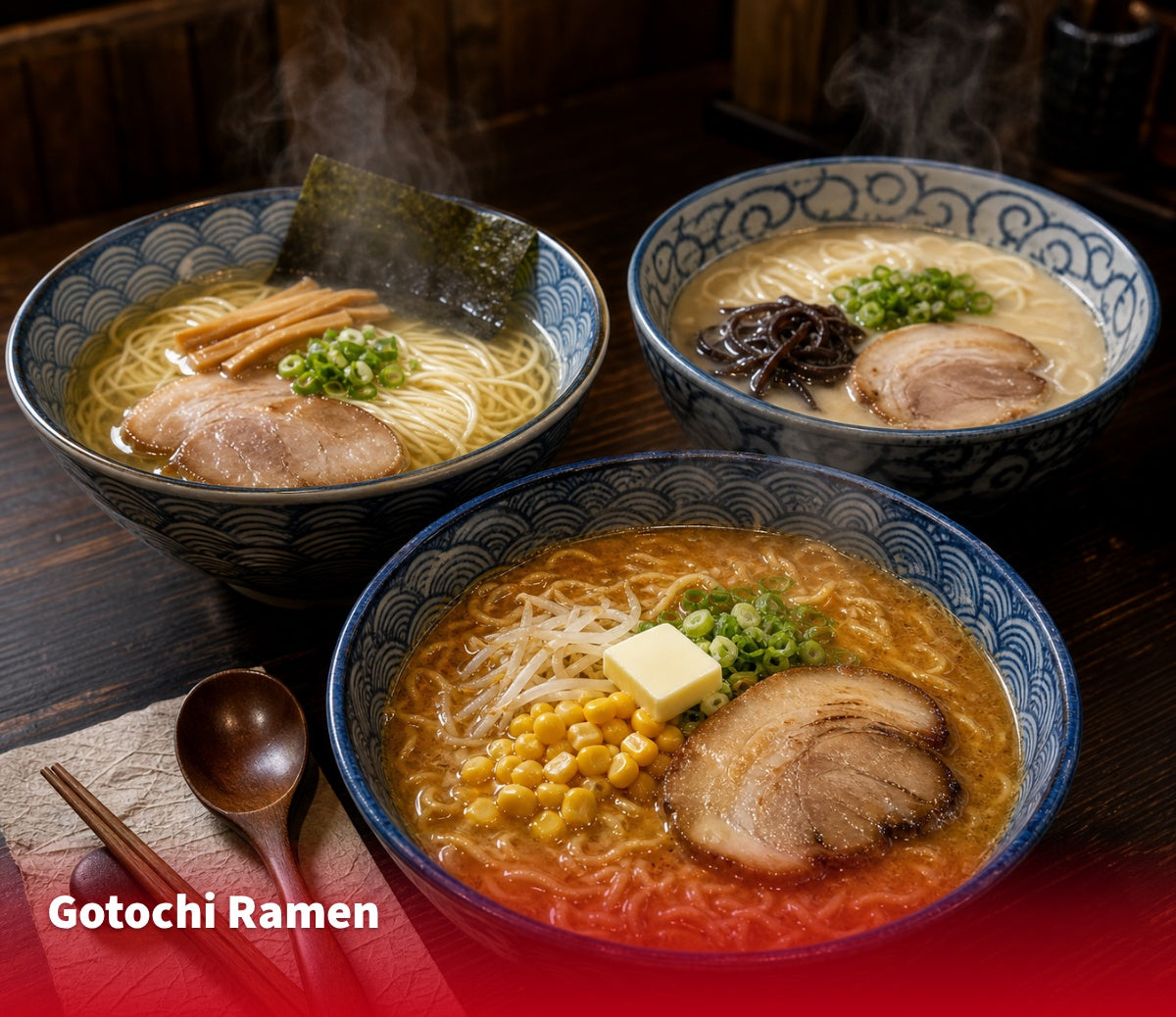

Ask someone outside Japan to describe Japanese ramen and you will usually get one bowl: pork broth, chashu, a soft egg, maybe some nori. It is a perfectly good bowl. It is also roughly as representative of Japan as one style of barbecue is of the United States.
Travel a few hours in any direction and the bowl changes completely. The broth switches from miso to salt to soy sauce. The noodles go from thin and straight to broad and curled. In one city you get a mound of stir-fried vegetables on top; in another, coarse black pepper and a broth so dark it looks like ink. These are "gotōchi rāmen" (ご当地ラーメン, local or regional ramen), and there are dozens of them.
The good news for anyone not currently in Japan: a substantial part of this map has been reproduced in cup form. Regional cup ramen is not a perfect substitute for a shop counter in Onomichi—but it is a genuinely useful way to taste how much the bowl changes from one prefecture to the next.
Want to taste the map? Start at opposite ends with Yamadai Sugomen Hakodate Shio and Sugomen Nagasaki Champon, or explore the Yamadai Sugomen regional cups at Tokyo Stash.
From this story, shipped from Japan:
 Yamadai Sugomen Hakodate Shio Ramen
 Yamadai Sugomen Sapporo Rich Miso Ramen
 Yamadai Sugomen Hakata Tonkotsu Ramen
 Yamadai Sugomen Toyama Black Ramen
 Acecook Gotochi no Ippai Sapporo Rich Miso Ramen
What You'll Learn
- 1) Why ramen changes from city to city
- 2) A north-to-south tour of the bowl
- 3) Not all cup noodles are made the same
- 4) The two series that map Japan
- 5) How to run your own tasting
1) Why Ramen Changes from City to City
Japan's ramen map was built bowl by bowl, never designed from above. Japan's Ministry of Agriculture, Forestry and Fisheries describes ramen culture as flourishing after the Second World War and becoming one of the country's everyday national foods, noting that many regional styles are said to have begun at postwar street stalls.
From there, each place adapted the form to what it had. Local ingredients mattered: a port town with a dried-sardine trade drifts toward fish-forward broth, while a poultry region builds its soup on chicken. So did the local noodle maker, whose equipment and house style shaped what neighborhood shops could actually serve. So did climate and working life—hot, fatty bowls make obvious sense through a Hokkaido winter. These are overlapping tendencies rather than a formula, and it is worth resisting tidy just-so explanations for any single bowl.
The last ingredient was deliberate promotion. From the 1980s, towns began using their local ramen as a reason to visit. MAFF's timeline identifies 1984 as the year Kitakata drew national attention as the first locality to use ramen explicitly for town revitalization. What had been simply "how they make it here" became a regional brand.
One caveat worth carrying through the rest of this article: gotōchi rāmen is a cultural and marketing category, not a protected standard. A city name does not guarantee a fixed recipe, and shops within the same city disagree with each other constantly. When we say "Sapporo is miso," read it as "one well-known Sapporo style," not a municipal ordinance.
2) A North-to-South Tour of the Bowl
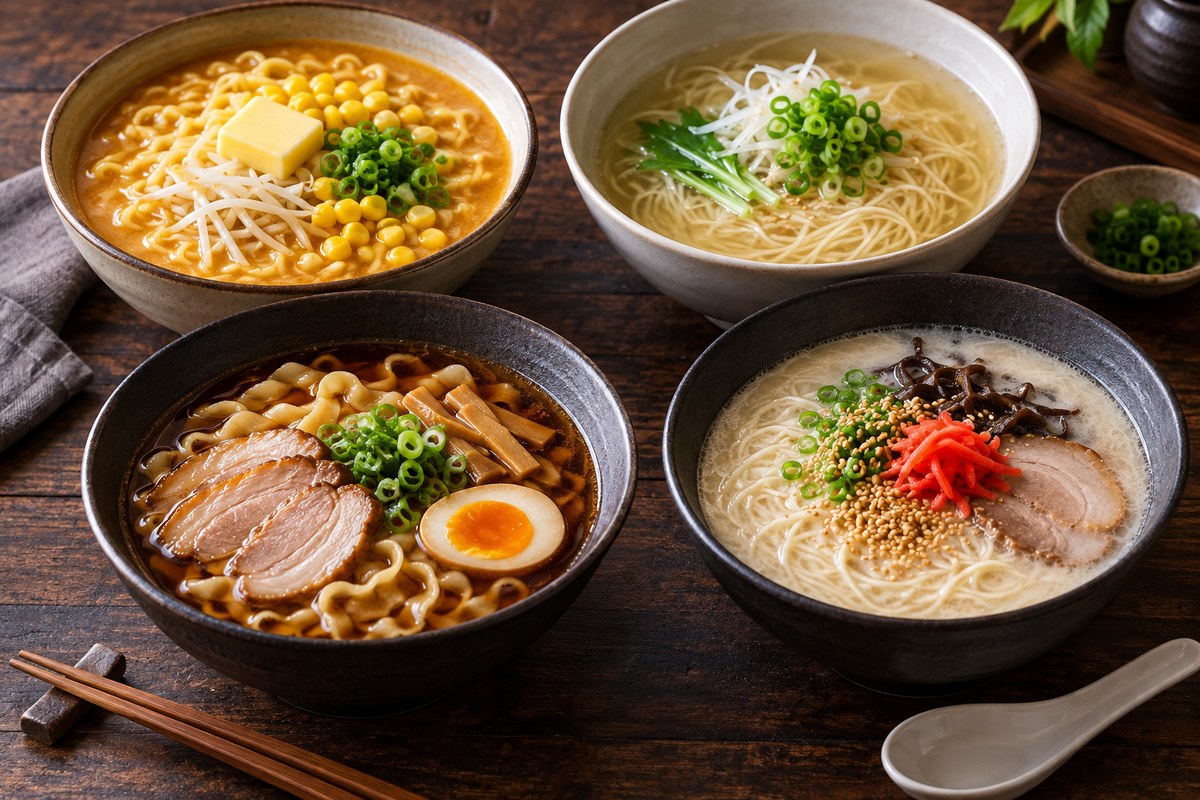
Hokkaido is usually described through three cities. Sapporo is the rich miso bowl—medium-thick wavy noodles, often bean sprouts, corn, butter, and pork, with many shops stir-frying the miso together with vegetables before the broth goes in. Hakodate, a port, goes the opposite way: a clear, gentle salt broth with thin straight noodles. Asahikawa seasons a "double soup" of seafood plus animal and vegetable stock with soy sauce, and may float a layer of lard on top to hold the heat in—a very practical response to a very cold city.
Tohoku has some of the country's most distinctive noodles. Kitakata in Fukushima is known for broad, flat, curled, high-water-content noodles with a springy chew, usually in a light soy broth; eating ramen for breakfast is a genuine local custom there. Aomori leans hard into "niboshi" (煮干し, dried sardine) for a deeply savory, unmistakably marine broth. Yamagata's tori chūka pairs chicken and Japanese-style dashi with wheat noodles—dashi meeting ramen. Sendai serves miso with a mound of chili-miso paste on top, so you dissolve it gradually and set your own heat.
Kanto is more varied than its reputation. Sano in Tochigi is famous for irregular, springy noodles traditionally kneaded using a bamboo pole, in a clear and gentle broth. Ibaraki and Saitama both have "stamina" styles—savory, garlicky, often thickened or vegetable-heavy energy food, with Ibaraki's version notably featuring liver, cabbage, and pumpkin, served hot or cold. Takeoka-style in Chiba runs dark and salty, strengthened with pork braising liquid and topped with a generous pile of chopped raw onion. Yokohama contributes two entirely different things: Iekei, a creamy pork-bone-and-soy broth enriched with chicken oil, thick straight noodles, spinach and nori, where diners specify noodle firmness, oil, and salt level; and sanmāmen, a bowl topped with a starchy stir-fry of vegetables and pork that keeps the whole thing steaming hot.
Chubu and Hokuriku hold some of the boldest bowls. Toyama Black is exactly what it sounds like—a very dark, assertive soy broth with coarse black pepper and thick firm noodles. Tsubame-Sanjō in Niigata covers a soy broth in pork back fat, with chopped onion to cut through it; Nagaoka, also in Niigata, is known for a clear ginger note running through the soy. Hida Takayama in Gifu is the opposite in temperament: delicate, old-fashioned, clear chicken-and-vegetable shoyu with thin curly noodles. Yaizu in Shizuoka builds around bonito. And Nagoya offers "Taiwan ramen," a very spicy bowl of chili, garlic, and minced pork—a Nagoya invention with a Taiwanese-inspired name, not a standard bowl you would find across Taiwan.
Kansai resists generalization, especially Kyoto, which is not the delicate bowl outsiders expect—the city is known both for back-fat-rich soups and for roasted, charred-soy profiles. Tenri in Nara serves a garlicky, chili-spiked, cabbage-loaded stamina bowl. Banshū in Hyogo leans gently sweet. Wakayama's chūka soba combines pork bone and soy with thin straight noodles, and comes with a local table custom: pressed sushi eaten alongside while you wait.
Chugoku and Shikoku bring the fish and the fire. Onomichi in Hiroshima is a seaside soy ramen with chicken and fish-dashi notes and back fat floating on top. Also in Hiroshima, soupless tantanmen dispenses with broth entirely—sesame, chili, soy and numbing pepper season the noodles directly, and you mix vigorously before eating. Kasaoka in Okayama reflects its poultry industry with chicken stock and firm chicken topping. Tokushima serves a sweet-savory pork-bone soy bowl with thin-sliced pork belly and often a raw egg, with rice on the side. Yawatahama in Ehime makes a lighter, clearer champon than its Kyushu cousin.
Kyushu closes the tour with the two most internationally famous. Hakata in Fukuoka is creamy tonkotsu with very thin straight noodles—so thin they cook in seconds, which is exactly why "kaedama" (替え玉, an extra portion of noodles added to your remaining broth) became standard practice there. Nagasaki champon is arguably not ramen at all: thick alkaline noodles cooked together with pork, seafood, cabbage, bean sprouts and fish cake in one pot, producing a complete stir-fry-and-noodle meal.
3) Not All Cup Noodles Are Made the Same
Japan's first instant ramen, Nissin Chicken Ramen, was released on August 25, 1958. Everything in the category since descends from that idea, but the engineering has diverged sharply—and the difference matters if you want a cup to actually taste regional.
Instant noodles are broadly classified by package type (bag or cup) and by how the noodles are dried. Fried noodles are cooked in oil at roughly 140–160°C for one to two minutes, which creates a porous structure that rehydrates fast. That porosity is the familiar instant-noodle character. Non-fried noodles are dried with hot air instead; the World Instant Noodles Association notes these can deliver a texture and taste closer to restaurant ramen. (Non-fried describes a drying method, incidentally—it is not automatically a health claim.)
A premium cup is a compact reconstruction of a restaurant bowl, with the components separated so each wakes up at the right moment. The powder or paste builds the broth. A separate liquid packet protects fragile aromas—ginger, sesame oil, chicken fat, chili—until the end, which is why so many cups have an "add after" sachet. Dried toppings, "kayaku" (かやく), supply texture and visual identity: corn signals Sapporo miso, spinach and nori signal Iekei.
The goal is resemblance, not duplication. A cup makes the regional cues legible in five minutes—the ginger in a Nagaoka bowl, the pepper in a Toyama Black, the fish in an Aomori niboshi. That is a real achievement, and it is also all it claims to be.
4) The Two Series That Map Japan
Two product lines do most of the work of putting the ramen map in a cupboard.
Yamadai markets the NewTouch Sugomen (スゴ麺) brand as a premium non-fried cup line built to reproduce the experience of freshly boiled noodles and to recreate regional noodle dishes specifically. Yamadai says its regional series is developed with cooperation from people in the relevant areas, while a separate line focuses on classic ramen flavors. That collaborative framing is the right way to read these cups: they are interpretations made in conversation with local food identities, not replacements for any particular shop.
What makes the Sugomen range genuinely useful is its breadth. The regional lineup runs from Hakodate salt and Sapporo rich miso in the north, through Aomori niboshi, Kitakata, Yamagata tori chūka and Sendai spicy miso, down through Sano, Ibaraki stamina, Takeoka-style Chiba, Yokohama Iekei and sanmāmen, Niigata and Nagaoka, Toyama Black, Shinshu miso, Hida Takayama, Yaizu bonito, Nagoya Taiwan ramen, two Kyoto styles, Tenri stamina, Banshū, Wakayama, Okayama, Onomichi, Hiroshima soupless tantanmen, Tokushima, Yawatahama champon, and on to Hakata tonkotsu and Nagasaki champon. Laid out together, it is close to a literal map.
Acecook's Gotōchi no Ippai (ご当地の一杯, "a local cup") series takes a more curated approach, presenting a focused set of flavors associated with different parts of Japan—Sapporo rich miso, Hakodate salt, Sendai spicy miso, Yokohama tonkotsu shoyu, Kyoto back-fat soy, Hakata back-fat tonkotsu. For a newcomer this works like a starter map: fewer decisions, clear contrasts, and a quick sense of how differently six cities think about a bowl of noodles.
One practical note on both: lineups, recipes, and packaging change through product renewals, so treat the current package as the authority on any specific item.
5) How to Run Your Own Tasting
Treat the instructions on the individual cup as the recipe—particularly the water line and the waiting time, which are set for that specific noodle. Use water at a full boil, close the lid properly, and check the packets before you start: liquid soup, aroma oil, chili paste, and sesame seasoning are frequently "add after" components, because heat and timing would destroy what makes them worth including. Stir up from the bottom before you taste anything.
Then taste the broth before adding extra chili or seasoning. Assertive styles—Toyama Black, Nagoya Taiwan ramen, Sendai spicy miso—move fast, and they are difficult to walk back.
The best way to learn the map is by contrast rather than volume. Pick two bowls that disagree with each other and eat them side by side: Hakodate salt against Sapporo miso teaches you what Hokkaido's range actually is. Hakata tonkotsu against Onomichi soy-and-back-fat shows how differently two coastal cities use pork fat. Aomori niboshi against Hida Takayama shoyu separates fish umami from chicken umami about as cleanly as anything can.
For each pair, pay attention to four things: the broth base, the noodle shape and thickness, the oil on the surface, and the toppings. Those four variables generate nearly the entire regional map. Once you can taste them separately, a cupboard becomes a fairly efficient geography lesson.
Conclusion: One Country, Dozens of Bowls
The single most useful thing to know about Japanese ramen is that there is no single Japanese ramen. There is a Hokkaido bowl built for cold, a Hakata bowl built for speed, a Hiroshima bowl with no soup at all, and a Nagasaki bowl that is really a stir-fry. Each one is a record of what a particular place had, needed, and eventually decided to be known for.
You do not need a plane ticket to start reading that record. Pick two cups from opposite ends of the country, boil the kettle, and pay attention to what changes. Then pick two more. It is one of the few geography lessons that works better on a weeknight than in a classroom.
Ready to start your tour? Pick a pair that disagrees—say Sugomen Hakata Tonkotsu against Sugomen Onomichi Chuka Soba—from the Yamadai Sugomen regional cups, or begin with Acecook Gotochi no Ippai Sapporo Rich Miso and more Acecook cups, at Tokyo Stash.
Keep reading:
Explore more Japanese snacks and culture stories on Tokyo Stash.