
In 1910, a 25-year-old named Fujii Rin'emon opened a small Western-style confectionery shop in Motomachi, Yokohama. It was a reasonable place to try such a thing—Yokohama was a port city where foreign goods and foodways were more visible than almost anywhere else in Japan—but it was still a bet. Cakes and cream-filled sweets were not yet part of Japanese daily life.
More than a century later, that bet has become a strawberry shortcake on a birthday table, a milk candy in a child's pocket, and a soft cookie on convenience store shelves across the country. Fujiya's history is really the history of how "yōgashi" (洋菓子, Western-style confectionery) stopped being foreign and became an ordinary part of Japanese eating.
This is a company story rather than a product review—about a shop that became a national brand, a mascot that became a landmark, and the quiet work of adaptation that made European and American sweets into Japanese ones.
Want to taste the history? Start with Milky milk candy, or explore Fujiya sweets—Milky, Country Ma'am, Nectar and more—at Tokyo Stash.
From this story, shipped from Japan:
 Fujiya Milky Milk Candy
 Country Ma'am Vanilla & Cocoa
 Fujiya Nectar Gummy Mix
 Country Ma'am Loquat (Chiba Regional Edition)
What You'll Learn
- 1) From a Yokohama shop to a household name
- 2) How Western sweets became Japanese sweets
- 3) The mascot that started as a shop sign
- 4) Milky, Country Ma'am, and Nectar
- 5) Cakes, restaurants, and the ritual of celebration
1) From a Yokohama Shop to a Household Name
Fujiya traces its founding to 16 November 1910, when Fujii opened his shop in Motomachi. As with many Japanese companies of the era, the founding and the incorporation are separate events: the corporation itself was formed later, in 1938.
The name works on several levels at once. It recalls the founder's own surname, Fujii; it invokes Mount Fuji; and Fujiya explains it as also expressing a wish to be fuji in the sense of "one of a kind," without equal. For a shop selling foreign-inspired sweets in 1910, that is a rather confident piece of naming—and a neat snapshot of a modernizing Japan borrowing ideas while insisting on its own identity.
2) How Western Sweets Became Japanese Sweets
The decisive move came early. In 1912, Fujii travelled to the United States to study confectionery and café culture, returning in 1913.
What he brought back was not only recipes. Fujiya credits that trip with changes to the shop itself—a soda fountain, café facilities, and a modern cash register. In other words, he was studying the whole apparatus around sweets: how they were displayed, sold, and consumed as an experience. The right framing for Fujiya's early years is not "Western food copied unchanged" but "Western confectionery made local."
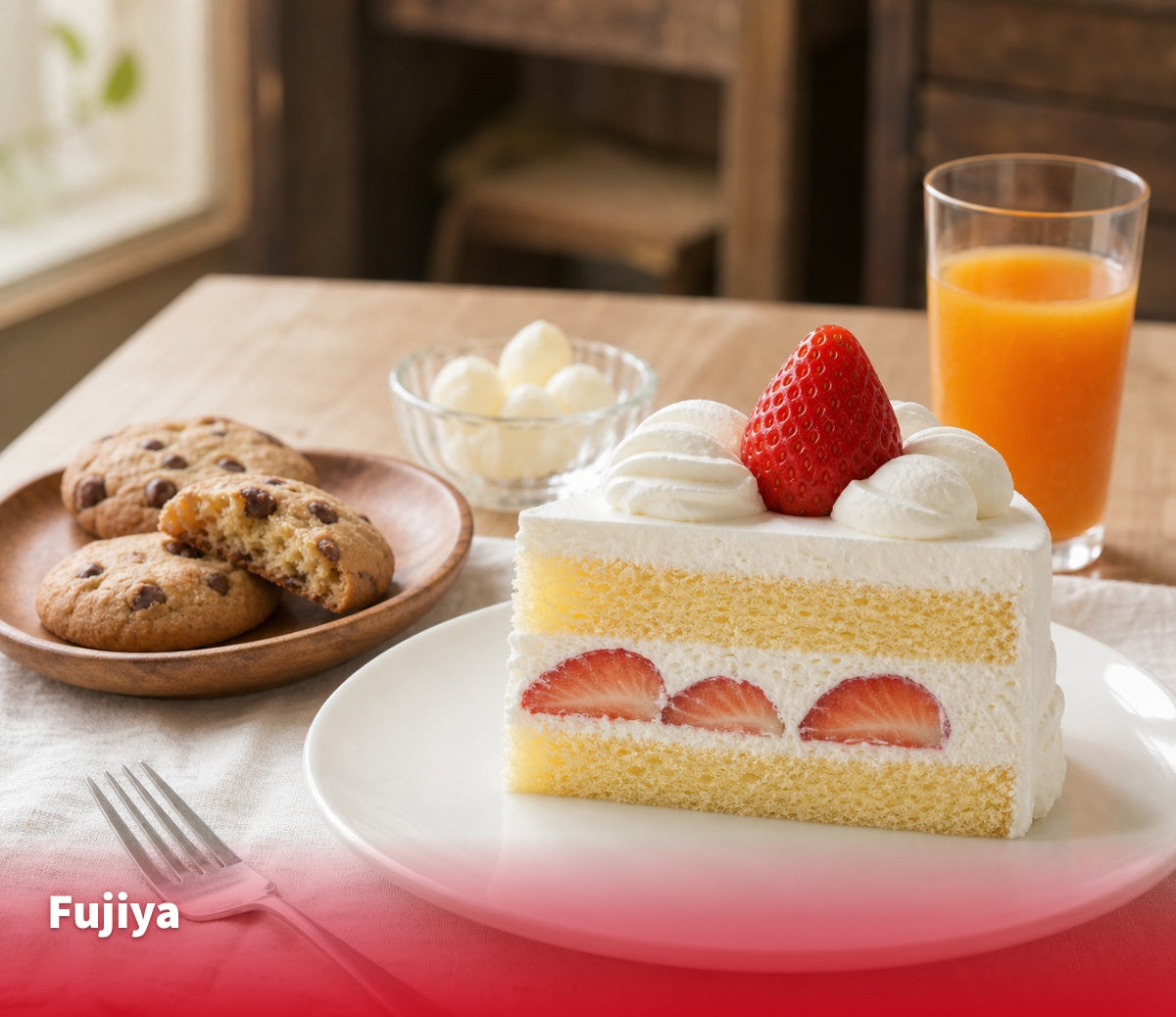
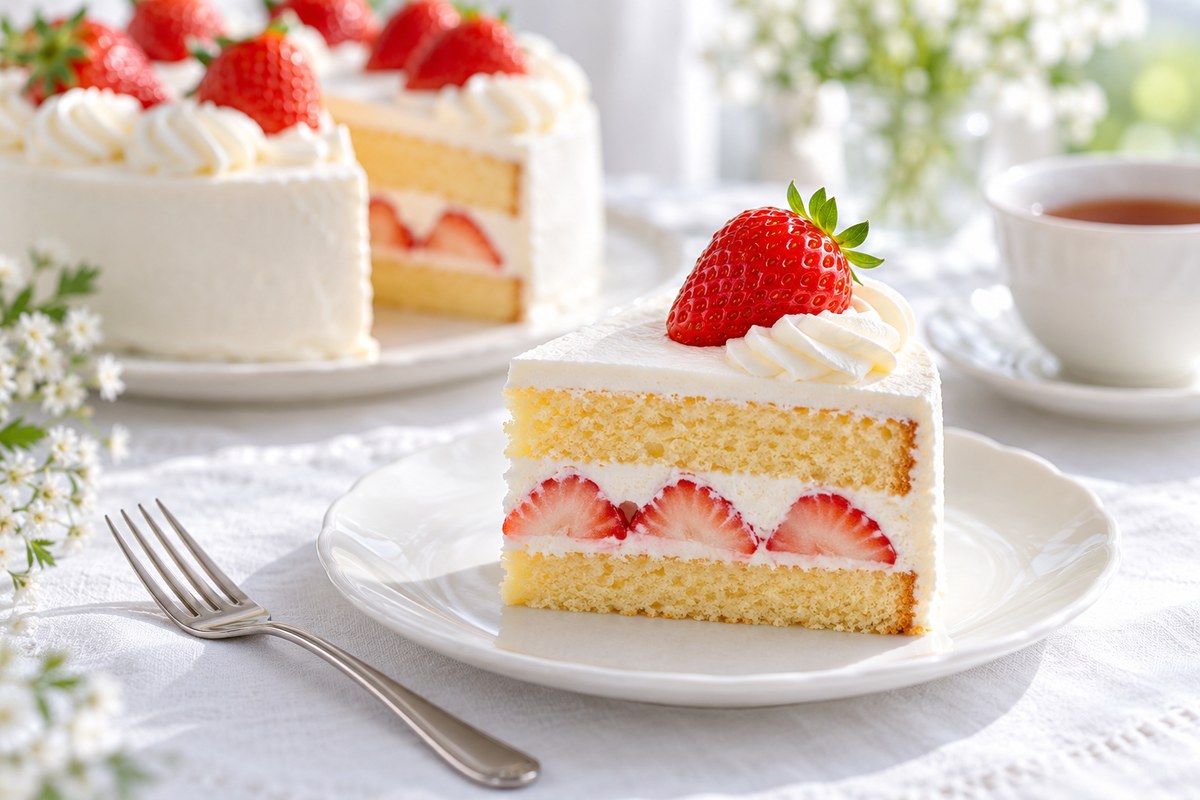
The clearest example is the cake. Fujiya dates its Japanese-style strawberry shortcake to 1922, describing it as a Western cake adapted for Japanese tastes and as an early domestic shortcake.
English-speaking readers should know that "shortcake" means something quite different in Japan. It is not the crumbly biscuit-and-berries dessert familiar in North America. Japanese shortcake is a light sponge cake layered with whipped cream and strawberries—airy, restrained in sweetness, and visually clean. That cake is now so thoroughly naturalized that most Japanese people would not think of it as a Western import at all, which is a fair definition of successful adaptation.
3) The Mascot That Started as a Shop Sign
Peko-chan arrived in 1950—not on television, not in a manga, but as a doll standing outside Fujiya shops. Her boyfriend character, Poko-chan, followed in 1951.
That physical origin matters. Before mass television, a distinctive figure on the pavement was how a shop became recognizable and memorable, especially to children. The early dolls were papier-mâché; as Fujiya expanded from the late 1950s, they shifted to vinyl and plastic. Generations of Japanese people have a specific memory of a particular Peko-chan standing outside a particular shop.
On the name: Fujiya's official explanation is that "Peko" is a Western-style rendering of beko, a Japanese nickname for a calf. That is the company's stated account rather than an independently settled etymology, so "is said to derive from" is the right register.
One thing worth stating plainly, because it is often missed: Peko-chan is Fujiya's protected intellectual property, not a public-domain character. The Peko-chan and Poko-chan figures received Japanese three-dimensional trademark registration in 1998. She can be discussed as history and as culture, but her artwork, shop dolls, and packaging designs are not free for reuse.
In the broader story of Japanese corporate mascots—a genuinely important part of the country's commercial culture—Peko-chan is a major early example of a character living across signage, packaging, merchandise, and family memory rather than functioning merely as a logo.
4) Milky, Country Ma'am, and Nectar
Three products carry most of Fujiya's everyday presence, and each is a snapshot of a different decade.
Milky launched in 1951—a soft candy made with sweetened condensed milk, whose current standard formulation lists condensed milk, cream, and milk among its ingredients. It is inseparable from its long-running line, "Milky is Mama's Taste." In postwar Japan, a rich milk candy was not a small thing, and that phrase did an enormous amount of emotional work.
Country Ma'am arrived in 1984, named for the image of a homemade cookie baked by an American "country ma'am." What makes it distinctive is structural: Fujiya describes it as a two-layer cookie—crisp on the outside, moist inside—produced using separate doughs and comparatively slow, low-temperature baking. That contrast is the product. It is reasonable to connect its longevity to an appreciation for contrasting textures and a softer cookie experience, though that is an editorial reading rather than a proven explanation for its success.
Nectar began in 1964 as a rich peach drink made with white-peach purée, and the brand has since crossed into confectionery as Nectar gummies. It is a useful reminder that Fujiya's range runs across candy, cookies, drinks, and gummies rather than sitting in one aisle.
Country Ma'am is also the most fun of the three to buy as a souvenir, because Fujiya sells numerous region-exclusive flavors tied to local foods—Aomori apple, "zunda" (ずんだ, sweet mashed edamame), Okinawan purple sweet potato, Nagoya-style ogura toast. Availability and flavors change constantly, so the sensible approach is to look at the current selection rather than hunting a specific one.
5) Cakes, Restaurants, and the Ritual of Celebration
Fujiya still operates on two tracks: takeaway Western-confectionery shops and family-oriented Fujiya Restaurants. That combination—everyday sweets, celebration cakes, cafés, and family meals under one brand—is unusual, and it explains how deeply the company is woven into ordinary Japanese occasions.
Its shops helped make decorated cakes accessible for birthdays, Christmas, and other family events. Fujiya's own history records Christmas cake sales in December 1910, very soon after the Motomachi shop opened.
That date invites a claim that should be resisted. It is fair to say Fujiya was an early and influential commercial promoter of Christmas cake in Japan; it is not safe to say it invented the tradition. Reference research from the National Diet Library notes competing origin dates and insufficient corroboration for several popular origin stories. Japan's Christmas cake custom has more than one plausible root, and a single company's timeline does not settle it.
What is uncontroversial is the outcome: a country where a white cream-and-strawberry cake is the expected centerpiece of Christmas Eve, and where that cake is a direct descendant of the shortcake Fujiya was adapting in 1922.
Conclusion: Adaptation, Not Imitation
Fujiya's real achievement is easy to overlook because it worked so well. Sponge cake with cream and strawberries, a milk candy, a soft-centred cookie, a peach drink—none of these read as foreign in Japan today, and that is precisely the point. A category that began as imported novelty became an ordinary part of how people celebrate and snack.
For a first order, treat the three as genuinely different experiences rather than interchangeable Japanese candy: Milky is creamy and chewy, Country Ma'am is a soft-centred cookie best appreciated for its two-layer contrast, and Nectar is a thick, fruit-forward peach drink or gummy. If regional Country Ma'am flavors are available, they are the most interesting thing on the shelf.
As always, follow the package for storage and best-before dates, and check the specific label for allergens—milk, wheat, egg, soy, nuts, gelatin, and fruit allergens all vary by flavor and format, so do not generalize from one variant to the brand.
Ready to try them? Start with Milky and Country Ma'am, or explore Fujiya sweets—Milky, Country Ma'am, Nectar and regional editions—at Tokyo Stash.
Keep reading:
Explore more Japanese snacks and culture stories on Tokyo Stash.