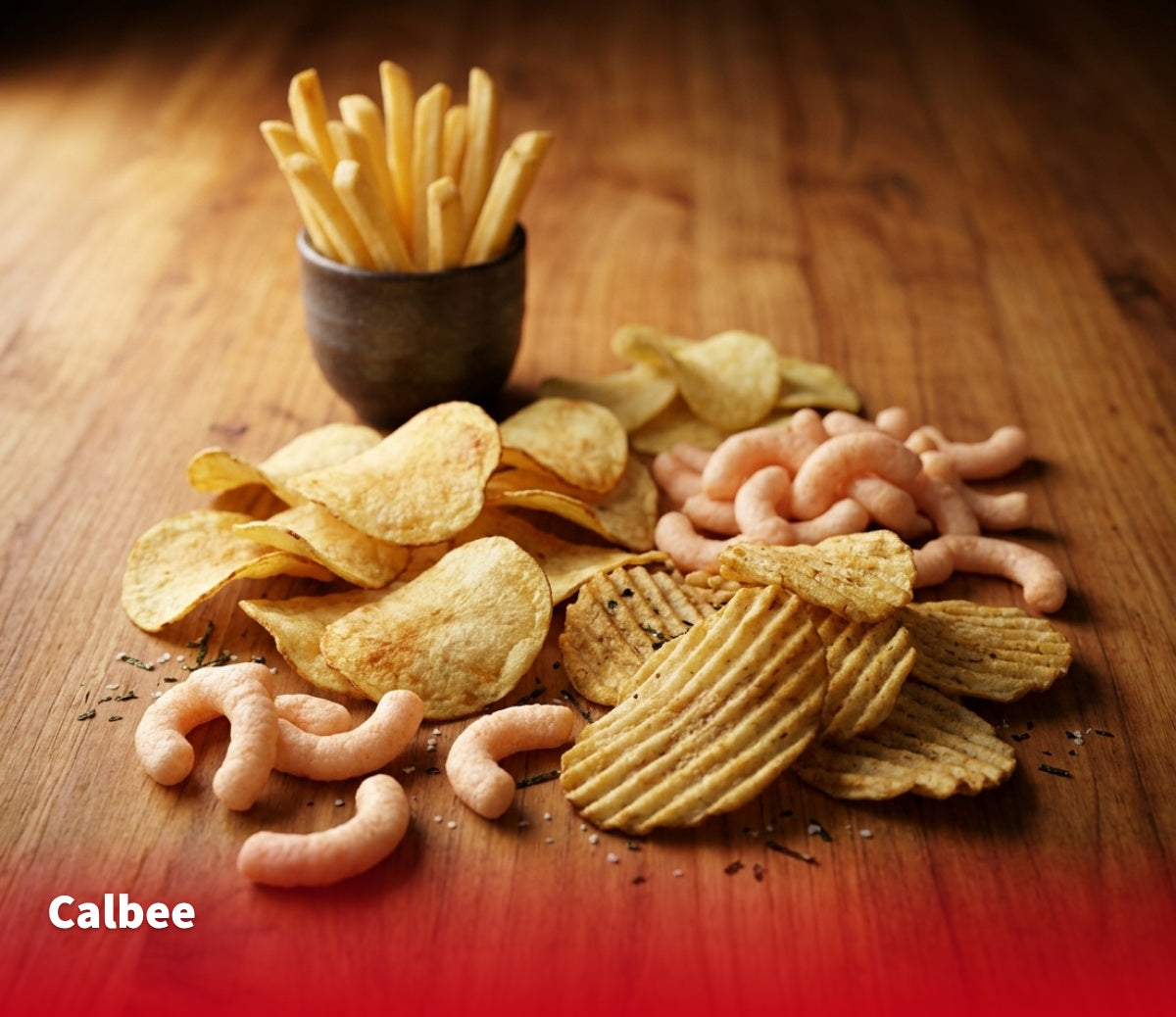

Walk into any convenience store in Japan—any one, in any city, at any hour—and count the Calbee products on the shelf. You will run out of fingers before you run out of bags. Potato chips in six flavors. Jagariko cups stacked three deep. Kappa Ebisen tucked next to the register. Calbee is not just a snack company. It is the background hum of Japanese snacking itself, so ubiquitous that most people in Japan cannot remember a time before it existed.
What makes Calbee remarkable is not simply its dominance—controlling roughly 70% of Japan's potato chip market—but the path it took to get there. This is a company that started making caramels in postwar Hiroshima, pivoted to shrimp snacks when no one asked for them, bet its future on a crop Japan barely grew, and then spent decades inventing entirely new textures that consumers didn't know they wanted. Every major product in Calbee's lineup represents a calculated risk that paid off.
In this article, we'll trace that path from a small Hiroshima workshop to the shelves of every konbini in the country—and explain why, if you want to understand Japanese snack culture, you need to understand Calbee first.
Want to try it yourself? Explore Calbee products at Tokyo Stash.
What You'll Learn
- 1) From caramel to chips: the Calbee origin story
- 2) The product that changed everything: Potato Chips Usushio
- 3) The texture innovators: Jagariko, Jagabee, Kataage
- 4) Kappa Ebisen and the snacks that started it all
1) From Caramel to Chips: The Calbee Origin Story
Calbee was founded in 1949 in Hiroshima—a city still rebuilding from devastation—by Takashi Matsuo. The company's first product was not a potato chip or a shrimp snack. It was a caramel. Specifically, Matsuo created a caramel fortified with calcium, hoping to address the nutritional deficiencies that plagued postwar Japan. Children were malnourished. Calcium and vitamins were scarce. Matsuo believed that a confection could be both a treat and a form of nourishment.
The company's name encodes this founding philosophy. "Calbee" is a portmanteau of "cal" from calcium and "bee" from vitamin B1—two nutrients Matsuo considered essential for rebuilding the health of a recovering nation. It is a name that sounds playful but carries the weight of its era.
The caramel business sustained the company through the 1950s, but Matsuo was restless. He was not interested in competing in an increasingly crowded confectionery market. He wanted to create something genuinely new—a snack category that did not yet exist in Japan. His attention turned to shrimp. Japan was surrounded by ocean. Shrimp was abundant and cheap. What if you could turn it into a shelf-stable, mass-produced snack?
The result, after years of development, was Kappa Ebisen, launched in 1964. We will return to this product in detail later, but its significance here is strategic: it proved that Calbee could succeed by creating entirely new categories rather than competing in existing ones. This instinct—to invent rather than imitate—would define every major move the company made for the next six decades.
By the late 1960s, Matsuo had turned his attention to an even more ambitious bet: potatoes. At the time, Japan was not a significant potato-growing country. Rice dominated agriculture. Potatoes were considered a subsistence crop, not a premium ingredient. Most Japanese consumers had no tradition of eating potato chips. Matsuo saw an empty landscape where others saw an obstacle, and he committed the company's future to filling it.
2) The Product That Changed Everything: Potato Chips Usushio
In 1975, Calbee launched Potato Chips Usushio—and permanently altered what Japanese people eat between meals.
Usushio (うすしお) translates to "light salt." The name itself is a statement of intent. Where American-style chips leaned into aggressive seasoning, Calbee went the opposite direction: a chip so lightly salted that you could taste the potato itself. The philosophy was distinctly Japanese—let the quality of the base ingredient speak, and season with restraint rather than force.
But creating a great-tasting lightly salted chip required extraordinary raw material. Mediocre potatoes under minimal seasoning taste like mediocre potatoes. Calbee needed the best, and Japan's existing potato supply was nowhere near sufficient for industrial-scale chip production. So the company did something that would reshape Japanese agriculture: it began contracting directly with farmers in Hokkaido, Japan's northernmost main island and its only region with a climate suited to large-scale potato cultivation.
These were not casual supply agreements. Calbee worked with Hokkaido farmers to develop specific potato varieties optimized for chip production—cultivars with the right starch content, the right moisture level, and the right sugar balance to fry into a clean, golden crisp without browning or turning bitter. The company essentially built its own agricultural supply chain from scratch, investing in the farming infrastructure that would guarantee consistent quality at massive scale.
Today, Calbee sources potatoes from over 1,000 contract farms across Hokkaido, and the island's potato fields are as much a part of the Calbee story as any factory or product line. The company's Hokkaido operations have become a tourist attraction in their own right—visitors come to see where Japan's favorite chips begin their journey.
Usushio's success was immediate and enduring. But Calbee did not stop at one flavor. In 1978, the company launched Consomme Punch (コンソメパンチ), a savory, bouillon-flavored chip that tasted like concentrated French onion soup. The name alone is quintessentially Japanese—the English word "consomme" paired with the Japanese marketing term "punch" to suggest bold flavor impact. Consomme Punch became an instant classic and remains one of Japan's top-selling chip flavors nearly five decades later.
The word "usu" (薄い, meaning thin or light) deserves special attention, because it recurs throughout Japanese snack naming as a signal of refinement. In a food culture that prizes subtlety and balance, "usu" is not a limitation—it is a promise. Usushio does not mean "less flavor." It means "precise flavor." This sensibility runs through Calbee's entire approach: maximum impact from minimum intervention.
By the 1990s, Calbee had captured roughly 70% of the Japanese potato chip market—a share it maintains to this day. No other snack company in any developed nation holds such a dominant position in a single category. To put it in perspective: in the United States, no single brand controls even 30% of the chip market. Calbee's dominance in Japan is structurally unprecedented.
3) The Texture Innovators: Jagariko, Jagabee, Kataage
If Calbee only made excellent potato chips, it would still be one of Japan's most important food companies. But what elevates Calbee from a chip maker to a snack innovator is its relentless pursuit of texture. The company does not just sell potatoes in different flavors—it sells potatoes in fundamentally different forms, each targeting a distinct sensory experience.
Jagariko (じゃがりこ), launched in 1995, is perhaps the most brilliant example. Jagariko are finger-length sticks made from dehydrated potato, shaped into rigid cylinders and baked until they achieve a texture that Japanese consumers describe as saku-saku (サクサク)—a crisp, light crunch that shatters cleanly between your teeth without crumbling into fragments. The experience is closer to snapping a breadstick than eating a chip. Each stick holds its shape until you bite through it, then dissolves into a starchy, savory melt on the tongue.
Jagariko was designed for a specific use case: snacking on the go without mess. The sticks sit upright in a cup with a resealable lid. You can eat them with one hand. Nothing falls into your lap. No grease transfers to your phone screen. In a country where eating while walking is still somewhat frowned upon and cleanliness in public spaces is paramount, this format solved a real problem. Jagariko became a konbini staple almost overnight, and today it is one of Calbee's top three revenue products.
There is also a cult practice among Jagariko devotees: pour hot water into a half-eaten cup, wait three minutes, and stir. The sticks dissolve into a rough, thick mashed potato. It is not on the package instructions—it is folk knowledge passed through internet forums and school hallways. The fact that a snack can transform into an entirely different food speaks to the purity of Jagariko's ingredient base: these really are just potatoes, reshaped.
Jagabee (じゃがビー), introduced in 2006, occupies a different textural space entirely. Where Jagariko is saku-saku, Jagabee is thick, firm, and natural. The sticks are cut from whole potatoes in thick, irregular batons—closer to a hand-cut French fry than a manufactured snack. The texture is denser and more substantial. You chew through a Jagabee stick the way you'd chew through a roasted potato wedge. The flavor profile leans into this naturalism: simple salt, butter and soy sauce, or black pepper. No artificial complexity. The product says, plainly, "this is a potato, and that is enough."
Jagabee was positioned as a slightly premium, slightly more adult alternative to Jagariko. The packaging is understated. The portions are smaller. The price point is higher. In Calbee's internal taxonomy, Jagariko is the democratic everyday snack; Jagabee is the one you choose when you want something a little more considered.
Kataage Potato (堅あげポテト), launched in 1993, takes yet another textural approach. Kataage literally means "hard-fried"—these are thick-cut chips cooked at lower temperatures for longer periods, producing a dense, crunchy chip that resists your bite before yielding. If standard Calbee potato chips are airy and light, Kataage is their muscular counterpart. Each chip has audible crunch. The chewing time is longer. The flavor release is slower and more sustained. Think of the difference between a standard potato chip and a kettle-cooked chip, then push it further.
Kataage was designed for a consumer segment that found regular chips too ephemeral—people who wanted a snack that demanded engagement, that filled the mouth with sound and resistance. In Japan, this textural preference even has a name: kataasa (硬さ), or hardness, which is treated as a positive quality descriptor rather than a deficiency. Kataage Potato became the definitive expression of this preference and has maintained a loyal following for over 30 years.
Together, these three products—Jagariko, Jagabee, Kataage—reveal Calbee's core insight: people do not just choose snacks by flavor. They choose by how the snack feels in their mouth. Calbee's product line is essentially a texture menu. Want something light and shattering? Jagariko. Dense and natural? Jagabee. Hard and crunchy? Kataage. Airy and delicate? Standard potato chips. Each product occupies a distinct position on the textural spectrum, and consumers rotate between them based on mood, occasion, and craving.
4) Kappa Ebisen and the Snacks That Started It All
Before there were potato chips, before Jagariko cups lined konbini shelves, there was Kappa Ebisen (かっぱえびせん)—the shrimp-flavored snack that launched in 1964 and gave Calbee its first national hit.
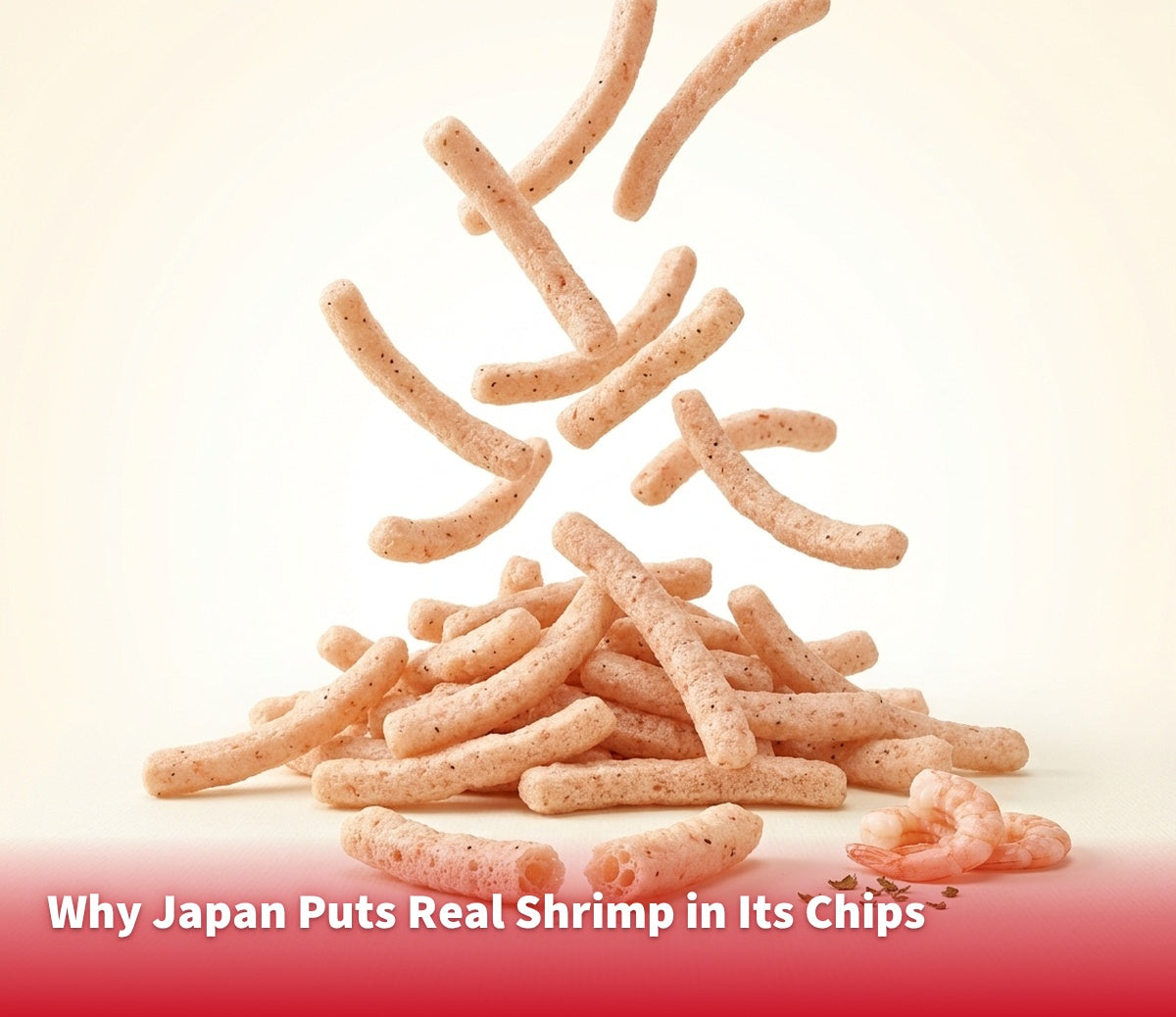
Kappa Ebisen is made from a dough of wheat flour and ground shrimp, extruded into small, curved sticks and fried until crisp. The shrimp is not a coating or a flavoring—it is integrated into the dough itself, which means the seafood taste is structural rather than superficial. Bite into a Kappa Ebisen stick and the shrimp flavor arrives immediately, carried on a light, airy crunch that dissolves quickly. It is a snack designed for speed: high impact, fast finish, reach for another.
The product's advertising slogan became one of the most famous in Japanese commercial history: "Yamerarenai, tomaranai" (やめられない、とまらない), which translates to "Can't stop, won't stop" or, more literally, "Can't quit, can't halt." The phrase entered the Japanese language as an idiom. People use it to describe anything compulsively repeatable—a catchy song, a page-turning novel, a habit they cannot break. That a snack food's advertising tagline became a permanent fixture of everyday Japanese speech tells you everything about Kappa Ebisen's cultural penetration.
The name itself carries a layer of Japanese folklore. Kappa are mythical water creatures from Japanese legend—green, turtle-shelled beings that live in rivers and ponds. The connection to shrimp is aquatic: kappa inhabit the same watery world as the shrimp that flavor the snack. It is a playful, distinctly Japanese piece of branding that would be difficult to replicate in any other culture.
Kappa Ebisen's importance to Calbee goes beyond revenue. It established the company's identity as a maker of original snacks—products that did not exist anywhere else in the world. In 1964, no other country had a mass-produced shrimp snack. Calbee did not adapt a Western format or copy a competitor. It invented something from scratch, using a locally abundant ingredient, and created consumer demand where none had existed. This is the same playbook the company would later use with potato chips, Jagariko, and every other major product.
Calbee's non-potato snacks extend beyond Kappa Ebisen. Saya Endo (さやえんどう), launched in 1988, applies a similar philosophy to snap peas. The snack is made from actual pea flour, shaped into hollow, pod-like forms that mimic the appearance of a real snap pea. The texture is light and delicate—a clean, vegetal crunch that feels closer to eating a dried vegetable than a processed snack. Saya Endo carved out a niche among health-conscious consumers who wanted something that felt virtuous without sacrificing crunch.
These non-potato products matter because they demonstrate that Calbee's genius is not potato-specific. The company's real skill is taking a single, familiar ingredient—shrimp, peas, potatoes—and engineering it into a snack format that maximizes texture and flavor with minimal processing. The ingredient is the star. The engineering is invisible. The result feels natural, almost inevitable, as if the snack had always existed and was simply waiting to be discovered.
Conclusion: The Quiet Giant of Japanese Snacking
Calbee's story does not follow the dramatic arc of a luxury brand or the viral trajectory of a novelty product. It is the story of a company that repeatedly looked at ordinary ingredients—shrimp, potatoes, peas—and asked a deceptively simple question: what is the best possible thing this ingredient can become?
From Takashi Matsuo's calcium-fortified caramels in postwar Hiroshima to a product empire that controls 70% of Japan's chip market, every major Calbee innovation shares the same logic. Find an ingredient. Respect it. Engineer a texture that makes it irresistible. Then make it available to everyone, everywhere, at every konbini in the country.
If you are new to Calbee, here is a practical guide based on what you now know. If you like light, airy crunch, start with the classic Potato Chips Usushio or Consomme Punch. If you want something that shatters cleanly in your mouth, reach for Jagariko. If you prefer dense, substantial chewing, try Kataage Potato or Jagabee. If you want something completely different from any chip you have ever eaten, Kappa Ebisen and its shrimp-flour base will take you there. Each product is a different answer to the same question—and all of them are worth asking.
Ready to explore Calbee? Shop Calbee snacks at Tokyo Stash.
Explore more Japanese snacks and culture stories on Tokyo Stash.