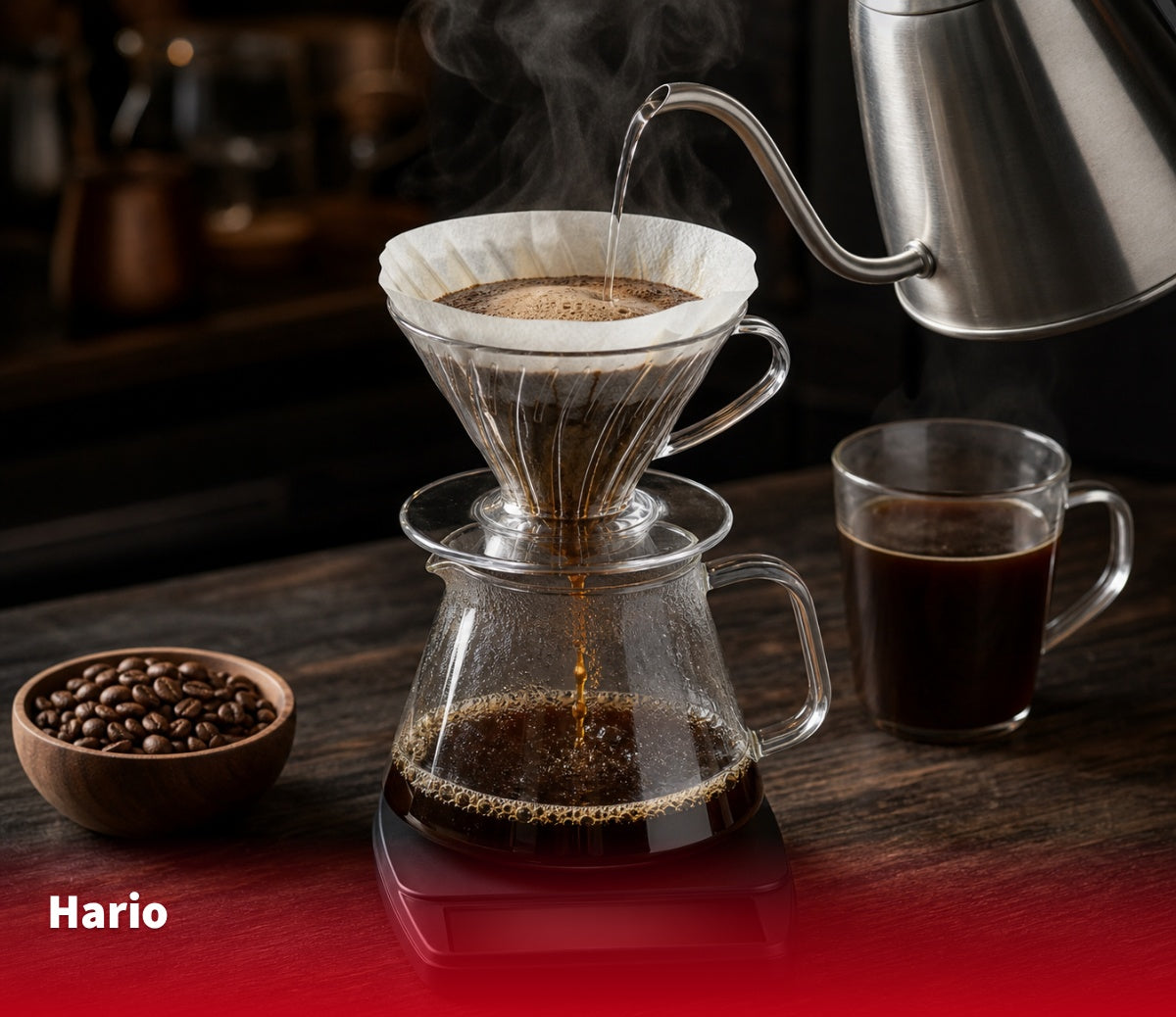

There is a good chance you have used a Hario product without knowing it was Japanese, and a better chance you did not know the company started out making equipment for laboratories.
That origin explains more about the V60 than any coffee story could. Hario's home products are built by a company that has spent a century thinking about how glass behaves when you heat it, how liquid moves through a vessel, and how to see what is happening inside. A cone-shaped coffee dripper and a round glass teapot look domestic. They are the output of a glass-melting furnace.
This is the story of how a Tokyo laboratory-glass maker ended up on specialty coffee counters worldwide—and what you actually need to know to use and care for the results.
Want to brew better coffee? Start with the Hario V60 Coffee Server Set, or explore all Hario glassware—servers, teapots and bottles—at Tokyo Stash.
From this story, shipped from Japan:
 Hario V60 Coffee Server Set 02
 Hario Jumping Leaf Pot 600ml
 Hario Heat-Resistant Coffee Decanter
 Hario V60 Drip Tray
 Hario Cafeor Dripper
What You'll Learn
- 1) From laboratory glass to the kitchen
- 2) What "heatproof glass" really means
- 3) Why the V60 looks simple and is not
- 4) The Japanese coffee culture behind it
- 5) How to brew a first cup
- 6) Care, safety, and shipping
1) From Laboratory Glass to the Kitchen
Hario traces its origins to Hiromu Shibata Works, founded in Tokyo in October 1921 to make laboratory glassware. The present Hario Co., Ltd. was established in 1964, when the heatproof-glassware division was separated from the earlier business. Both dates are worth keeping distinct: 1921 is the origin of the glassmaking, 1964 is the company you buy from today.
The name is less modest than the products. Hario explains it as meaning "King of Glass."
What makes the company unusual among kitchenware brands is that it genuinely makes its own glass. At its Koga factory, raw materials including silica sand, borax, and boric acid are mixed and melted in an all-electric furnace. Hario is not assembling imported glass parts—it is a glass manufacturer that happens to sell coffee equipment. (The company describes itself as operating the only heatproof glass factory in Japan—Hario's own characterization rather than an independently verified fact.)
2) What "Heatproof Glass" Really Means
Borosilicate glass is a glass family containing silica and boron compounds. Compared with the ordinary soda-lime glass used for most windows and jars, it generally has a lower thermal-expansion coefficient—meaning it expands and contracts less when its temperature changes.
In plain terms: when you pour boiling water into a vessel, the inside surface heats before the outside does. In ordinary glass, those two surfaces try to change size at noticeably different rates, and the resulting stress can crack it. In heatproof glass the difference is much smaller, so the stress stays below breaking point.
A precision note: it is safer not to assume every Hario item is borosilicate to the same specification. The company's listed raw materials are consistent with borosilicate-type heatproof glass, but exact composition and permitted uses should be checked per product.
And the important caveat: heat-resistant is not unbreakable. Hario's own instructions warn against heating an empty glass vessel, adding cold water while heating, touching hot glass with a wet cloth, and using abrasive or metal scrubbers. A sudden temperature difference can still break the glass—especially if there is already a chip or scratch. Hario classifies its glassware by intended use, including products rated for boiling water, microwave, oven, or direct flame, so direct-flame compatibility in particular has to be checked item by item.
3) Why the V60 Looks Simple and Is Not
The name is a description. V60 refers to the brewer's V-shaped cone and its 60-degree angle. That is the whole naming convention, and once you know it the object becomes legible.
Hario identifies three signature design features, each doing a specific job:
- The 60-degree cone. A steeper cone creates a deeper bed of coffee grounds than a flat-bottomed brewer, so water travels through more coffee on its way down.
- Spiral ribs. The raised spirals inside leave air channels between the paper filter and the brewer wall, rather than letting the wet paper seal flat against it.
- One large hole. A single big outlet means the brewer itself is not restricting the flow much—so your pouring speed largely determines how fast the water moves through.
That last point is the whole philosophy. The V60 is not a device that brews coffee for you; it is a device that gets out of the way and lets your technique matter. This is exactly why it is beloved by people who enjoy dialing in variables, and mildly frustrating for anyone who wants to press a button.
On dates: Hario's design history places the completed design in 2004, while Hario UK describes a commercial relaunch in 2005. Either way, it arrived in the mid-2000s. Hario notes its products have been used by baristas in international brewing competitions, and the V60 is now widely used in specialty coffee.
4) The Japanese Coffee Culture Behind It
The V60 did not appear from nowhere. Japan has a long-established coffee culture centered on "kissaten" (喫茶店), traditional coffee-and-tea shops that sustained a practice of carefully prepared, table-served coffee long before "specialty coffee" was a phrase.
Two brewing methods are strongly associated with classic kissaten. Nel drip (ネルドリップ) uses a cloth filter rather than paper, producing a notably rounder, heavier cup. Siphon brewing uses glass vessels and vapour pressure, and is as much theatre as method—which is presumably why it looks so good on a kissaten counter.
It would be an overreach to say pour-over was invented in Japan; it was not. The fair claim is that Japan has been an important influence on today's manual-brewing culture, through kissaten practice, through equipment like the V60, and through a general willingness to treat brewing a single cup as something worth doing attentively.
That attentiveness shows up in Hario's tea products too. The Jumping Leaf Pot is deliberately rounded so tea leaves have room to circulate visibly while brewing—the convection movement sometimes called "jumping." It is a design decision that only makes sense if you think being able to watch the process is part of the point. Which, in a company founded on laboratory glassware, it clearly is.
5) How to Brew a First Cup
A reasonable beginner reference: 15 g of coffee to 250 g of water, ground medium-fine, with water at 92–96°C (198–205°F). These are starting points, not universal rules—every coffee and every palate will push them around.
- Rinse the paper filter with hot water and discard the rinse water. This removes papery flavour and preheats the brewer and server.
- Add the grounds and level the bed flat.
- Bloom. Pour roughly twice the coffee's weight in water (about 30 g) and wait around 30 seconds. Fresh coffee releases carbon dioxide here and visibly swells.
- Pour in stages, in slow circles from the centre outward, keeping the bed submerged but not flooding the edges.
- Finish at around 2.5 minutes total. Much faster suggests grinding finer; much slower suggests grinding coarser.
If your cup tastes thin and sour, the water moved through too quickly—grind finer or pour more slowly. If it tastes heavy and bitter, it took too long—grind coarser. That single adjustment fixes most first attempts.
6) Care, Safety, and Shipping
Wash heatproof glass with a soft sponge rather than an abrasive pad or metal scrubber—scratches are where future breaks begin. Never heat a vessel empty, never add cold water to a hot vessel mid-heating, and do not set hot glass down on a wet or cold surface.
Check the individual product for dishwasher, microwave, oven, and direct-flame suitability rather than assuming that all Hario glass shares one rating. Plastic and silicone parts frequently have different requirements from the glass they attach to.
One practical note about ordering glassware internationally: it is fragile, and it should reach you individually protected, immobilized inside the box, and ideally double-boxed with generous cushioning around the inner box. Inspect on arrival, before you pour boiling water into something that may already have a chip.
Conclusion: Equipment That Expects Something From You
The most interesting thing about Hario is the through-line from 1921 to now: a company that makes glass for people who want to see and control what is happening inside it. A laboratory beaker and a V60 are, in a real sense, the same object with different jobs.
If you are buying your first piece, the dripper and a matching server is the classic starting point—and the simplest way to find out whether you enjoy brewing coffee slowly or would rather someone else did it. Both are legitimate answers.
Ready to start? See the Hario V60 Coffee Server Set and the Jumping Leaf Pot, or browse all Hario glassware at Tokyo Stash.
Keep reading:
Explore more Japanese culture stories on Tokyo Stash.