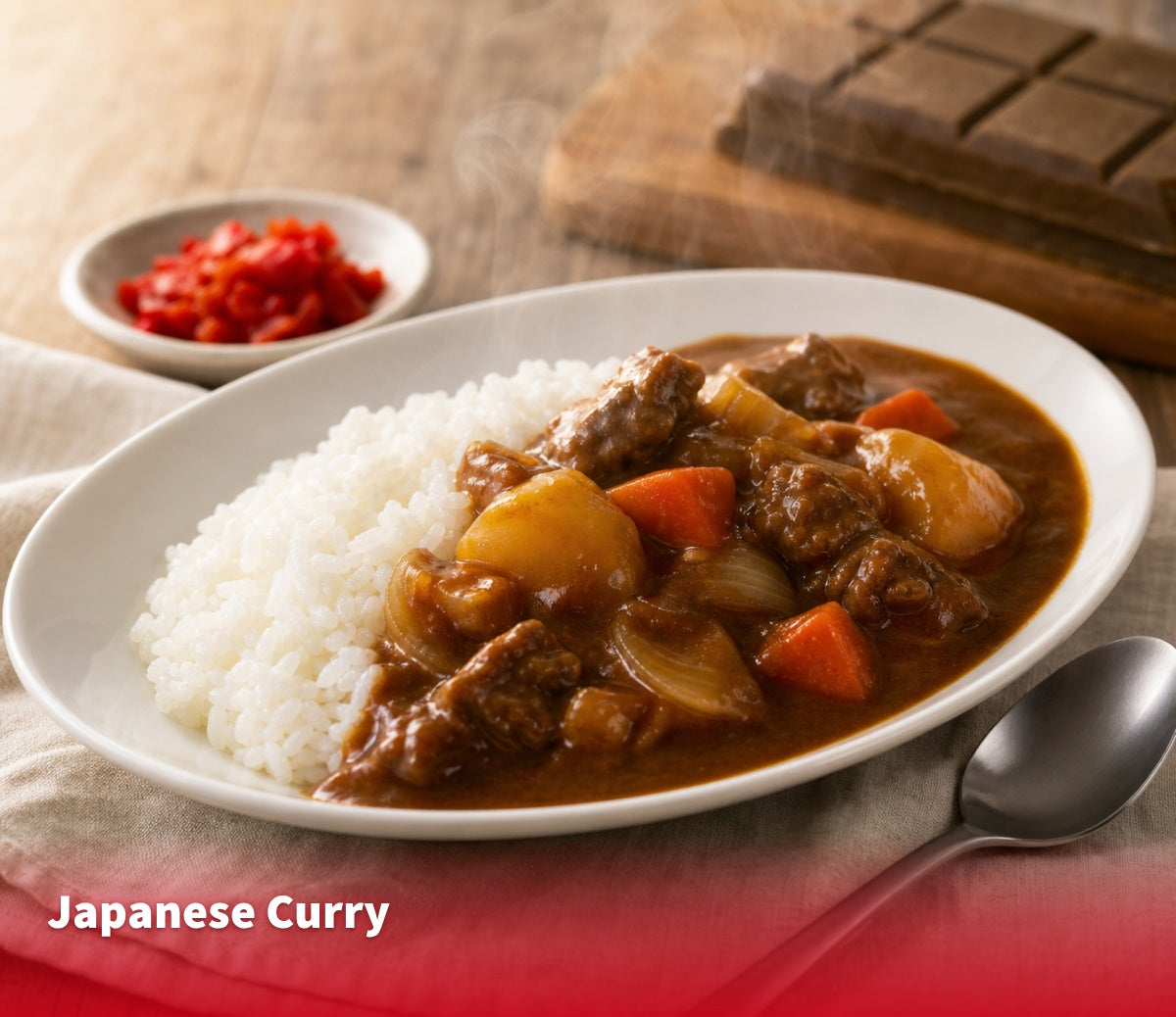

Order curry in Tokyo and you will be handed something unexpected: a plate, not a bowl. On one side, a mound of short-grain rice. On the other, a thick brown sauce that clings to the spoon like gravy. It is mild, faintly sweet, and studded with soft potato and carrot. If you arrived expecting the food of Delhi or Chennai, you may wonder whether something has gone wrong.
Nothing has gone wrong. "Kare raisu" (カレーライス, curry rice) is one of Japan's most-eaten dishes, and it is not an attempt to reproduce any single Indian dish. It is its own cuisine, shaped by an unlikely route through the British Empire, by a navy that needed to feed sailors at scale, and by a small brown block of roux sold in every Japanese supermarket.
It is worth saying at the outset that "Indian curry" is itself an umbrella label covering many distinct regional cuisines, each with its own techniques and ingredients. So the honest comparison is not "Japan versus India." It is the story of how a set of South Asian spice traditions passed through British hands, arrived in Meiji-era Japan, and then became something Japanese cooks made entirely their own.
Want to taste the difference yourself? Start with S&B Golden Curry roux (medium hot) or a ready-to-heat Golden Curry pouch, or explore more S&B curry products at Tokyo Stash.
From this story, shipped from Japan:
 S&B Golden Curry Roux Medium Hot
 S&B Golden Curry Retort Pouch Medium Hot
 S&B Red Can Curry Powder
 S&B Curry Plus Garam Masala
 Momoya Hana Rakkyo Pickled Shallots
What You'll Learn
- 1) The long way around: India, Britain, then Japan
- 2) The roux difference: why it eats like a gravy
- 3) From navy galley to school lunch tray
- 4) How a box of roux created "our family's curry"
- 5) The pouch that changed dinner
1) The Long Way Around: India, Britain, Then Japan
The most common misunderstanding about Japanese curry is that it is Indian curry with the heat turned down. The more accurate version is stranger and more interesting: curry reached Japan by way of Britain. By the time it arrived, South Asian spice traditions had already been translated by the British into two portable inventions—a pre-mixed curry powder and a flour-thickened stew.
That detour matters, because it explains nearly everything that follows. The dish that landed in Japan in the Meiji period was already thickened with flour and already seasoned from a single blended tin, rather than built from whole spices toasted and ground for one specific recipe. Japanese cooks did not simplify an Indian dish. They received an English one and adapted it further.
Curry appeared in Japanese cookbooks of the era; Seiyō Ryōri Shinan (Guide to Western Cooking), published in 1872, is among the period texts that carried recipes of this kind. Crucially, curry was filed not under "foreign food from Asia" but under "yōshoku" (洋食)—Japanese-style Western cuisine. That category also gave Japan omurice, hayashi rice, and korokke. To a Japanese diner of the time, curry was not exotic-Eastern. It was exotic-Western.
Once it was paired with a bed of Japanese short-grain rice, the dish stopped being an import at all. Rice is sticky enough to hold sauce, substantial enough to carry a heavy stew, and central enough to Japanese eating that any sauce poured over it becomes, in effect, domesticated.
2) The Roux Difference: Why It Eats Like a Gravy
The single biggest difference is texture. Japanese curry is opaque, glossy, and thick enough to sit in a mound beside rice without running across the plate. That comes from a roux: flour cooked in fat or oil together with curry powder, then dissolved into a simmering stew. As the starch heats in liquid it swells and sets, giving the sauce a body closer to a Western gravy than to many South Asian preparations.
Compare the construction. Across India's many regional cuisines, cooks typically build flavor by frying whole or ground spices in oil at the start, then developing body with ingredients such as onions, tomatoes, yogurt, coconut, lentils, or ground nuts—methods that vary enormously by region and dish. Japanese curry generally starts from a finished blend, so the spice profile arrives pre-balanced and lands in a similar place from one kitchen to the next.
Then there is sweetness. A well-made Japanese curry tastes gently sweet before it tastes hot, and that sweetness has several sources: onions cooked down until they turn jammy, plus—depending on the brand and the household—sugar, fruit, honey, apple, chutney, or dairy. Heat is present but rarely dominant. The spices are aromatic rather than sharp.
What goes into the pot is equally distinctive. The classic combination is onion, carrot, potato, and a bite-size meat, simmered until the vegetables are soft enough to break under a spoon. These are large, humble, filling pieces. A Japanese curry is not a delicate sauce for scooping with bread; it is a one-plate meal built around rice.
3) From Navy Galley to School Lunch Tray
Curry might have stayed a Western-restaurant novelty. Two institutions made it a national food instead.
The first was the Imperial Japanese Navy, which adopted a British-modeled curry because it suited large-scale cooking: one pot, cheap and adaptable ingredients, served over a staple grain, and satisfying for hungry crews. The Navy's 1908 cooking manual, Kaigun Kappōjutsu Sankōsho, included curry-related guidance.
You will often read that the Navy adopted curry "to cure beriberi." That is too neat. Beriberi is caused by vitamin B1 deficiency, and what actually reduced it was a broad reform of sailors' diets toward more varied, protein-containing meals. Curry was one practical part of that change—not a medicine in a pot. The legacy is real, though: Japan Maritime Self-Defense Force units still serve curry on Fridays, with recipes that vary from unit to unit, which turns a standard weekly meal into a small point of pride.
The second institution was the school lunch. Postwar school meals put curry in front of children nationwide, and Japan's Ministry of Agriculture, Forestry and Fisheries still identifies curry rice as an enduringly popular school-lunch menu. That is how a dish becomes a national comfort food: not by being invented, but by being eaten by everyone at the age of eight.
There is even a date attached. January 22 is promoted in Japan as "Curry Day," commemorating a nationwide school-lunch curry initiative in 1982. It is an industry-recognized commemorative day rather than a public holiday—but the fact that it exists at all says something about curry's place in the culture.
4) How a Box of Roux Created "Our Family's Curry"
Walk into a Japanese supermarket and you will find an aisle of flat boxes containing a slab of solid roux, scored into segments like a chocolate bar. Break off what you need, drop it into the pot, and it dissolves into curry. Inside that block is a complete cooking system: thickener, fat, curry powder, salt, and sweet-savory seasoning, all in one dissolvable product.
This format is central to the Japanese household image of curry, though it is worth avoiding the claim that blocks exist nowhere else. What is fair to say is that it removed the need to measure several separate seasonings, which suited a dish already built around big pieces of potato, carrot, and onion.
Boxes are labeled by heat: "amakuchi" (甘口, mild), "chūkara" (中辛, medium-hot), and "karakuchi" (辛口, hot). These labels do more than measure chile. Mild versions tend to be rounder and sweeter; hot versions lean peppery and spice-forward. They are product-level profiles set by each manufacturer, not a calibrated international heat scale—so one company's medium-hot is not guaranteed to match another's.
That flexibility is what produces "uchi no karē" (うちのカレー, our family's curry). One household uses pork and grated apple; another beef and a spoonful of coffee; another chicken with mushrooms, or a knob of butter, or a square of chocolate stirred in at the end. Some families swear the pot tastes better on day two, after a night in the refrigerator. The dish stays recognizable; the signature is personal.
The Japanese curry aisle has evolved to serve exactly this instinct. S&B's Curry Plus range, for instance, sells single-purpose enhancers—garam masala, bouillon, chutney, fond de veau—designed to be added to a curry you have already made. They are, in effect, a commercial acknowledgment that no two families want the same pot.
The company behind much of this is a useful thread in itself. S&B traces its origins to founder Minejiro Yamazaki's 1923 business and says it went on to produce Japan's first fully domestic curry powder. Its Red Can curry powder is built on a pre-blended spice profile that company materials describe as including turmeric, coriander, cumin, fenugreek, pepper, red chile, and dried citrus peel. Golden Curry, launched in 1966, remains one of the most recognizable roux brands in the country.
5) The Pouch That Changed Dinner
Roux blocks assume you are cooking for a family. But Japan also needed curry for one person, at 9pm, with no chopping. The answer was the retort pouch: food sealed in a heat-resistant bag and sterilized under pressure, making it shelf-stable and ready after a few minutes in hot water.
Otsuka Foods launched Bon Curry on February 12, 1968, initially around the Hanshin area, with national distribution following in 1969. The company describes it as the world's first commercially sold retort-pouch curry.
The more interesting point is what came after. The pouch separated the curry from the cooking pot entirely, and in doing so it created a whole category. Today that category runs from inexpensive everyday pouches to regional specialties and premium restaurant-style products—retort curries built around a particular shop's recipe, a specific spice approach, or a named regional style. S&B alone offers ready-to-heat Golden Curry, keema, beef, and a range of restaurant-collaboration pouches.
For an overseas cook, the pouch is also the lowest-effort way in. There is no roux to dissolve and no ratio to judge. Follow the package exactly, though: some pouches are designed to be heated in boiling water in the bag, while others are microwave-safe only after the contents are transferred to a suitable container.
Conclusion: A Dish That Stopped Being an Import
Japanese curry tastes nothing like the curries of India because it was never trying to. It arrived through Britain already thickened and pre-spiced, got adopted by a navy that needed to feed people at scale, was handed to every schoolchild in the country, and then was rebuilt around a block of roux that let each family write its own version. Somewhere in that sequence it stopped being a foreign dish and became a Japanese one.
If you are cooking it for the first time, start with a medium-hot roux and follow the water quantity on that specific package. Sauté onion, add your protein with carrot and potato, simmer until everything is tender, then turn off the heat before stirring in the roux—it dissolves far more smoothly that way. Bring it back to a gentle simmer, stirring up from the bottom, because it thickens fast and will catch on the pan.
Serve it over freshly cooked rice rather than bread. If you can find them, add "fukujinzuke" (福神漬け, sweet-tangy chopped pickles) or "rakkyō" (らっきょう, pickled shallots) on the side; their sharpness cuts the richness exactly where it needs cutting. One note before you shop: roux blocks are not automatically vegetarian, vegan, or free of wheat and dairy, so check the individual package.
Ready to make it tonight? Pick up S&B Golden Curry roux and a jar of pickled rakkyō for the side, or explore S&B ready-to-heat pouches and Curry Plus enhancers at Tokyo Stash.
Keep reading:
Explore more Japanese snacks and culture stories on Tokyo Stash.