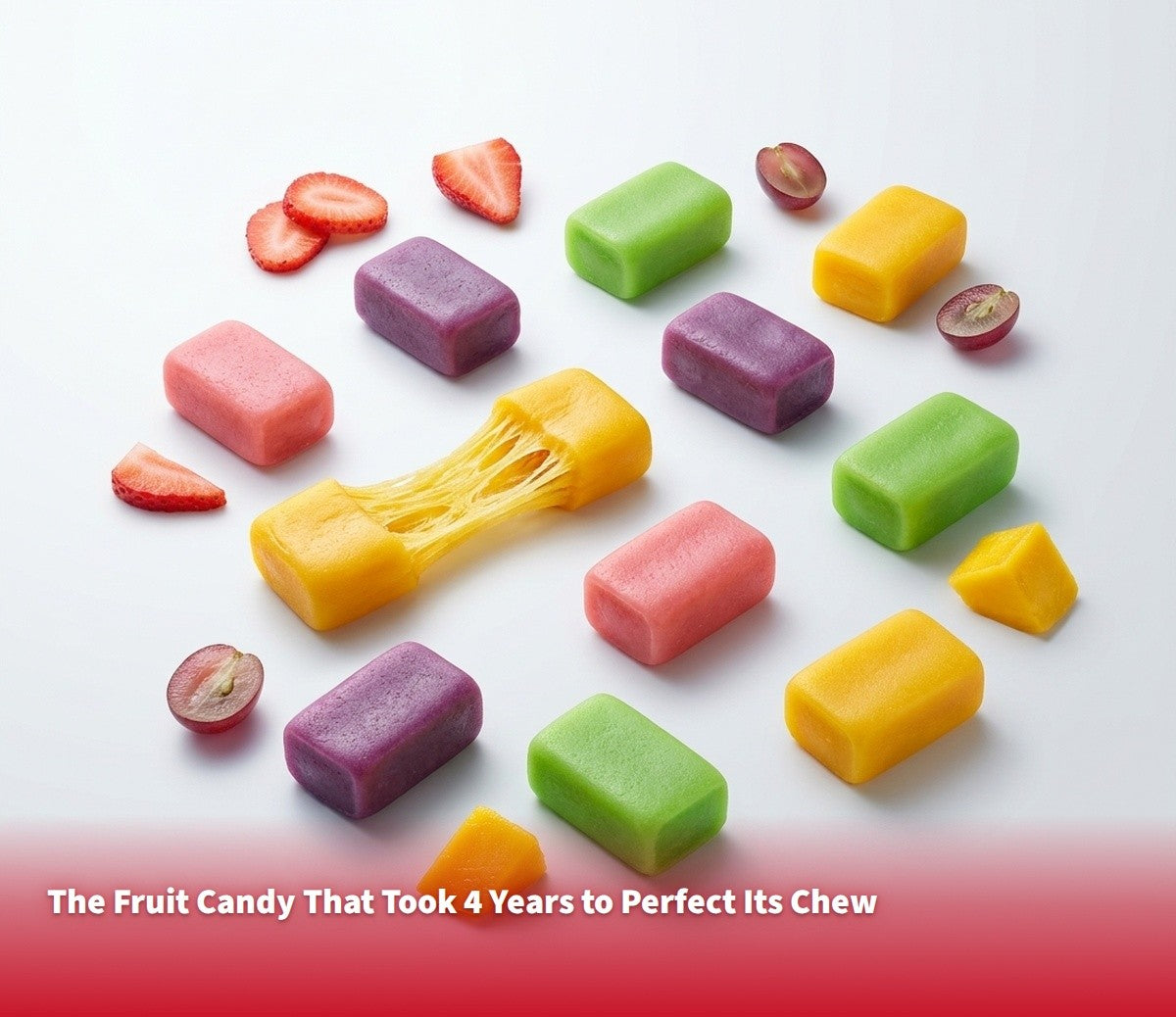

In the early 1970s, a team of food scientists at Morinaga—one of Japan's oldest and most inventive confectionery companies—sat down with an unusual assignment: create a candy that chews like gum but disappears like candy. Not gum. Not caramel. Not a hard sweet you suck on until it shrinks away. Something entirely new—a confection with the prolonged, satisfying resistance of chewing gum, but one that gradually dissolves, releasing waves of real fruit flavor as it goes.
It took them four years and over a thousand prototypes. When they finally got it right, the result was Hi-Chew—a name that announced its ambition plainly. "Hi" for high quality. "Chew" for the sensation the entire project was built around. The first flavor was grape, launched in 1975, and it was unlike anything on the Japanese candy shelf. Soft but resilient. Fruity but not cloying. A candy that asked you to chew, and rewarded you for it.
Half a century later, Hi-Chew is sold in over 30 countries, is a top-five chewy candy brand in the United States, and has produced more flavor variations than most people can count. But the real story is not about global expansion or flavor lists. It is about why a Japanese candy company spent four years obsessing over a single physical sensation—and why that obsession produced something the rest of the world could not stop chewing.
Want to try Hi-Chew for yourself? Browse Morinaga products at Tokyo Stash.
What You'll Learn
- 1) The quest for "chewing gum you can swallow"
- 2) The science of the perfect chew
- 3) From Japan to the world: Hi-Chew goes global
- 4) 12 flavors and counting: the Hi-Chew universe
1) The Quest for "Chewing Gum You Can Swallow"
To understand Hi-Chew, you have to understand the man whose company made it possible. Taichiro Morinaga founded Morinaga & Company in 1899 after spending over a decade apprenticing in American candy factories. He returned to Tokyo with a conviction that Japan deserved Western-style confections made with Japanese precision. By the time his company celebrated its 70th anniversary in the late 1960s, Morinaga had already given Japan Milk Caramel, Chocoball, and DARS. But the R&D team was restless. They wanted to solve a problem that no candy maker had cracked.
The problem was this: chewing gum delivers a satisfying, prolonged chewing experience, but you cannot eat it. You chew and chew, extract the flavor, and then spit out a flavorless lump. Caramels and toffees, on the other hand, dissolve as you chew—but they are dense, they stick to your teeth, and the chewing experience is more of a battle than a pleasure. What if there were a candy that gave you the best of both—the sustained chewing satisfaction of gum, but with the ability to swallow it, and with real fruit flavor that lasted from the first bite to the last?
Development began in earnest around 1971. The Morinaga team experimented with dozens of combinations of gelatin, starch, fruit purees, and softening agents. The challenge was fundamentally contradictory: the candy needed to be firm enough to resist the jaw for 30 to 60 seconds of chewing, yet soft enough to eventually dissolve on the tongue. Too firm, and it became indistinguishable from gum. Too soft, and it collapsed instantly like a gummy bear. The window between those two extremes was vanishingly narrow.
The breakthrough came with what Morinaga would later call the three-layer structure. Rather than trying to make a single homogeneous candy do contradictory things, the engineers built Hi-Chew in layers, each with a different job. An outer candy shell provided the initial bite resistance. A soft, elastic chewy center—the heart of the product—delivered the sustained chewing sensation. And a fruit juice filling, embedded within the center, released concentrated flavor as the layers broke down. It was not a recipe. It was architecture.
The name Hi-Chew was chosen to communicate exactly what the product was: an elevated chewing experience. In Japanese marketing language of the 1970s, the prefix "Hi" (from "High") signaled premium quality. "Chew" was self-explanatory. Together, the name was a promise: this is chewing, but better.
Hi-Chew launched in 1975 with a single flavor: grape. The choice was strategic. Grape was the most popular artificial fruit flavor in Japan at the time, familiar and universally liked. It gave consumers a safe entry point into a completely unfamiliar candy format. The grape Hi-Chew was an immediate success. Within its first year, it established itself as a new category on the Japanese candy shelf—not gum, not caramel, not hard candy, but something that had not existed before. Morinaga had spent four years inventing a product that created its own market.
2) The Science of the Perfect Chew
If you have ever chewed a Hi-Chew side by side with a Starburst or an Airhead, you already know that something is fundamentally different. The Hi-Chew resists your jaw more deliberately. It stretches instead of crumbling. It releases flavor in waves rather than dumping everything at once. And it lasts—noticeably, measurably longer. This is not an accident. It is the result of engineering decisions that reflect a distinctly Japanese obsession with texture.
The three-layer construction is the foundation of everything. The outer shell is a thin candy coating, slightly firmer than the interior, which gives Hi-Chew its initial snap when you bite down. This shell is not structural in the way a hard candy shell would be—it yields almost immediately—but it provides a brief moment of resistance that signals to your jaw: there is something to chew here. The chewy center, which makes up the bulk of the candy, is a proprietary blend of glucose syrup, hydrogenated palm kernel oil, gelatin, and starch. The exact ratios are the product of those four years of R&D and remain closely guarded. This center has a specific elasticity that Morinaga engineers calibrated to mimic the chewing resistance of bubble gum—firm enough to push back against your molars, elastic enough to stretch rather than tear, but degradable enough to gradually break down into a smooth, swallowable mass. The fruit filling, concentrated within the center, is a blend of fruit juice, fruit puree, and natural and artificial flavoring. As the chewing action breaks down the center layer, it ruptures tiny pockets of this filling, releasing bursts of flavor throughout the chewing cycle.
The result is a candy that unfolds over time. The first few seconds deliver the shell snap and an initial hit of fruit flavor. The next 20 to 30 seconds are the core experience: steady chewing resistance with gradually intensifying fruit taste as more filling is released. The final 10 to 15 seconds bring a softening—the candy begins to lose its structure, becoming smoother and creamier on the tongue before dissolving entirely. The whole arc lasts roughly 40 to 60 seconds, depending on how aggressively you chew. That arc—from firm to soft to gone—is what four years of prototyping produced.
This matters because Japanese consumers evaluate candy along texture dimensions that most Western palates barely register. The Japanese language has an extraordinarily rich vocabulary for mouthfeel. "Mochi-mochi" (もちもち, soft and springy) describes the quality of fresh rice cakes and well-made udon noodles—and it is the word most often used to describe Hi-Chew's texture. "Neri-neri" (ねりねり, kneadable and pliable) captures the way Hi-Chew stretches when you pull it apart. These are not casual adjectives in Japanese food culture. They are precise evaluative criteria, and consumers use them with the same seriousness that a wine critic uses "tannin" or "body."
Morinaga's R&D team reportedly tested over 1,000 prototypes during the four-year development cycle. Many of these variations differed by fractions of a percentage in their gelatin-to-starch ratios—tiny adjustments that produced perceptible differences in chewing resistance and dissolve time. The team used trained sensory panels to evaluate each prototype along multiple texture axes: initial firmness, elasticity, stickiness (they wanted low stickiness—Hi-Chew should not cement itself to your molars the way caramel does), dissolve rate, and residual mouthfeel after swallowing.
One detail that surprises most people: Hi-Chew is temperature-sensitive. At room temperature (around 20 to 25 degrees Celsius), it has its standard firmness and chew. On a warm day, or if you have been carrying a piece in your pocket, the candy softens noticeably—the chew becomes more yielding, almost creamy. In cooler conditions—straight from a refrigerator, or on a cold winter day—it firms up, and the chewing resistance increases. Some Hi-Chew enthusiasts deliberately refrigerate their candy for a firmer, longer-lasting chew. Others prefer it slightly warm. Morinaga has never publicly recommended a serving temperature, but the temperature sensitivity is a feature, not a flaw—it gives each piece a slightly different character depending on when and where you eat it.
The engineering is invisible by design. When you chew a Hi-Chew, you do not think about gelatin ratios or three-layer construction. You think: this tastes like strawberry, and it feels good to chew. That seamlessness—the gap between the complexity of the engineering and the simplicity of the experience—is what separates Hi-Chew from every imitation that has followed.
3) From Japan to the World: Hi-Chew Goes Global
For its first three decades, Hi-Chew was a purely Japanese phenomenon. It dominated the domestic chewy candy market, spawned dozens of flavors, and became a staple in every convenience store and supermarket in the country. But outside Japan, almost nobody had heard of it. That began to change in the 2000s, when Morinaga made the strategic decision to bring Hi-Chew to the United States—a market saturated with chewy candy brands that had been entrenched for decades.
The initial approach was cautious. In 2008, Morinaga began distributing Hi-Chew through Asian grocery stores and specialty import shops on the US West Coast. This was a low-risk strategy: the Asian-American community already knew the product, and specialty retailers were willing to stock unfamiliar brands. Hi-Chew quickly became a best-seller in these channels, but Morinaga's ambitions were larger. They wanted mainstream shelf space—the candy aisle at CVS, Walmart, and Target.
Breaking into the American mainstream candy market is extraordinarily difficult. The aisle is controlled by a handful of legacy brands—Starburst, Skittles, Jolly Rancher, Airheads—with decades of brand recognition, massive advertising budgets, and established distribution networks. A Japanese import with a name that most Americans could not pronounce had no obvious path in. Morinaga's strategy was patient and unconventional.
The first major breakthrough came through Major League Baseball. In the early 2010s, Morinaga struck sponsorship deals with several MLB teams, including the Los Angeles Angels, the Minnesota Twins, and the Tampa Bay Rays. Hi-Chew became the "official chewy candy" of these franchises, distributed in stadium stores and handed out during promotions. The logic was sound: baseball games are long, fans want something to chew, and the stadium context positioned Hi-Chew as a fun, shareable snack rather than a niche import. The MLB partnerships generated awareness among exactly the demographic that buys the most candy—families with children.
Word of mouth did the rest. The texture was the ambassador. Americans who tried Hi-Chew for the first time consistently reported the same reaction: this is not like any chewy candy I have had before. The chew was longer, the fruit flavor was more intense, and the candy did not stick to their teeth the way Starburst did. Social media accelerated the discovery. YouTube reviews, TikTok taste tests, and Reddit threads comparing Hi-Chew to its American competitors generated millions of organic impressions. Hi-Chew became that rare thing: a product that sells itself once someone tries it.
By the mid-2010s, Hi-Chew had secured shelf space in major US retailers. By the 2020s, it had become a top-five chewy candy brand in the United States—a remarkable achievement for a Japanese import competing against brands with half a century of American market presence. Today, Hi-Chew is sold in over 30 countries, including across North America, Europe, Southeast Asia, and Oceania.
Hi-Chew's international trajectory is unusual among Japanese confections. A handful of Japanese snacks have achieved genuine global success—Pocky (Glico's chocolate-dipped biscuit sticks) is probably the most prominent—but the majority remain niche products outside Asia, beloved by import-shop regulars but unknown to mainstream consumers. What makes Hi-Chew different is that its appeal is both familiar and novel. The fruit flavors—grape, strawberry, mango—are universally recognized. There is no cultural barrier to understanding what a strawberry candy is. But the texture is something most foreign consumers have never experienced. That combination—familiar flavor, novel sensation—is the ideal formula for crossover success. You do not need to explain what Hi-Chew is. You just need someone to chew one.
Crucially, Morinaga did not reformulate Hi-Chew for international markets. The Hi-Chew sold in an American gas station uses the same three-layer construction, the same chewy center formulation, and the same fruit-forward flavor profile as the Hi-Chew sold in a Tokyo convenience store. The company's position was firm: the texture is the product. Change the texture, and it is no longer Hi-Chew. This refusal to compromise is a hallmark of Morinaga's approach, and it is a large part of why Hi-Chew's international reputation mirrors its domestic one—the product delivers the same experience regardless of where you buy it.
4) 12 Flavors and Counting: The Hi-Chew Universe
When Hi-Chew launched in 1975, there was one flavor: grape. Today, the product line spans dozens of varieties across multiple tiers, formats, and regional exclusives. At Tokyo Stash, we carry a curated selection of 12 flavors—a cross-section of Hi-Chew's range that captures both the classics and the surprises.
The permanent lineup reads like a tour of Japan's fruit obsession. Grape is the original—the flavor that proved the concept in 1975 and remains a best-seller nearly five decades later. Its continued popularity is a testament to how well Morinaga nailed the balance between bold Concord grape sweetness and the chewy delivery system. Strawberry arrived shortly after grape and has become the single most popular Hi-Chew flavor worldwide, outselling every other variety in both domestic and international markets. The strawberry version is sweeter and lighter than grape, with a bright, almost creamy fruit character. Green Apple brings tartness to the lineup—a sharp, slightly sour counterpoint that appeals to consumers who find the other flavors too sweet. Mango delivers tropical richness, with a flavor profile that leans closer to ripe Alphonso mango than the generic "tropical" taste of most Western mango candies.
Then there are the flavors that reveal Hi-Chew's Japanese DNA. Peach is not the aggressive, syrupy peach of Western candy. It is modeled after Japanese white peach—hakuto—which is delicate, floral, and almost perfume-like. If you have never tasted a Japanese peach, this Hi-Chew flavor will surprise you. Melon channels the Yubari melon of Hokkaido, one of Japan's most prized (and expensive) fruits. The candy version captures the musky sweetness of ripe melon with startling accuracy. Lychee offers something most Western consumers have limited experience with: the fragrant, rose-scented sweetness of fresh lychee fruit, a flavor that reads as exotic and sophisticated.
Beyond the permanent lineup, Hi-Chew operates on a seasonal and limited-edition rotation system that mirrors the broader Japanese snack industry. Japan-exclusive flavors cycle through convenience store shelves on roughly seasonal schedules. Hokkaido Melon, a regional exclusive, uses concentrated melon flavoring sourced from Hokkaido and is often only available at airports and souvenir shops in the region. Okinawan Pineapple captures the tangy-sweet character of pineapple grown on Japan's southernmost islands. Shinshu Grape—a Nagano regional edition—uses a different grape variety than the standard grape Hi-Chew, producing a more complex, wine-like flavor profile. These regional editions feed directly into Japan's omiyage (souvenir gift) culture: travelers buy them as presents to bring back to friends and coworkers, which means every limited-edition flavor becomes a miniature ambassador for its home region.
In recent years, Morinaga has introduced a Premium Hi-Chew line that pushes the product upmarket. Premium Hi-Chew pieces are larger, softer, and contain real fruit pieces embedded within the chewy center. The fruit inclusions add a new textural element—small bursts of genuine fruit fiber that you encounter mid-chew, providing a contrast to the smooth, elastic base. The Premium line includes flavors like Amaou Strawberry (using Fukuoka's famous premium strawberry variety), Shine Muscat (a high-end Japanese grape cultivar), and Golden Pineapple. These are positioned not as everyday snacks but as small indulgences, sold at higher price points and in smaller packages.
Morinaga's flavor strategy reflects a deep understanding of how Japanese consumers relate to fruit. In Japan, fruit occupies a cultural position that has no real equivalent in the West. Premium fruit is a luxury gift item—a single Yubari melon can sell for over 10,000 yen, and perfectly shaped strawberries are displayed in department stores like jewelry. Even everyday fruit is treated with a reverence that would strike most Western consumers as unusual. Hi-Chew's flavor development taps into this cultural relationship. Each flavor is not just "fruit-flavored candy"—it is an attempt to capture a specific fruit at its peak ripeness, translated into chewy candy form. The grape Hi-Chew does not taste like generic grape. It tastes like the idea of a perfect grape.
The rotation strategy serves a commercial purpose too. By cycling limited-edition flavors in and out, Morinaga creates urgency. If you see Okinawan Pineapple Hi-Chew on the shelf in July, you know it will be gone by September. This scarcity drives impulse purchases and repeat store visits—the same psychology that powers Japan's entire convenience store snack ecosystem. Hi-Chew is not a product you buy once and forget. It is a product you keep rediscovering, one seasonal flavor at a time.
Conclusion: Four Years for a Feeling
Hi-Chew's story is, at its core, a story about taking texture seriously. Most candy companies would not spend four years and a thousand prototypes perfecting a chew. Most candy companies would not build a three-layer architecture into a product that weighs a few grams and costs less than a dollar. Most candy companies, faced with the contradictory demand of "chews like gum but dissolves like candy," would have compromised in one direction or the other and called it good enough.
Morinaga did not compromise. They engineered. They tested. They calibrated gelatin-to-starch ratios in fractions of a percent until the chewing arc—firm to soft to gone—lasted exactly as long as it should. And when they brought Hi-Chew to the world, they refused to reformulate it for foreign palates. The texture is the product. That was true in 1975, and it is true today.
The next time you unwrap a Hi-Chew, slow down. Feel the brief resistance of the outer shell. Notice how the center pushes back against your molars, elastic and deliberate. Pay attention to the moment—maybe 30 seconds in—when the fruit flavor intensifies as the filling breaks open. Then notice the gradual softening, the transition from chew to melt, the smooth finish as the candy disappears. That 60-second arc is what four years of work produced. It is not just a candy. It is a feeling, engineered from the inside out.
Ready to experience what four years of R&D tastes like? Explore the Morinaga collection at Tokyo Stash and find your favorite Hi-Chew flavor.
Explore more Japanese snacks and culture stories on Tokyo Stash.