
The first time most people try a Japanese snack, the same thought crosses their mind: it's tiny. A Japanese Kit Kat Mini weighs 11.6 grams. The American Kit Kat bar weighs 42 grams. A standard Snickers is 52 grams; the closest Japanese chocolate bar equivalent sits around 25 to 35 grams. The packaging is meticulous. The sweetness is restrained. The whole experience feels, for lack of a better word, designed—as if someone thought carefully about every gram and every gram of sugar.
They did. Japanese snacks are not smaller because Japan cannot make them bigger. They are not less sweet because the factories ran out of sugar. Every difference you notice between a Japanese snack and its Western counterpart is the result of deliberate choices rooted in culture, eating habits, and a fundamentally different idea of what a snack is supposed to do.
This article breaks down the four biggest differences—size, sweetness, texture, and overall philosophy—so that the next time you open a Japanese snack, you understand exactly what you are holding and why it was made that way.
Curious to taste the difference? Browse Japanese snacks at Tokyo Stash.
What You'll Learn
- 1) The size gap: why Japanese snacks come in smaller portions
- 2) The sweetness dial: turned down on purpose
- 3) Texture over flavor: the other priority
- 4) Why these differences matter for you
1) The Size Gap: Why Japanese Snacks Come in Smaller Portions
Let us start with the numbers, because they are striking.
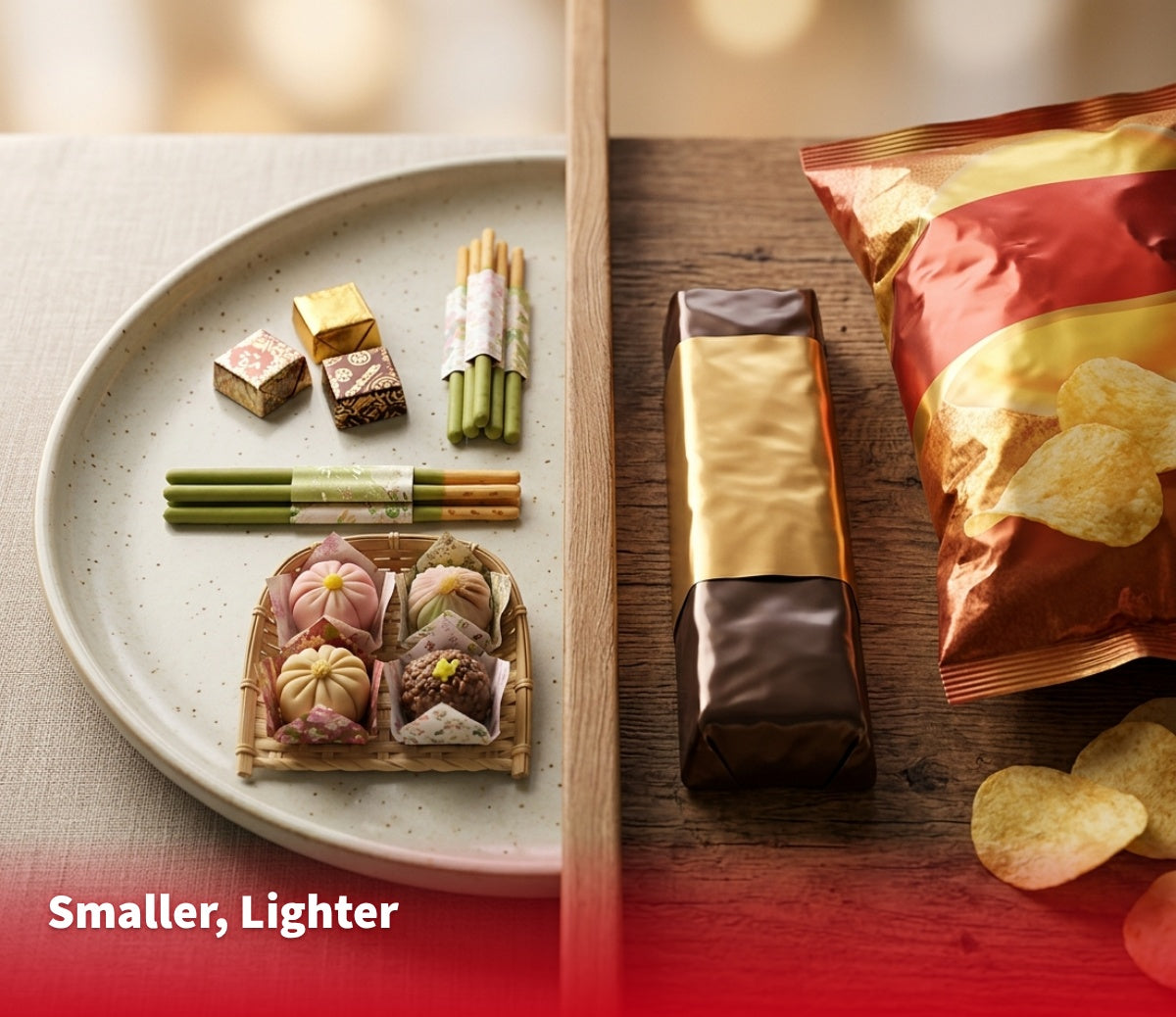
A US Snickers bar weighs 52.7 grams and delivers 250 calories. A Japanese chocolate bar from Meiji or Lotte typically weighs 25 to 35 grams. A single Kit Kat Mini—the format most commonly sold in Japan—weighs 11.6 grams. Its American counterpart, the standard four-finger Kit Kat, weighs 42 grams, nearly four times as much. Pocky comes in a box that looks substantial but contains slim pretzel sticks totaling around 60 to 75 grams, shared over a dozen or more individual pieces. A bag of Calbee potato chips sold at a Japanese convenience store holds 60 grams; the standard US single-serve bag of Lay's is 28.3 grams, but the "grab bag" format that dominates vending machines and checkout aisles runs 77 to 85 grams.
Western consumers sometimes interpret this as getting less for their money. That interpretation misses the point entirely.
Japanese snack design operates on a principle best captured by a single word: "hitokuchi" (一口), meaning "one bite" or "one mouthful." The idea is that each piece should be consumed in one or two bites—a complete, self-contained eating experience that begins and ends cleanly. You do not gnaw on a Japanese chocolate bar over ten minutes. You place a single piece in your mouth, let it melt or crunch, and the experience is done. If you want more, you take another piece. Each piece is a fresh start.
This connects directly to a broader Japanese eating philosophy: variety over volume. Consider the Japanese bento box. A typical bento does not contain a large portion of one thing. It contains small portions of many things—rice, fish, pickled vegetables, a small piece of fruit, perhaps a tiny dessert. The satisfaction comes from the range of flavors and textures, not from the sheer amount of food. Japanese snacking follows the same logic. A box of assorted Kit Kat flavors, each piece individually wrapped, is not a single snack. It is a miniature tasting menu. You might eat a Strawberry Cheesecake Kit Kat, then a Matcha Kit Kat, then a Sake Kit Kat—three distinct flavor experiences, totaling maybe 35 grams of chocolate.
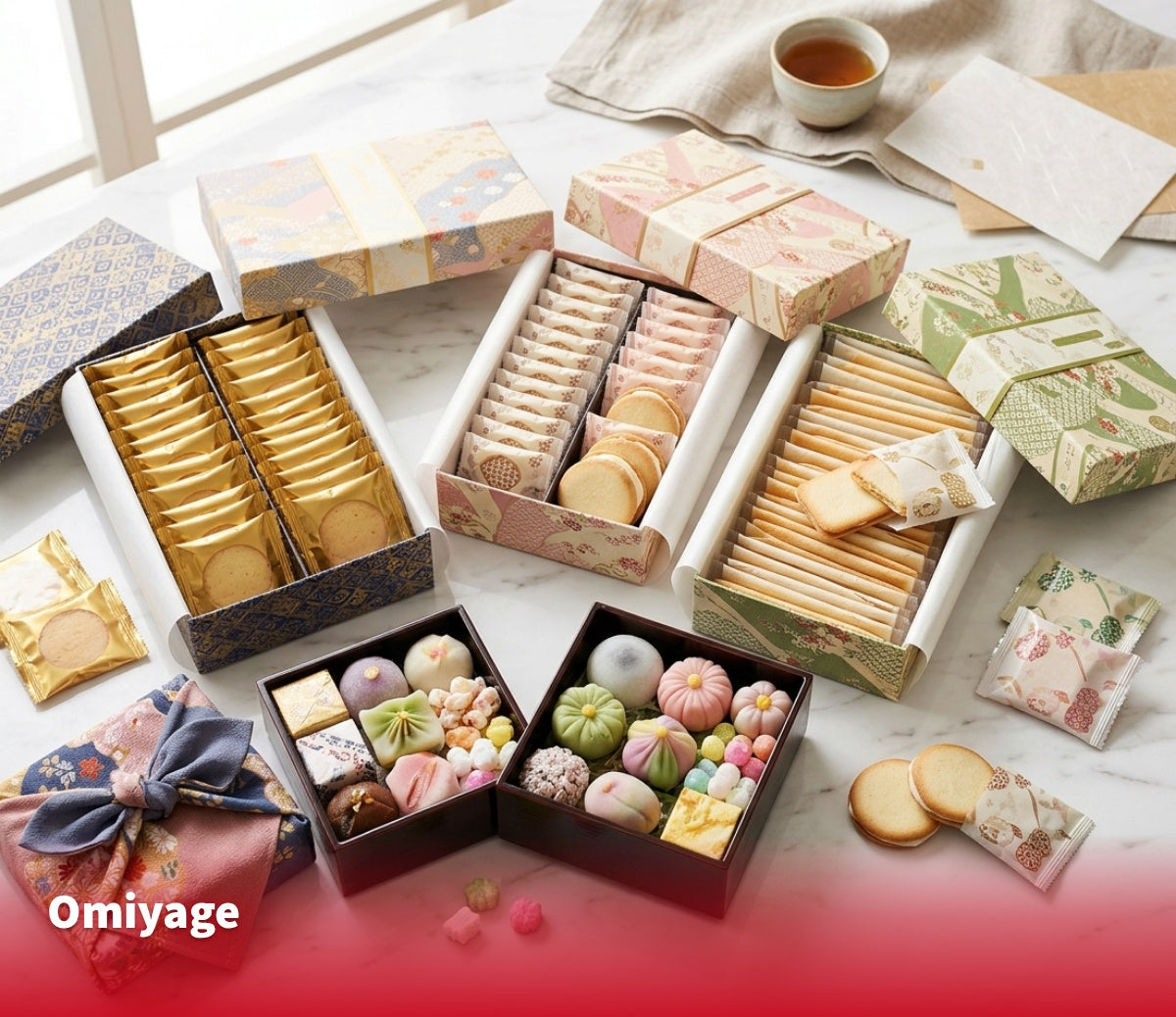
The individual wrapping that often surprises Western consumers is part of this design, not an afterthought. Each wrapper serves multiple functions: it keeps the piece fresh until the moment of eating, it makes the snack portable and shareable (critical in a culture where omiyage gift-giving drives billions of yen in annual snack sales), and it creates a small ritual around each piece. Unwrap, eat, dispose of the wrapper. There is a beginning and an end. The wrapper is a frame around the experience.
There is also a practical dimension. Japan is a society of commuters. Millions of people eat snacks on trains, at desks, during five-minute breaks at work. A snack that requires two hands, leaves crumbs, or takes fifteen minutes to finish is poorly suited to this reality. The small, individually wrapped, one-bite format is engineering for real life.
2) The Sweetness Dial: Turned Down on Purpose
If size is the most visible difference, sweetness is the most immediate one. Bite into a Japanese chocolate and then bite into an American one. The gap is impossible to miss.
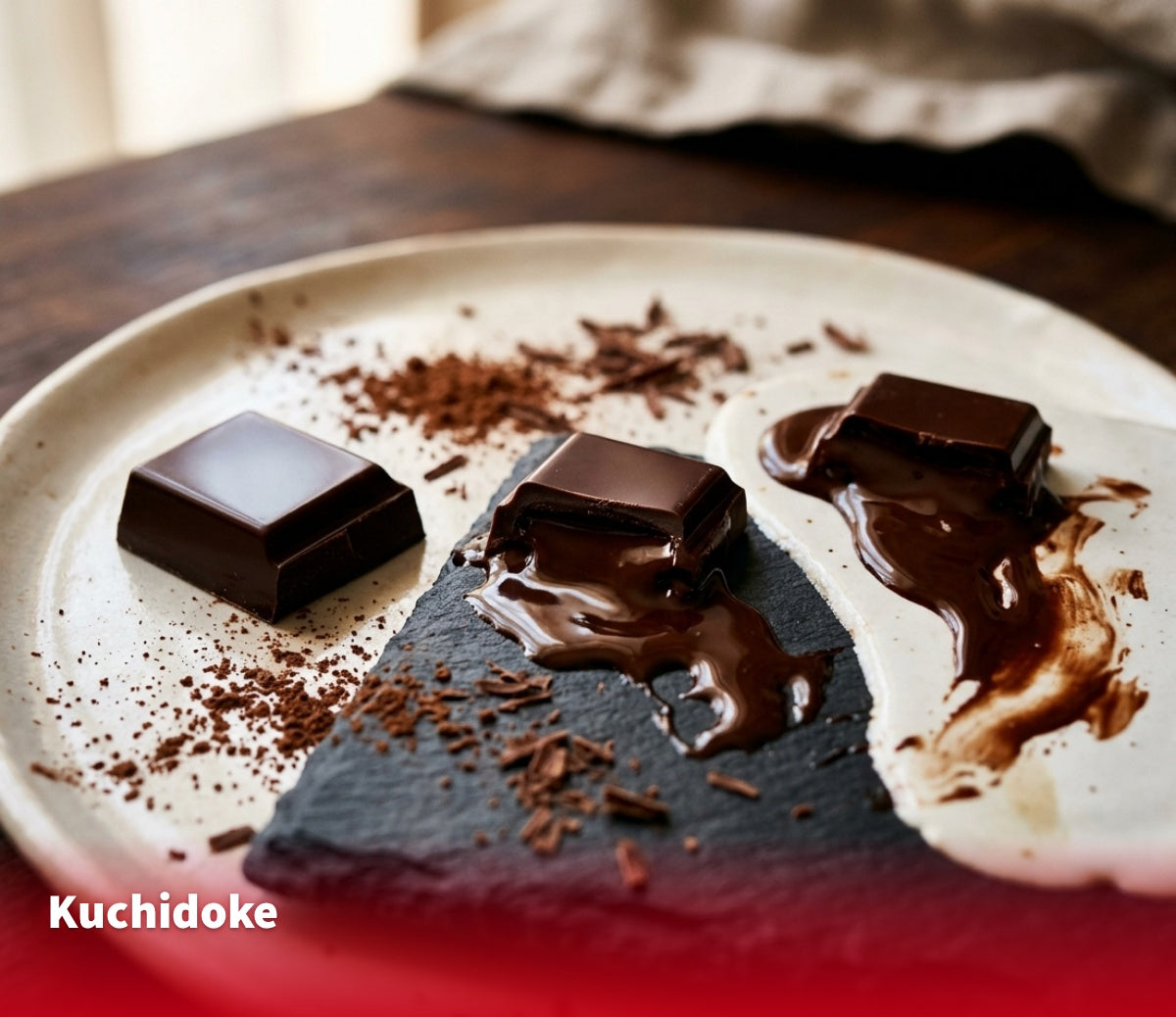
The numbers back up what your tongue already knows. Japanese confectionery products typically contain 20 to 40 percent less sugar than their Western equivalents by weight. A Meiji Milk Chocolate bar lists roughly 39 grams of sugar per 100 grams of product. A Hershey's Milk Chocolate bar contains about 56 grams of sugar per 100 grams—nearly 44 percent more. When you move to items like cookies and biscuits, the pattern holds. Country Ma'am cookies from Fujiya are sweet, certainly, but place one next to a Chips Ahoy and the American cookie will taste conspicuously sugarier.
This is not accidental. It is a preference with deep cultural roots.
Japanese confectionery descends from wagashi—the traditional sweets that evolved alongside the tea ceremony over centuries. Wagashi are designed to be eaten with bitter matcha tea, and their sweetness is calibrated to complement, not compete with, the tea's intensity. A good wagashi is sweet, but the sweetness is restrained and rounded, never sharp or aggressive. It recedes quickly, leaving a clean finish that invites a sip of tea. This aesthetic of restraint became so deeply embedded in Japanese taste that when Western-style confectionery arrived in the Meiji era, Japanese makers instinctively tempered the sugar. They did not copy Western recipes gram for gram. They adapted them to a palate that had been trained, for centuries, to prefer sweetness as a supporting player rather than the lead.
In modern Japan, this preference has its own vocabulary. The phrase "amasa hikae-me" (甘さ控えめ, "sweetness restrained") appears on packaging as a selling point, not a warning. It signals sophistication—an assurance that the product will not overwhelm you. A chocolate that is "amasa hikae-me" is marketed the way a French wine might be described as "elegant" or "restrained." Less sugar is a feature, not a compromise.
Look at how Japan handles the Kit Kat, a product that exists in both markets. The Japanese Matcha Kit Kat is deliberately bittersweet. The matcha powder contributes a vegetal bitterness that pushes against the white chocolate's sweetness, producing a complex, layered flavor where neither element dominates. The standard American Kit Kat is tuned to a different frequency entirely: sweet milk chocolate with enough sugar to hit fast and hit hard. Neither approach is objectively "better." But they reflect fundamentally different ideas about what a candy bar should taste like.
There is a practical consequence here for international consumers: when you eat Japanese snacks for the first time, the reduced sweetness can initially register as "mild" or even "bland" if your palate is calibrated to Western sugar levels. Give it a few days. Once your tongue adjusts, you start tasting the flavors that sugar was masking—the roasted grain in a biscuit, the actual cocoa in a chocolate, the subtle tang of real fruit in a gummy. The sweetness was turned down so you could hear everything else.
3) Texture Over Flavor: The Other Priority
In most Western snack markets, the first question about any product is: what does it taste like? Chocolate. Strawberry. Barbecue. Sour cream and onion. The flavor is the headline, and the texture is background—assumed rather than discussed.
In Japan, the question is just as likely to be: how does it feel? Is it saku-saku (light and crispy)? Mochi-mochi (soft and chewy)? Pari-pari (thin and crackly)? Fuwa-fuwa (fluffy and airy)? The Japanese language has over 400 onomatopoeic expressions for food texture—a vocabulary so rich that it has no parallel in English, French, or any other European language. And these are not obscure academic terms. They appear on snack packaging, in TV commercials, and in everyday conversation. A Japanese consumer choosing between two cookies at a convenience store will read the texture word on the package the way a Western shopper reads "spicy" or "mild."
This cultural weight on texture explains something that puzzles many Western observers: why Japanese snack companies release so many texture variants of the same product. Consider Pocky. Glico does not just make Chocolate Pocky. They make standard Pocky (thin, crisp pretzel with a chocolate coat), Pocky Gokuboso (ultra-thin, sharper crunch), and Pocky Midi (thicker, softer, more biscuit-like). The flavor is essentially the same—chocolate. The difference is entirely textural. And each variant has its loyal audience.
Calbee does the same thing with potato chips. A Western chip company differentiates primarily by flavor: salt, vinegar, barbecue, cheese. Calbee differentiates by both flavor and texture. Their standard Potato Chips (usushio, light salt) are thin and crispy. Kataage Chips are thick-cut and hard-crunchy—"kataage" literally means "hard-fried." Jagariko are not chips at all but extruded potato sticks with a dense, audible crunch. Jagabee are thicker again, closer to a French fry in shape, with a different bite resistance. Four products, all made from potatoes, all from the same company, each occupying a distinct textural niche.
This is not an accident of product-line bloat. It reflects a genuine consumer demand. Japanese eaters evaluate a snack along two axes simultaneously—flavor and mouthfeel—and they expect both to be precisely calibrated. A cookie that tastes right but feels wrong is a failed product. This dual evaluation is inherited from washoku (traditional Japanese cuisine), where texture has always been treated as a full dimension of the eating experience. Sashimi is judged by its firmness and slipperiness as much as its flavor. Tempura batter must be shatteringly light. Udon noodles must have "koshi" (a springy resistance when bitten). This rigor carried directly into the snack aisle.
For international consumers, the texture emphasis produces a noticeable effect: Japanese snacks often feel more precise than their Western counterparts. Every layer seems intentional. The chocolate coating on an Alfort biscuit is thick enough to provide a distinct snap before yielding to the crumbly biscuit underneath. The wafer layers in a Kit Kat Mini are calibrated so that you feel each layer give way individually. This is not accidental. It is the result of a product development culture where texture engineers have as much influence as flavor chemists.
4) Why These Differences Matter for You
If you have read this far, you understand the "why" behind Japanese snack design. Now the practical question: how should this knowledge change the way you buy and eat Japanese snacks?
Expect smaller sizes but more complexity. A single Japanese chocolate piece is not trying to fill you up. It is trying to deliver a complete sensory experience in one or two bites. If you approach it expecting the sustained sugar rush of a full-size Western candy bar, you will be confused. If you approach it as a small, concentrated moment of flavor and texture, it clicks immediately. The value is in the precision, not the volume.
Try variety over quantity. Japanese snack culture is built on exploration. Instead of buying a large quantity of one thing, buy small quantities of many things. An assorted box of Kit Kat flavors. A few different types of Pocky. A Calbee chip alongside a rice cracker alongside a mochi-textured sweet. This is how Japanese consumers themselves snack—cycling through different flavors and textures rather than committing to a single one. The bento-box mentality applies to snacking too.
Notice the texture. This might be the single most important piece of advice. Most Western snack consumers eat on autopilot—hand to mouth, repeat, done. Japanese snacks reward attention. Bite slowly. Notice whether the coating cracks or melts. Feel whether the interior is crisp, chewy, or airy. Listen—seriously—to the crunch. Japanese snack makers agonize over these details, and the differences between products are often textural rather than flavor-based. If you eat too fast, you miss the entire point.
Give your palate time to adjust. If you have spent years eating Western confectionery, your sweetness baseline is set high. Japanese snacks will initially taste muted by comparison. This is normal. After a few days of eating Japanese sweets, your palate recalibrates downward, and suddenly you start tasting subtleties that sugar was drowning out. The roasted notes in a biscuit. The bitterness of real matcha. The clean, dairy richness of milk chocolate that is not buried under corn syrup. The adjustment period is brief, and the payoff is significant.
Rethink the "snack as fuel" mental model. In much of the Western world, a snack is functional—a bridge between meals, a quick energy hit, something to keep hunger at bay. It is consumed quickly and evaluated mainly on whether it tastes good and fills you up. Japanese snacking operates on a different model: the snack as experience. Each piece is a small event with a beginning (unwrapping), a middle (eating), and an end (the finish and aftertaste). This does not mean Japanese snacking is precious or pretentious. It just means the design priorities are different. The snack is not fuel. It is a three-second vacation.
None of this makes Japanese snacks "better" than Western ones in some objective sense. A Snickers bar is an exceptionally well-engineered product that does exactly what it was designed to do: deliver a massive hit of sugar, chocolate, caramel, and peanut in a convenient format. But Japanese snacks are designed to do something different—to offer precision, restraint, variety, and texture in a small package. Understanding that difference is the key to enjoying them fully.
Conclusion: Different Design, Different Pleasure
Japanese snacks are smaller because "hitokuchi"—one bite—is the goal, not the limitation. They are less sweet because centuries of wagashi tradition taught an entire culture that restraint is sophistication. They prioritize texture because Japanese eaters evaluate mouthfeel with a vocabulary and a seriousness that most Western palates have never been trained to use. And they are individually wrapped, elaborately packaged, and endlessly varied because snacking in Japan is not about volume. It is about experience.
The next time you hold a Japanese Kit Kat Mini in your hand—11.6 grams, individually wrapped, subtly sweet—you are holding the product of a design philosophy that has been evolving for over a century. It is small on purpose. It is less sweet on purpose. And the way it feels when it breaks between your teeth was decided by someone whose entire job is making sure that snap is exactly right.
Eat slowly. Try several. Pay attention to how they feel, not just how they taste. That is how these snacks were designed to be enjoyed.
Ready to experience the difference? Explore Japanese snacks at Tokyo Stash.
Explore more Japanese snacks and culture stories on Tokyo Stash.