
Ask a casual observer to name Japan's biggest snack companies and you will hear Glico, Meiji, Morinaga—the Tokyo and Osaka giants whose products fill airport duty-free shelves from Narita to Kansai. Ask someone who actually lives in Japan which company they reach for when they want a biscuit with their afternoon tea, and a different name comes up: Bourbon.
Bourbon is not a small company. It generates over 130 billion yen in annual revenue and produces over 1,000 product varieties. Yet outside Japan, it operates in a kind of pleasant obscurity—overshadowed by flashier brands with bigger marketing budgets. This is a company that has spent a century perfecting cookies, wafers, crackers, and chocolate biscuits from a factory in one of the snowiest regions on Earth, and it has done so with a quiet confidence that lets the products speak for themselves.
If you have ever eaten an Alfort, twisted open a tube of Petit cookies, or bitten into an Elise wafer, you already know Bourbon. You just might not have realized that all of those came from the same maker—or how deep the kingdom goes.
Want to explore the lineup? Browse Bourbon products at Tokyo Stash.
What You'll Learn
- 1) From Niigata snow country: the Bourbon origin story
- 2) Alfort: the ship that sailed to fame
- 3) The Petit series and the art of 100-yen happiness
- 4) Elise, Roanne, and the rest of the kingdom
1) From Niigata Snow Country: The Bourbon Origin Story
Bourbon was founded in 1924 in Kashiwazaki, Niigata Prefecture—a city on the Sea of Japan coast where winter snowfall routinely buries houses up to their second-story windows. Niigata is rice country, sake country, and above all, snow country. It is about as far from the image of a glamorous confectionery capital as you can get. The company's original name was Hokuetsu (a classical name for the Niigata region), and for its first several decades it operated as a regional biscuit maker, producing simple crackers and cookies for local consumption.
What changed Bourbon's trajectory was a combination of ambition and a deliberate choice of identity. In 1989, the company renamed itself "Bourbon"—after the House of Bourbon, the French royal dynasty associated with elegance and refinement. It was an aspirational move, a declaration that this snow-country biscuit maker intended to craft products worthy of European sophistication. The name was not chosen at random. Bourbon's leadership saw an opportunity to position their biscuits not as cheap commodity snacks but as affordable luxuries—everyday products made with a perfectionism that belied their modest price tags.
The factory headquarters still operates in Kashiwazaki today. The company has never relocated to Tokyo or Osaka, and this geographic stubbornness has shaped its character in ways that matter. Being outside the media and marketing centers of Japan meant Bourbon could not compete on advertising spend. Instead, it competed on product quality and range. While rivals poured budgets into television campaigns and celebrity endorsements, Bourbon poured money into R&D and manufacturing precision. The result is a product catalog of staggering breadth—cookies, wafers, crackers, rice snacks, chocolate confections, gummy candies, and more—where almost everything is quietly excellent.
There is a Japanese concept called jimi—understated, unpretentious, solid. Bourbon is the jimi snack company. It does not seek attention. It earns loyalty through the simple, repeatable experience of opening a package and finding that the biscuit inside is exactly as good as you remembered.
2) Alfort: The Ship That Sailed to Fame
If Bourbon has a flagship, it is Alfort—and the word "flagship" is almost literally appropriate, because every piece of Alfort chocolate has a sailing ship embossed on its surface.
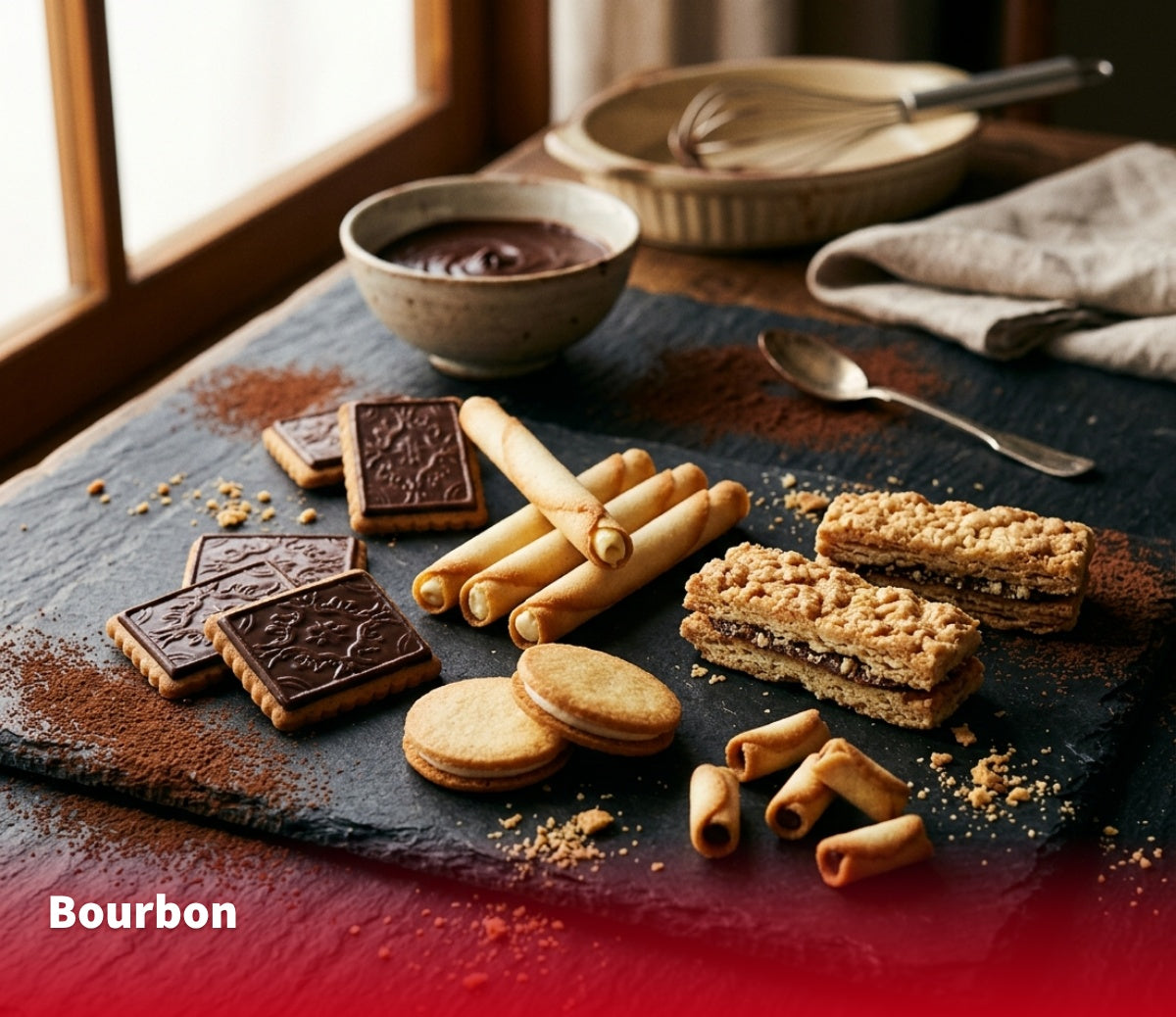
Alfort launched in 1994 and quickly became one of the best-selling chocolate biscuits in Japan. The concept is deceptively simple: a slab of chocolate sitting on a whole-wheat biscuit. But the execution is where Bourbon's obsessiveness shows. The biscuit is baked to a specific crumbliness—firm enough to snap cleanly, tender enough to dissolve without chewing effort. The chocolate layer is thick enough to register as its own presence, not merely a coating. And the two components are calibrated so that they finish together in your mouth: the biscuit does not outlast the chocolate, and the chocolate does not outlast the biscuit.
The sailing ship relief is Alfort's visual signature, and it carries deliberate symbolism. Bourbon has described the ship as representing adventure and the excitement of discovery—the idea that each piece is a small voyage. It is the kind of poetic product storytelling that Japanese confectionery companies excel at, and in Alfort's case, it works because the design is genuinely beautiful. The ship is detailed enough to admire before you eat it, which creates a brief moment of pause—a micro-ritual that elevates the experience beyond mindless snacking.
Over the years, Alfort has expanded into a family of varieties. The original milk chocolate remains the standard-bearer. Rich Milk deepens the cacao. Vanilla White pairs white chocolate with the wheaty biscuit. Matcha and strawberry versions appear seasonally. The Alfort Premium line uses higher-percentage cacao and richer butter biscuits, pushing the product into territory that genuinely competes with specialty chocolate bars costing three times as much.
There is a recommended way to eat Alfort that Bourbon devotees swear by: place it chocolate-side down on your tongue and let it melt. This way, the chocolate hits your taste buds first, and the biscuit's wheaty sweetness arrives as a second wave. It is the kuchidoke approach—prioritizing the melt over the crunch—and it transforms a simple biscuit into something that feels almost meditative.
Here is the fact that surprises most people outside Japan: Alfort outsells many products from Meiji and Lotte in the chocolate biscuit category. It does this without major celebrity endorsements, without elaborate marketing campaigns, without the brand recognition that names like Kit Kat or Pocky enjoy internationally. It sells because people buy one box, eat it, and buy another. That is the purest form of product success there is.
3) The Petit Series and the Art of 100-Yen Happiness
If Alfort is Bourbon's prestige product, the Petit series is its democratic masterpiece.
Petit is a line of miniature snacks sold in slim, cylindrical tubes at a price point of roughly 100 to 150 yen—less than a dollar. Each tube contains a single variety of bite-sized cookie, cracker, or chip. The range is vast: over 20 varieties at any given time, spanning sweet and savory, crunchy and chewy, Western-style and Japanese-style.
Petit Chocolate Chip Cookie is the approachable starting point—tiny, crispy cookies studded with chocolate chips. Petit Usu-yaki offers thin, soy-sauce-glazed rice crackers, delicate enough to shatter at a touch. Petit Potato is a salted chip in miniature. Petit Shittori Choco Cookie ("shittori" meaning moist or soft) delivers a fudgy, almost brownie-like texture. Petit Ebi-sen is a shrimp-flavored cracker. The variety is dizzying, and that is entirely the point.
The genius of Petit lies in its pricing psychology. At 100 yen, trying a new flavor is essentially risk-free. You are not committing to a full-size bag that might sit half-eaten in your pantry. You are spending the equivalent of loose change on a few minutes of snacking pleasure. If you love it, you come back for more. If it is not your thing, you have lost nothing. This low barrier to experimentation is what makes Petit a gateway product—it is how many Japanese consumers first discover Bourbon's quality, one tiny tube at a time.
The tube format itself is clever. It fits in a jacket pocket, a desk drawer, a purse. In Japanese office culture, where snacking at your desk is common but discretion is valued, Petit is the ideal desk snack—small, quiet, tidy. There are no rustling bags, no greasy fingers, no crumbs. You twist open the cap, shake out a few pieces, and twist it closed again. It is snacking engineered for the rhythms of a working day.
Petit also thrives in the otsumami (drinking snack) context. The savory varieties—Usu-yaki, Potato, Ebi-sen—pair naturally with beer, chu-hai, or sake. In izakayas and at home drinking sessions, you will often see a handful of Petit tubes lined up alongside the drinks. The tube format makes it easy to offer guests a choice: "Sweet or salty? Crunchy or soft? Pick a tube."
The cumulative effect is that Bourbon achieves something remarkable with Petit: it occupies shelf space across an entire snacking spectrum at the lowest possible price point. Walk into any Japanese convenience store and you will find a row of Petit tubes near the register. They are impulse buys, pantry staples, and comfort snacks all at once. No other brand in Japan covers as much ground in such a compact, affordable format.
4) Elise, Roanne, and the Rest of the Kingdom
Alfort and Petit get the most attention, but Bourbon's true depth reveals itself in the products that fill the spaces between. This is where the "cookie kingdom" metaphor stops being a metaphor and becomes a simple description of reality.
Elise has been in production since 1979, making it one of Bourbon's longest-running products. It is a rolled wafer tube filled with flavored cream—think of a pirouette or a barquillo, but executed with Japanese precision. The wafer shell is impossibly thin, baked to a crispness that shatters the instant your teeth close on it. Inside, the cream is smooth and generous, available in chocolate, vanilla, and seasonal variations. Elise is the product that Bourbon employees reportedly cite most often as their personal favorite, and once you eat one, you understand why. The textural contrast between the brittle wafer and the soft cream is addictive in a way that is difficult to describe and impossible to resist.
Roanne takes the wafer concept in a different direction. Instead of a rolled tube, Roanne is a round wafer sandwich—two thin, disc-shaped wafers pressed together with a layer of cream between them. The wafers are lighter and airier than Elise's, and the cream is whipped to a fluffier consistency. Where Elise is about the drama of the shatter, Roanne is about gentleness—a soft crunch that gives way to an almost mousse-like filling. Vanilla cream Roanne is the classic, but chocolate and seasonal strawberry versions rotate through the lineup.
Lumonde is perhaps Bourbon's most texturally unique creation. It is a layered biscuit—thin sheets of crispy dough pressed together with cocoa cream between each layer—that produces a sensation unlike any other biscuit on the market. Bite into a Lumonde and it does not crunch so much as crumble and dissolve, collapsing into a cascade of flaky, cocoa-dusted fragments that melt on your tongue. Japanese snack reviewers describe it with the word saku-saku—the sound of something light and crispy yielding under gentle pressure. If Alfort is a study in chocolate-meets-biscuit solidity, Lumonde is its opposite: fragility as a feature.
Blanchul bridges the gap between wafer and chocolate bar. It consists of thin, crispy crepe layers rolled into a cylinder and coated in chocolate—matcha chocolate, milk chocolate, or white chocolate depending on the variety. The result is a snack that behaves like a chocolate bar on the outside but reveals a delicate, layered crunch inside. Blanchul's matcha version, in particular, has developed a cult following among matcha enthusiasts for its ability to deliver genuine matcha bitterness alongside the sweetness of white chocolate.
Step back and look at these products together—Alfort, Petit, Elise, Roanne, Lumonde, Blanchul—and a pattern emerges. Each one occupies a distinct textural territory. Alfort is the firm snap of chocolate on biscuit. Elise is the brittle shatter of a thin wafer. Roanne is the gentle yield of an airy sandwich. Lumonde is the dissolving crumble of layered pastry. Blanchul is the crispy roll under a chocolate shell. Petit covers everything in between at pocket-change prices.
No other Japanese confectionery company covers this much textural ground in the biscuit and cookie category alone. Glico has Pocky and Pretz but stays within the stick format. Meiji focuses on chocolate bars and gummy. Morinaga's strength is in candy and chews. Bourbon, by contrast, has built a complete biscuit company—one that can offer you a different texture for every mood, every occasion, every time of day, all under a single maker's guarantee of quality.
This is the kingdom. It was built not by conquest but by patience—a hundred years of quietly making biscuits in the snow country, getting each one a little bit better than the last.
Conclusion: The Quiet Giant
Bourbon does not have Glico's "running man." It does not have Meiji's omnipresent chocolate bars or Morinaga's globally recognized Hi-Chew. What it has is something harder to build and harder to fake: a product catalog of extraordinary depth, where almost everything is good and many things are genuinely great.
The Alfort biscuit with its embossed sailing ship has become an icon of Japanese snacking without ever needing a mascot or a jingle. The Petit series has made 100-yen happiness available in over 20 flavors. Elise, Roanne, Lumonde, and Blanchul prove that there are more ways to experience a cookie than most people ever imagined.
All of this comes from a factory in Niigata where winters bury everything in white and the company philosophy is simply to make things well, consistently, without fuss. In a snack industry driven by trends, limited editions, and viral moments, Bourbon's strategy is almost radical in its simplicity: make the biscuit excellent, price it fairly, and let people find it on their own.
They have been finding it for a hundred years. And once you start exploring the kingdom, you will understand why they keep coming back.
Ready to discover your favorite? Shop Bourbon snacks at Tokyo Stash.
Explore more Japanese snacks and culture stories on Tokyo Stash.