
There is a bottle so familiar that most people have stopped seeing it. It sits on restaurant tables from Osaka to Ohio, and its contents get treated as a single generic thing: soy sauce, the salty brown liquid you shake onto rice.
That description is wrong in an interesting way. Japanese "shoyu" (醤油, soy sauce) is not a salt solution with coloring. It is a brewed product—closer in principle to beer, miso, or bread than to table salt—made from soybeans, wheat, salt, water, and a mold called koji, then fermented and aged for months. That fermentation is why a few drops can taste savory, sweet, roasted, and faintly fruity all at once.
It is also not one product. Japan recognizes five main styles of soy sauce, and Japanese cooks choose between them the way a Western cook chooses between vinegars. This is the story of how that seasoning works, how a brewing town in Chiba turned it into a global staple, and what to reach for when you finally open a proper bottle.
Curious to taste the difference? Start with Kikkoman Itsudemo Shinsen whole-soybean soy sauce, or explore Kikkoman's everyday cooking seasonings at Tokyo Stash.
From this story, shipped from Japan:
 Kikkoman Itsudemo Shinsen Whole Soybean Soy Sauce
 Higeta Honzen Premium Soy Sauce 200ml
 Kikkoman Teriyaki Sauce
 Kikkoman Hon Tsuyu Noodle Soup Base
 Kikkoman Uchi no Gohan Gomoku Mixed Rice
What You'll Learn
- 1) What soy sauce actually is
- 2) Five styles, one pantry
- 3) Kikkoman's real timeline: Edo-period roots, a 1917 company
- 4) "Delicious on Meat": how shoyu went global
- 5) From tabletop pour to weeknight dinner
1) What Soy Sauce Actually Is
Traditional Japanese soy sauce begins with four ingredients and a microbe. Soybeans are soaked and steamed. Wheat is roasted and crushed. Both are then inoculated with "koji" (麹, a cultivated mold used across Japanese fermentation) to create soy-sauce koji—a stage that takes roughly three days in Kikkoman's described process.
That koji is then mixed with brine to form "moromi" (諸味), a living mash. Over several months of aging, lactic-acid bacteria and yeasts develop the sauce's aroma, color, and depth. The mash is pressed to separate the liquid, then clarified, heat-treated, and bottled. Nothing about the finished flavor is added at the end; it is grown.
Each ingredient has a job. Soybeans supply most of the savory depth. Wheat contributes sweetness and roasted aroma—which is why Japanese soy sauce smells more complex than you might expect from something so dark. Salt seasons and protects the mash during its long ferment. Understanding this makes one label worth knowing: "honjozo" (本醸造) means traditionally brewed, with flavor developed by microbial fermentation rather than by blending in amino-acid liquid.
A related term causes frequent confusion. "Marudaizu" (丸大豆, whole soybean) describes the soybean material—whole beans rather than defatted processed soybean—not a separate official category. A product can be both honjozo and marudaizu. The two words answer different questions: how was it made, and what was it made from.
2) Five Styles, One Pantry
Japan's JAS standards classify soy sauce into five main types, and the differences are practical rather than academic.
Koikuchi (濃口) is the all-purpose dark soy sauce that accounts for most of what people picture. Brewed from soybeans and wheat, it balances aroma, color, and saltiness, and it is the right default for almost any recipe that just says "soy sauce."
Usukuchi (薄口) is the one most often misunderstood abroad. The name means "light taste," but it refers chiefly to color, not salt content—and it can actually be saltier than koikuchi. Cooks reach for it when they want to season a clear broth or a pale vegetable without staining it brown. If you have ever wondered how a Kansai udon broth stays golden rather than muddy, this is the answer.
Tamari (たまり) is typically darker, richer, and thicker, often made with little or no wheat, and is popular for dipping and glazing. One important caution: "tamari" alone does not guarantee a product is wheat-free or gluten-free. Only a package that explicitly says so should be treated that way.
Saishikomi (再仕込み) is brewed twice—the second ferment uses unpasteurized soy sauce in place of brine, producing a notably darker, fuller-bodied result often used as a finishing sauce for sashimi.
Shiro (白) is the outlier: made mostly from wheat with very little soybean, it is pale amber and comparatively mild and sweet-leaning, used where color must stay light.
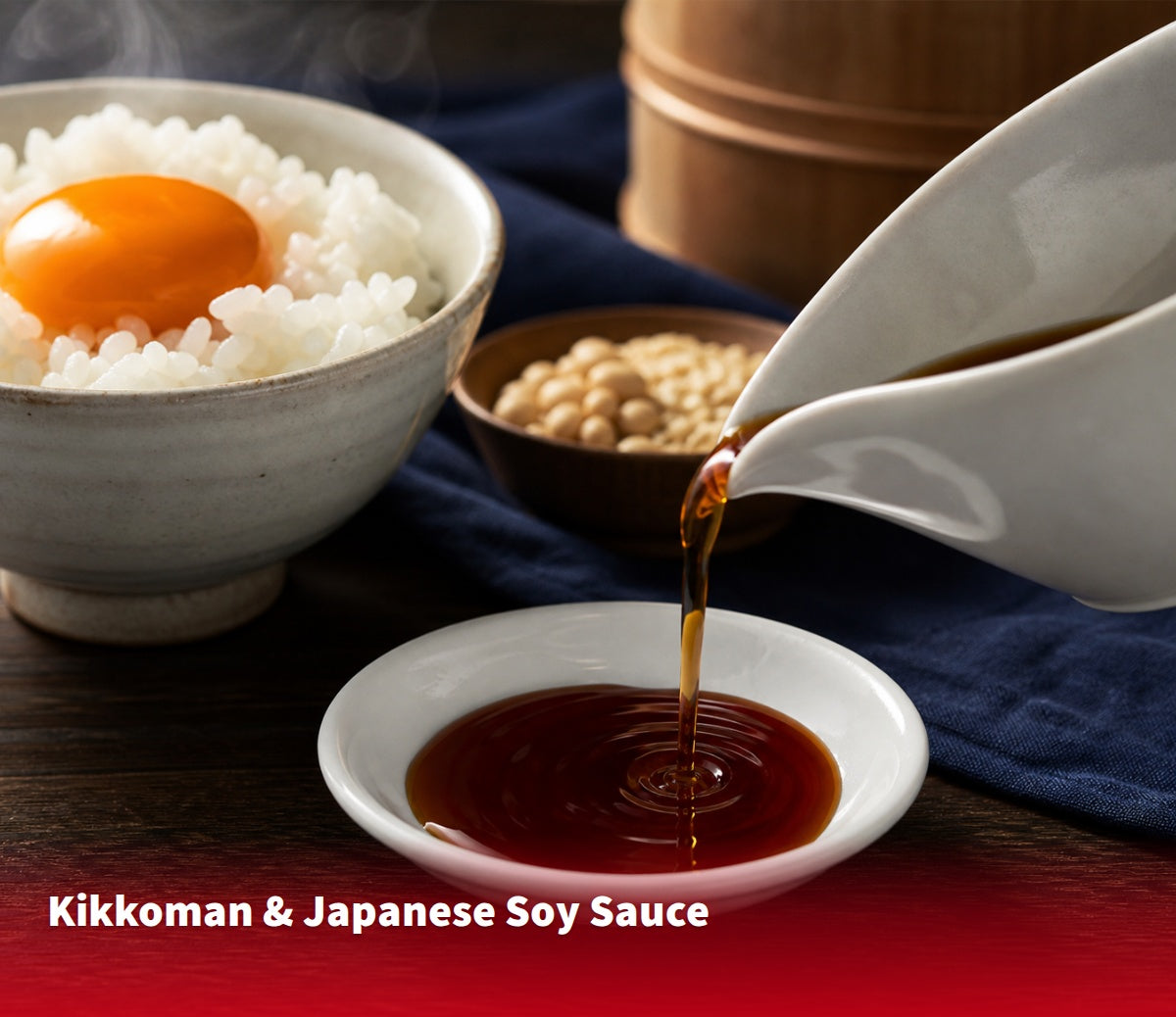
Beyond these five sits a whole shelf of seasoned soy-sauce products built for one job. A soy sauce made for "tamago kake gohan" (卵かけご飯, raw egg over hot rice) is a good example: rather than plain shoyu, these are typically blended with mirin and the umami of bonito and kelp. The existence of such products says something about the culture—Japanese cooks match the seasoning to the dish with real precision.
3) Kikkoman's Real Timeline: Edo-Period Roots, a 1917 Company
Kikkoman's history is best understood as three clocks running at once, because conflating them produces most of the myths you will encounter.
The first clock is the brewing lineage of Noda, in what is now Chiba Prefecture. Kikkoman places its roots in early Edo-period Noda and states that its honjozo brewing history extends back to the mid-seventeenth century. Noda's advantages were practical: access to soybeans, wheat, salt, good water, and river transport down to Edo—the city we now call Tokyo. A brewing center needs raw materials and a way to ship, and Noda had both.
The second clock is the company. In 1917, eight family brewing businesses in Noda merged to form Noda Shoyu Co., Ltd., the corporate predecessor of today's Kikkoman. That is the founding date of the firm. The name changed to Kikkoman Shoyu Co., Ltd. in 1964, and the present Kikkoman Corporation dates from 1980.
The third clock is the brand. The famous hexagonal mark is associated with a tortoise-shell motif—kikkō means tortoise shell, while man (萬) evokes ten thousand, together suggesting long life and prosperity. Kikkoman says the mark was likely first used around 1820 and registered in Japan in 1912, with domestic trademarks unified under the current mark in 1940. The company itself presents that 1820 date as approximate, so it is worth holding loosely.
Keeping the clocks separate matters. It is accurate to say the brewing tradition Kikkoman comes from is centuries old. It is not accurate to say the company is 300 years old—it was incorporated in 1917.
Noda was not Chiba's only soy-sauce town. Down the coast in Choshi, Higeta traces its brewing origin to 1616, when Tanaka Genba began making and selling tamari; Higeta Shoyu Co., Ltd. was established in 1918. The two companies' paths eventually crossed: Higeta's own chronology records a capital alliance with Noda Shoyu in 1937, a separation of management in 1947, sales entrusted to Kikkoman from 1966, and a further capital alliance in 2004. Higeta today describes itself as part of the Kikkoman Group's domestic Japanese-style seasoning business, with particular strength in professional and industrial use—soba tsuyu, men-tsuyu, and kaeshi. It is neither an unrelated competitor nor simply Kikkoman under another label.
4) "Delicious on Meat": How Shoyu Went Global
Plenty of national condiments never travel. Kikkoman's did, and the reason is less about the sauce than about how it was introduced.
The company established a U.S. sales and marketing base in San Francisco in 1957. Rather than positioning soy sauce as a specialty item for Japanese restaurants, it showed American shoppers where shoyu fit in the cooking they already did—supermarket demonstrations, accessible recipes, and the memorable line "Delicious on Meat." That reframing is the whole strategy in three words. Soy sauce stopped being something you used with sushi and became something you used with steak.
Local production followed. Kikkoman began bottling and producing teriyaki sauce in the United States with Leslie Salt in 1968, and established Kikkoman Foods, Inc. in Walworth, Wisconsin, in 1972, with shipments from the Wisconsin plant beginning in 1973. A Japanese seasoning was now brewed in the American Midwest.
Teriyaki became the bridge. A sweet-savory soy-based marinade and glaze mapped neatly onto grilling and barbecue, which meant a cook needed no new technique to use it. Kikkoman notes that "teriyaki" entered Webster's New World Dictionary in its 1970 edition—useful evidence of how quickly the word became part of American English. It is fair to say Kikkoman helped popularize teriyaki in the United States; it would be overreach to say any one company invented the category outright.
5) From Tabletop Pour to Weeknight Dinner
In a Japanese kitchen, soy sauce changes job from dish to dish. Poured straight at the table—"kake-jōyu" (かけ醤油)—a few drops season chilled tofu, sashimi, or a bowl of rice. Simmered slowly, it works differently: in nikujaga, a meat-and-potato stew, soy sauce is absorbed over time rather than tasted on the surface. Combined with dashi and mirin it becomes "tsuyu" (つゆ), the base for noodles and dipping. Sweetened and thickened, it becomes "tare" (たれ), a glaze.
Which brings us to a side of Kikkoman that shoppers outside Japan rarely see. Alongside the soy sauce bottles sits "Uchi no Gohan" (うちのごはん, literally "our home meal")—a range of stir-fry sauces, microwave meal bases, soup bases, and mixed-rice seasonings. A mixed-rice packet is stirred into hot cooked rice and delivers a seasoned dish complete with ingredients and dashi flavor, without a separate long cooking step. One variety pairs chicken and burdock root with sweet-savory soy seasoning; others run from German potato to sesame mapo tofu.
Kikkoman frames these as a response to demand for shorter, easier preparation that still supports a home-cooked meal, and that framing is worth taking seriously. It is tempting to read convenience products as the opposite of cooking. In practice they split the work differently: the packet handles flavor balancing—the part that takes experience—while the cook still shops, prepares, and serves. For a household on a weeknight, that is not a shortcut around dinner. It is what makes dinner happen.
Conclusion: Read the Label, Then Pour
Soy sauce rewards a small amount of attention. Start with a good koikuchi and use it as your default. Add usukuchi when you want a clear soup to stay clear, and a saishikomi or tamari when you want a richer sauce for dipping. If you eat eggs over rice, a dedicated egg-rice seasoning is a genuinely different experience from plain shoyu.
A few practical notes. Soy sauce is shelf-stable unopened, but oxygen dulls its flavor and darkens its color once opened—refrigeration is a sensible default for a conventional bottle, though modern air-tight freshness packages carry their own guidance, so follow the label. Reduced-sodium versions exist if you want the umami with less salt; one Kikkoman Japanese product is stated at 40% less salt than its standard koikuchi. And remember that standard shoyu contains wheat as well as soy: fermentation does not remove that concern, so anyone managing wheat allergy or celiac disease should read the ingredient statement and look for an explicit gluten-free claim rather than assuming.
The bottle on the table has a longer story than its ubiquity suggests—a Chiba brewing tradition, a 1917 merger of eight families, a Wisconsin factory, and a word that entered the dictionary. Not bad for something most people stopped seeing.
Ready to upgrade your pantry? Pick up Kikkoman Itsudemo Shinsen soy sauce or Higeta Honzen premium soy sauce, then browse Kikkoman's Uchi no Gohan meal bases and Higeta soy sauce and noodle bases at Tokyo Stash.
Keep reading:
Explore more Japanese snacks and culture stories on Tokyo Stash.