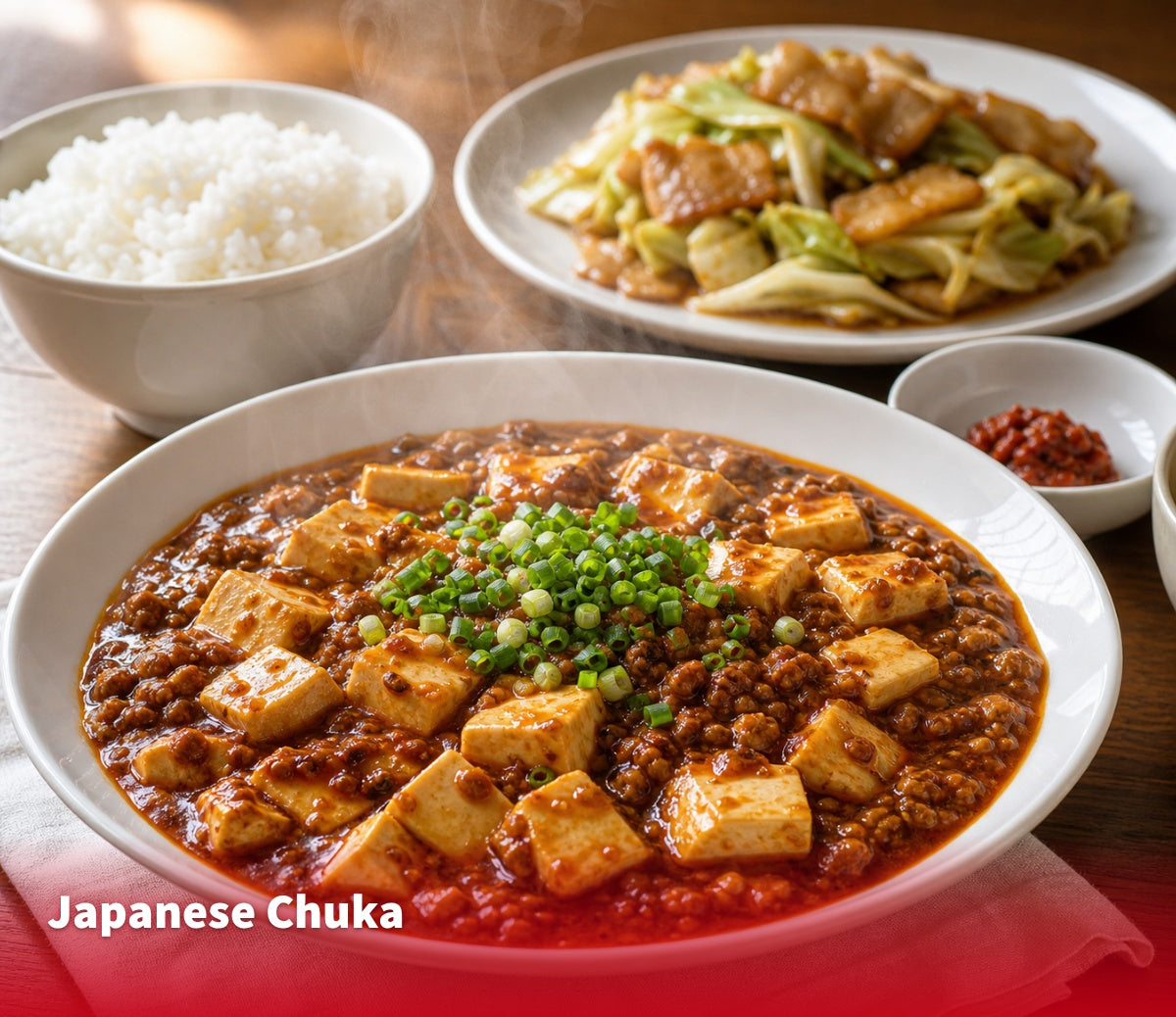

Open a Japanese family's refrigerator on a Tuesday evening and there is a reasonable chance dinner will be Chinese. Not takeout, and not a special occasion—just mābō dōfu over rice, or pork and cabbage stir-fried in a dark sweet sauce, on the table in fifteen minutes.
This is "chūka ryōri" (中華料理), and calling it "Chinese food in Japan" undersells what happened. Over more than a century, Chinese culinary influences were absorbed, adapted, and rebuilt in Japan until they became a cuisine with its own classics and its own childhood memories. It is related to the food of China the way Italian-American cooking is related to the food of Italy: genuinely descended from it, and genuinely its own thing.
One clarification before we start. "Chinese food" is not a single cuisine—China's regional food cultures are enormously varied, and comparing any Japanese dish to one imagined Chinese standard would be misleading. So this is not a story about a copy and an original. It is a story about how a set of flavors travelled, changed, and found a permanent place on Japanese weeknight tables.
Want to cook it tonight? Start with Ajinomoto Cook Do Hoikoro sauce, or explore Ajinomoto seasonings at Tokyo Stash.
From this story, shipped from Japan:
 Ajinomoto Cook Do Hoikoro Stir-Fry Sauce
 Ajinomoto Cook Do Koumi Paste
 Kikkoman Uchi no Gohan Sesame Mabo Tofu Sauce
 Nagatanien Gomoku Chahan no Moto Fried Rice Mix
 Ajinomoto Nabe Cube Chicken Dashi Salt
What You'll Learn
- 1) Chuka is a Japanese cuisine, not a knockoff
- 2) Chen Kenmin and the Japanese language of Sichuan flavor
- 3) Six weeknight classics, explained
- 4) The sauce packet that made it possible
- 5) Beyond the packet: pastes, rice mixes, and broth cubes
1) Chuka Is a Japanese Cuisine, Not a Knockoff
Japanese has two words where English has one. "Chūka ryōri" (中華料理) generally signals the familiar, affordable, Japan-adapted repertoire; "chūgoku ryōri" (中国料理) more often signals regional Chinese cooking presented on its own terms. These are cultural labels rather than legal categories, and the line between them is soft—but the distinction tells you something real about how Japanese diners read a menu.
The clearest evidence of adaptation sits in dishes that have quietly become Japanese. "Gyōza" (餃子) in Japan are typically pan-fried and eaten as a side dish alongside rice; across many Chinese traditions, dumplings are boiled or steamed and can be the staple food themselves. That is not a small tweak. It changes what the dish is in a meal.
Ramen went further still and became a Japanese food outright. "Tenshinhan" (天津飯)—a crab or egg omelet over rice with a thickened sauce—is widely described as a Japanese-created Chinese-style dish, though accounts of exactly which restaurant invented it and when do not agree. It carries the name of a Chinese city and is not a dish you should expect to find there.
The adaptation was gradual rather than sudden. Chinese dishes entered Japanese households over a long period, and once-unfamiliar ingredients such as oyster sauce and "doubanjiang" (豆板醤, fermented chile-bean paste) became common in home recipes only in the later decades of the twentieth century. Japanese home cooks did not receive this cuisine fully formed. They learned it, ingredient by ingredient.
2) Chen Kenmin and the Japanese Language of Sichuan Flavor
If one person stands at the center of this story, it is Chen Kenmin (陳建民, 1919–1990), a Sichuan-born chef who became one of the great popularizers of Sichuan-style cooking in postwar Japan. He appeared on NHK's Today's Cuisine from 1966, which put his recipes in front of a national audience.
It is worth being precise about the claim. Chen is often credited with "bringing" mapo tofu, ebi chili, and Japanese-style hoikoro to Japan, but the evidence supports major popularization and adaptation rather than sole invention. Mapo tofu recipes were already appearing in Japanese cookbooks around the time Chen's restaurant Shisen Hanten opened in 1958. Cookbook writers, restaurant cooks, food manufacturers, and home cooks all had a hand in it.
What Chen did superbly was translate. His ebi chili is described by NHK as an adaptation using ketchup and egg, not a direct copy of a Chinese original. Japanese versions of his dishes often softened fierce chile heat, leaned on sweet-savory pastes, and used vegetables that were easy to buy in Japan. The aim was never to replace Sichuan cuisine. It was to make particular dishes inviting and repeatable in a Japanese kitchen, with Japanese ingredients and a Japanese pan.
There is a second, less famous milestone worth knowing. Marumiya's 1971 release of a mapo tofu sauce base is often credited as a real factor in the dish reaching ordinary homes. Television taught people to want it; a packet made it a Tuesday.
3) Six Weeknight Classics, Explained
Mapo tofu (麻婆豆腐) is soft tofu and minced meat in a spicy, thickened sauce. The Sichuan reference point is famous for fermented chile-bean paste and the tingling aroma of Sichuan pepper. Japanese home versions typically dial the heat and the numbing quality down, and may add sweetness or a miso-like richness. Both are worth eating; they are simply different recipes built from a shared idea.
Mapo eggplant (麻婆茄子) applies a related savory-spicy profile to eggplant, usually in a softer, sweeter register. Eggplant soaks up sauce in a way tofu does not, which makes it the more forgiving of the two for a first attempt.
Hoikoro (回鍋肉) is Japan's pork-and-cabbage stir-fry in a dark, sweet, fermented-bean sauce. Its Chinese namesake huíguōròu has regional variants that may use different vegetables and lean more chile-forward, so treat the Japanese cabbage-and-sweet-miso profile as one branch rather than the definition.
Chinjao rosu (青椒肉絲) is a fast stir-fry of finely shredded meat and green peppers. Japanese versions frequently use beef, while pork is common in many Chinese versions. Honestly, "shredded meat and green pepper stir-fry" tells you more about it than the name does.
Ebi chili (エビチリ) is shrimp in a red, sweet-hot sauce, often built with tomato ketchup in Japanese recipes. Chinese-inspired, certainly—but the well-known Japanese version has its own logic: bright tomato, moderate heat, and a sauce engineered to cling to rice.
Happōsai (八宝菜) is a mixed stir-fry of vegetables, seafood, and meat bound in a light glossy sauce, and a natural thing to spoon over rice. The name evokes "eight treasures," but neither Japanese nor Chinese versions require exactly eight ingredients. It is poetry, not a recipe.
4) The Sauce Packet That Made It Possible
Here is the piece of the story that most overseas readers have never encountered: the Japanese supermarket category called "awase chōmiryō" (合わせ調味料), or combined seasonings.
A combined seasoning is not a generic "stir-fry sauce." It is a sauce for one named dish, already carrying the salt, sweetness, savory depth, aromatics, and often the starch that dish needs. You cook the fresh pork, tofu, shrimp, or vegetables yourself; the packet handles the flavor balancing, which is the part that takes years to learn.
Ajinomoto launched Cook Do in May 1978 as exactly this—menu-specific Chinese-style combined seasonings. The initial six included sauces for happosai, mapo tofu, sweet-and-sour pork, ebi chili, and hoikoro. Ajinomoto notes the category itself was not yet widely familiar when the product appeared. (It is worth resisting the tidy claim that Cook Do was "Japan's first" combined seasoning; the company history establishes its launch and its influence, which is a strong enough story.)
What the packet really sold was a dinner plan. Naming the dish on the front meant a shopper chose a flavor and a meal at the same moment. And it left more agency than a ready meal does: the cook still selects, cuts, and cooks the fresh ingredients. It would be an overreach to say combined seasonings alone drove any social change—but it is fair to say they made a whole category of dishes reliably repeatable at home.
5) Beyond the Packet: Pastes, Rice Mixes, and Broth Cubes
Once you want to adjust rather than follow, you meet the jars. Doubanjiang is a fermented chile-bean paste associated especially with Sichuan cooking, supplying salt, fermented depth, and heat—start with a small spoonful. Tianmianjiang (甜麺醤) is a sweet wheat-and-bean paste and a key note in many Japanese hoikoro sauces. Oyster sauce adds glossy savory sweetness and travels far beyond Chinese-style cooking.
You will also find gochujang shelved alongside them, though it is Korean rather than Chinese. That is a useful reminder that a Japanese pantry is not divided into sealed national boxes. It is also worth saying plainly that not every Japanese household keeps all of these on hand—many people buy one for a particular dish rather than stocking the full set.
The convenience logic extends past Chinese food. "Chāhan no moto" (チャーハンの素) is a powdered fried-rice seasoning—Nagatanien launched its filled version in 1987—that turns cooked rice and an egg into fried rice in about three minutes of stir-frying, with dried ingredients included. This suits a common Japanese habit of turning leftover rice into a fast meal, though that is a cultural pattern rather than a household rule.
Ajinomoto's Nabe Cube shows the same idea in a different shape: one cube makes one serving of hot-pot broth, so a single person can make a small pot without opening a large soup base. Different cuisine, same underlying Japanese grocery instinct—compact, dish-specific flavor systems that leave the cooking to you.
Conclusion: Start with One Packet
The practical advice is simple. Heat the pan first and cook your meat or firm vegetables until nearly done before the sauce goes in. Add the sauce late and toss over medium-high heat just until it bubbles and coats—sweet sauces scorch if you hold them over high heat. If the sauce contains starch, give the pouch a squeeze to redistribute it before opening, and let watery vegetables cook down first or the glaze will thin out.
Then start improvising. Add mushrooms, bell peppers, broccoli, extra tofu, or leftover chicken. If you significantly increase the vegetables, consider a second packet or a small correction with soy sauce and a starch slurry. For less heat use part of a spicy packet; for more, add chile oil or doubanjiang gradually. Check the package for allergens each time—wheat, soy, sesame, shellfish, egg, milk, and meat extracts vary by product.
Japanese chuka earns its place on the weeknight table because it is fast, savory, rice-friendly, and endlessly adjustable. Start with hoikoro or mapo tofu, cook it once by the packet, then start making it yours. That, more than any recipe, is how this cuisine became Japanese in the first place.
Ready to try it? Pick up Cook Do Hoikoro sauce for the stir-fry and Nagatanien Gomoku Chahan no Moto for the fried rice, or browse mabo-style sauces and mixes, at Tokyo Stash.
Keep reading:
Explore more Japanese snacks and culture stories on Tokyo Stash.